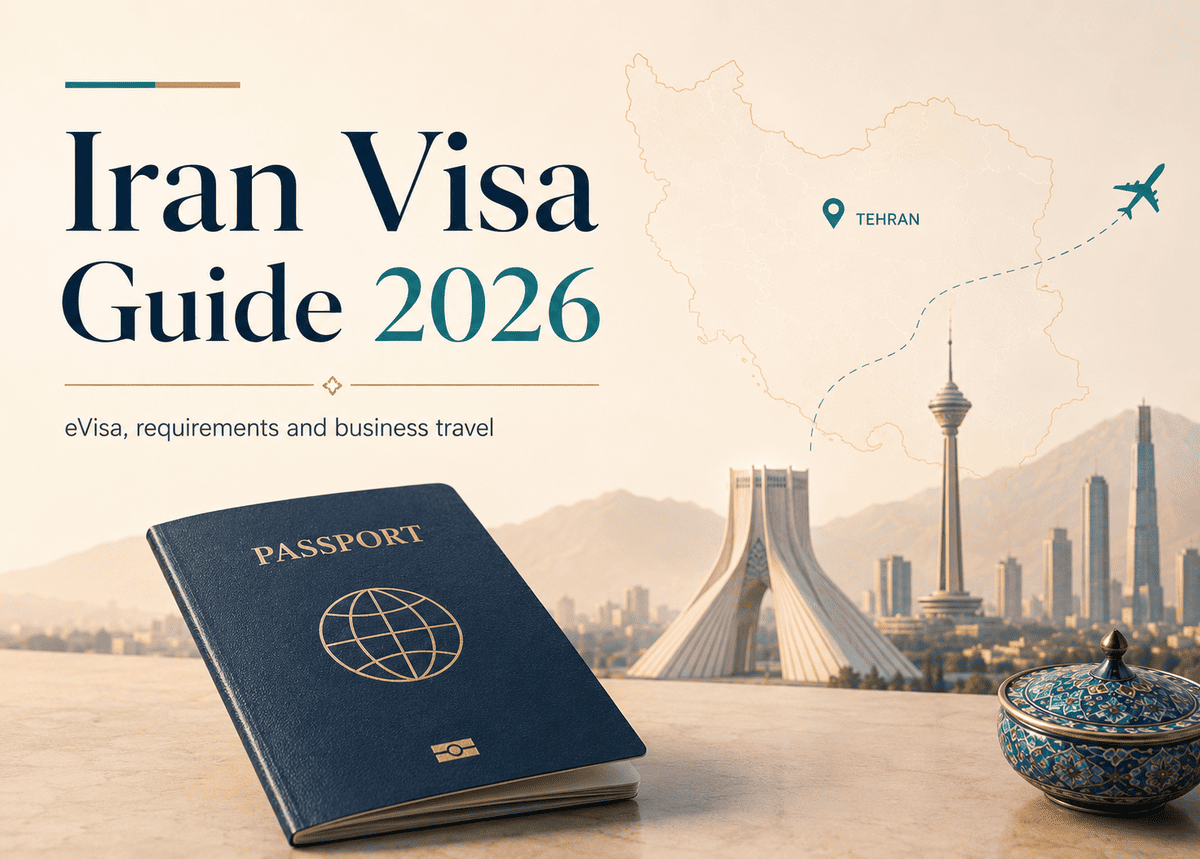
Iran Visa Guide 2026: Requirements, eVisa, Visa on Arrival & Business Travel
Last reviewed: August 2026
Getting a visa for Iran is relatively straightforward for many nationalities, but there is no single rule that applies to every traveler.
Your nationality, purpose of travel, passport type and where you intend to collect the visa can all affect the process. Some travelers can enter Iran without a visa, others can apply through Iran’s electronic visa system, and certain nationalities face additional approval requirements.
This guide explains the main routes available in 2026, including tourist visas, business travel, Iran’s eVisa system, visa on arrival, visa exemptions and the documents travelers should prepare.
Important: Iranian visa rules are nationality-specific and can change. Always verify your eligibility with Iran’s Ministry of Foreign Affairs e-Visa system and the Iranian embassy or consulate responsible for your application before purchasing non-refundable travel.
Where to Apply for an Iran Visa
The official online portal for Iranian visa applications is operated by the Ministry of Foreign Affairs of the Islamic Republic of Iran.
Official Iran eVisa portal:
https://evisa.mfa.gov.ir/en/
You can use the portal to:
- start a new Iran visa application
- select the appropriate visa category
- upload your passport and photograph
- choose the embassy or consulate where your visa will be processed
- follow the visa application process
Do you need a visa to travel to Iran?
For most foreign nationals, the answer is yes — unless their passport qualifies for one of Iran’s visa-waiver arrangements.
Iran currently has several different forms of visa exemption rather than one universal visa-free list.
The Ministry of Foreign Affairs identifies citizens of Azerbaijan, Turkey, Syria, Georgia, Armenia, Egypt, China, Iraq, Oman and Kazakhstan as being subject to visa-waiver arrangements. The precise permitted stay and conditions can differ between nationalities.
Iran also operates a separate unilateral tourism visa-waiver scheme for ordinary passport holders from 27 countries. Eligible travelers may enter for tourism for up to 15 days once every six months, and that 15-day stay is not extendable under this exemption.
The 27 countries are:
- United Arab Emirates
- Bahrain
- Saudi Arabia
- Qatar
- Kuwait
- Uzbekistan
- Kyrgyzstan
- Tunisia
- Mauritania
- Tanzania
- Zimbabwe
- Mauritius
- Seychelles
- Indonesia
- Brunei Darussalam
- Japan
- Singapore
- Cambodia
- Vietnam
- Brazil
- Peru
- Cuba
- Mexico
- Bosnia and Herzegovina
- Serbia
- Croatia
- Belarus
Travelers who qualify for visa-free entry should still verify the conditions attached to their nationality before departure, particularly if they intend to stay longer, enter for work or business rather than tourism, or make repeated visits.
A note for Indian passport holders
Older Iran travel guides may still state that Indian citizens qualify for 15-day visa-free tourism.
That information is now outdated.
Iran’s Consulate General in Mumbai announced that the tourist visa waiver for holders of ordinary Indian passports was discontinued effective 22 November 2025. Indian travelers should therefore check the current visa procedure before travel rather than relying on older articles describing visa-free entry.
What is the Iran eVisa?
Iran’s Ministry of Foreign Affairs operates the country’s official electronic visa application system.
The MFA states that visa categories defined by the Iranian government can be applied for through its online visa portal.
Submitting the online application is generally the first stage of the process. Depending on your nationality and type of visa, further approval or processing may then be required before the visa is issued.
The system should not be confused with private travel agencies or commercial websites that offer Iran visa assistance.
How to start an application
- Go to the official Iran eVisa portal:
https://evisa.mfa.gov.ir/en/ - Start a new visa application.
- Enter your personal and passport details.
- Select your purpose of travel and visa category.
- Upload the required photograph and passport image.
- Select the Iranian embassy, consulate or eligible issuance location associated with your application.
- Submit the application and retain your application/reference details.
- Follow the instructions provided for the remaining approval and issuance process.
Applicants should check the requirements of their selected Iranian embassy or consulate because the final procedure can vary by nationality and place of issuance.
How to apply for an Iran visa online
For a standard application, the process generally follows these steps.
Step 1 — Determine the correct visa type
Select the visa category that corresponds to the real purpose of your trip.
Tourism, business meetings, employment, study, journalism and medical travel do not necessarily use the same visa.
Choosing an incorrect category can delay or result in refusal of the application. Iranian diplomatic missions specifically advise applicants to ensure that they meet the requirements of the visa category they select.
Step 2 — Prepare your passport
Your passport should generally have at least six months of remaining validity.
This requirement is consistently stated by Iranian diplomatic missions for tourist, entry, transit and other visa categories.
Some embassies may impose additional requirements, such as available blank pages or proof of legal residence if you apply from a country where you are not a citizen.
Step 3 — Complete the MFA eVisa application
Applicants provide information such as:
- personal details
- passport information
- nationality
- purpose of travel
- intended dates
- place where the visa will be issued
- accommodation or host information where applicable
- digital passport photograph
- passport identity-page image
The information should match the passport exactly.
False, misleading or incomplete information can lead to refusal and may create problems with future entry. Iranian diplomatic missions explicitly warn applicants against submitting inaccurate or fraudulent information.
Step 4 — Choose where the visa will be issued
The application normally asks the traveler to identify the Iranian embassy, consulate or other eligible issuance point associated with the application.
Choose this carefully.
Iranian diplomatic missions warn that selecting the wrong place of issue can delay processing.
Step 5 — Wait for MFA processing
The application is reviewed by the relevant Iranian authorities.
There is no reliable universal processing time that applies to every nationality and embassy.
For example, individual Iranian missions publish different processing periods depending on their local procedure, while some nationalities require additional review.
For this reason, travelers should apply well before their planned trip and avoid assuming that a visa will be approved within a fixed number of days.
Step 6 — Complete issuance requirements
Once the required authorization or confirmation has been obtained, the responsible embassy or consulate may request items such as:
- original passport
- visa application or submission notice
- passport photograph
- travel insurance
- visa fee
- proof of residence in the country of application
- additional nationality-specific documentation
Requirements vary by diplomatic mission.
Step 7 — Keep a copy of the issued eVisa
Some Iranian diplomatic missions state that visas are issued electronically and advise travelers to carry a printed copy of the eVisa for presentation to immigration authorities when entering and leaving Iran.
Documents commonly required for an Iran tourist visa
Although requirements differ by nationality and embassy, travelers should generally be prepared with:
- passport valid for at least six months
- completed eVisa application
- passport photograph
- passport identity-page scan
- accommodation or hotel information
- proposed travel itinerary
- travel insurance covering Iran
- visa or residence permit for the country where they are applying, when applicable
- visa fee
An Iranian embassy may also request additional documentation or an interview.
Do not assume that a document list found on one embassy’s website applies identically everywhere. The final issuance process is handled by the specific Iranian mission associated with your application.
How long can you stay in Iran on a tourist visa?
There is no single duration that should be assumed for every visa.
Some Iranian diplomatic missions currently describe standard tourist visas as allowing around 30 days of stay, but the actual permitted stay and the period during which the visa can be used to enter Iran are separate concepts and can differ according to the visa issued.
Always check both:
Visa validity — the period during which you may use the visa to enter Iran.
Duration of stay — the number of days you are permitted to remain after entry.
The dates and conditions printed on your issued visa are what ultimately matter.
Does Iran offer visa on arrival?
Iran maintains a Visa on Arrival (VOA) mechanism for eligible foreign nationals at designated international entry points.
The Ministry of Foreign Affairs states that travelers entitled to obtain visas at border checkpoints must pay the relevant visa fee at the airport in euros.
However, eligibility is nationality-dependent.
A traveler should therefore never assume that VOA is available simply because they are flying into an international airport in Iran.
Iranian diplomatic missions also encourage advance electronic processing in many cases. Where possible, obtaining the relevant authorization before traveling is the lower-risk approach.
If you plan to use Visa on Arrival:
- Check that your passport is currently eligible.
- Check that the airport or border point supports the procedure.
- Confirm the required insurance and documents.
- Confirm the current visa fee.
- Carry printed copies of relevant approvals and accommodation details.
- Avoid relying on old travel blogs for nationality eligibility.
Official Visa on Arrival information:
https://evisa.mfa.ir/en/visa-arrival/
Iran visa fees
Iran does not have one universal visa fee for all foreign travelers.
Fees can vary according to:
- nationality
- visa category
- single or multiple entry
- place of issuance
- normal or urgent processing
- embassy or consulate handling the application
Official Iranian diplomatic missions publish different fee schedules for the nationalities they serve.
For that reason, a guide claiming that an “Iran visa costs €X” without specifying nationality and issuance location is likely oversimplifying the process.
Check the fee directly with the Iranian diplomatic mission responsible for issuing your visa.
Travel insurance for Iran
Travel insurance is commonly required as part of the visa issuance process.
Iranian diplomatic missions state that travel-visa holders should have insurance covering emergencies or accidents during their stay in Iran. The policy information should normally correspond to the traveler and the duration of the trip.
Because acceptance requirements can differ, verify whether your existing international policy is acceptable before assuming that it satisfies the visa requirement.
Iran visa rules for US, UK and Canadian passport holders
Travelers holding passports from the United States, United Kingdom and Canada should not follow the standard Iran tourist-visa process without checking the additional requirements that apply to them.
Iranian diplomatic missions state that these passport holders require a Visa Reference Number / visa grant notice obtained from Iran, and identify Iranian travel agencies as a route for obtaining it.
Applications can therefore involve more advance coordination and longer review than those for many other nationalities.
Travelers in these categories should:
- start the process well in advance
- work with an appropriate Iranian travel agency where required
- prepare a clear itinerary
- confirm any current guide or itinerary restrictions
- obtain the required reference number
- confirm the collection procedure with the relevant Iranian mission
They should not plan around Visa on Arrival unless eligibility has been explicitly confirmed for their passport and circumstances.
How does an Iran business visa work?
Foreign executives, investors, suppliers, buyers, consultants and specialists visiting Iran for commercial purposes should pay particular attention to the Entry Visa, rather than assuming a tourist visa is appropriate.
Iranian diplomatic missions describe the Entry Visa as applicable to activities including:
- official business
- trade negotiations
- seminars and conferences
- work-related visits
- certain professional activities
For this route, an Iranian organization may play an important role in the application.
An official Iranian embassy states that the required reference number can be obtained following approval by the MFA Visa Department based on an application from the Iranian counterpart, such as a sponsoring company, corporation, institution or ministry.
A typical business-visit process may therefore look like:
Foreign visitor → Iranian business counterpart → MFA authorization/reference → Iranian embassy or consulate → visa issuance → travel to Iran
The documents may include:
- passport valid for at least six months
- MFA reference number
- eVisa confirmation
- business invitation or information about the Iranian counterpart
- visa fee
- travel insurance
- any documentation requested by the issuing embassy
Business travelers should accurately describe the purpose of the visit rather than using a tourist application for commercial activity.
Can an Iranian company invite a foreign business visitor?
Yes.
Iran’s official visa procedures provide a route through which an Iranian company, corporation, institution or other qualifying counterpart can support the application of a foreign visitor traveling for business purposes.
This is particularly relevant for people traveling to Iran for:
- supplier meetings
- factory visits
- negotiations
- investment discussions
- trade fairs and exhibitions
- technical consultations
- partnership discussions
- market-entry work
The Iranian counterpart generally initiates or supports the reference-number process with the Ministry of Foreign Affairs.
The exact procedure and documentation should be confirmed before travel because the requirements can depend on both the visitor and the inviting organization.
What if you have an Iranian host?
Having an Iranian host can be relevant to some visa applications.
Official Iranian consular guidance notes that authorization numbers may be obtained through relatives, business host parties or travel agencies depending on the type and circumstances of the trip.
Applicants should provide truthful and complete host information whenever the application requests it.
Can you extend an Iran visa after arrival?
Extensions may be possible for certain visas, but they should not be assumed to be automatic.
Iranian consular guidance states that travelers requiring an extension after entering Iran should contact the relevant Iranian immigration authorities before the permitted stay expires.
Whether an extension is approved depends on the individual case and visa category.
Travelers entering under the special 15-day visa-free tourism arrangement for the 27 eligible countries should note that the exemption itself is explicitly described as non-extendable.
Common mistakes that can delay an Iran visa application
Applying under the wrong visa category
A business trip should not automatically be filed as tourism simply because it is shorter.
Choose the visa category that reflects the real purpose of travel.
Passport validity below six months
This is one of the most consistently stated requirements across Iranian consular guidance.
Incorrect information
Names, passport numbers and dates should match the passport precisely.
Selecting the wrong embassy
The place of visa issuance chosen in the application matters and can affect processing.
Relying on outdated visa-waiver information
Iran has changed exemption arrangements before. India’s November 2025 change is a clear recent example.
Booking non-refundable travel too early
Visa approval is discretionary and processing can take longer than expected. One Iranian embassy specifically notes that flight-ticket purchase is not required for the application and warns applicants that further assessment can extend processing.
Iran visa checklist before you travel
Before departure, confirm that you have:
- a passport with sufficient validity
- the correct visa or verified visa-free eligibility
- a printed copy of your electronic visa where applicable
- travel insurance accepted for Iran
- accommodation information
- your host or business-counterpart details where relevant
- return or onward travel information where requested
- copies of important documents
- checked the current operating status of your airline and entry point
Visa approval and the practical ability to travel are separate issues. Flight schedules, border procedures and consular operations can change, so check current conditions shortly before departure.
Frequently asked questions about Iran visas
Can I apply for an Iran visa myself?
Many travelers can begin their application directly through Iran’s official Ministry of Foreign Affairs eVisa system. Some nationalities and visa categories, however, require an Iranian travel agency, host or business counterpart to participate in the authorization process.
Is the Iran eVisa website official?
Yes. Iran’s Electronic Visa system is operated by the Ministry of Foreign Affairs of the Islamic Republic of Iran.
Is Iran visa on arrival available to everyone?
No. Eligibility depends on nationality and entry conditions. Check your passport’s current status before traveling.
Do I need six months left on my passport?
Iranian diplomatic missions generally require at least six months of passport validity for visa applications.
Can Americans get an Iran visa?
There is a visa route for US passport holders, but additional approval requirements apply. US, UK and Canadian passport holders should arrange the required Iranian reference number and confirm the latest procedure before travel.
Can British citizens get an Iran visa?
Yes, subject to the additional procedures applicable to UK passport holders, including obtaining the required visa reference/grant notice from Iran.
Can Canadians get an Iran visa?
Yes, but Canadian passport holders are also subject to additional approval procedures and should begin the process well in advance.
Do business travelers need an invitation?
For an Entry Visa supported by an Iranian business counterpart, the Iranian organization may apply for the MFA reference number required for the visa process.
Should I use a visa agency?
Not necessarily.
Many travelers can start the official eVisa application themselves. An agency becomes more relevant where the nationality, tourist arrangement or required authorization calls for an Iranian intermediary.
Always distinguish between a private visa-service website and Iran’s official Ministry of Foreign Affairs portal.
Final advice
The most important thing to understand about getting an Iran visa is that nationality and purpose of travel determine the route.
For many travelers, the process begins with the MFA electronic visa application and is followed by approval and issuance through the selected Iranian mission.
Others may qualify for visa-free entry or Visa on Arrival.
Business visitors may need an Iranian counterpart to obtain an MFA reference number, while US, UK and Canadian passport holders face additional procedures.
Before making irreversible travel arrangements:
- Check whether your nationality needs a visa.
- Select the correct visa category.
- Apply through Iran’s official MFA system.
- Verify the requirements of the embassy or consulate that will issue the visa.
- Allow additional time for nationality-specific review.
- Recheck entry and travel conditions shortly before departure.
Iran’s visa system is manageable once the correct route is identified, but using current, nationality-specific information is far more reliable than following a generic visa checklist.
About Hormuz
Hormuz provides independent intelligence on Iran’s companies, industries, markets, infrastructure and commercial environment for international decision-makers.
If you are researching Iran for a future business visit, you can use Hormuz to identify companies, understand industries, compare locations and prepare the commercial context for meetings before entering the market.