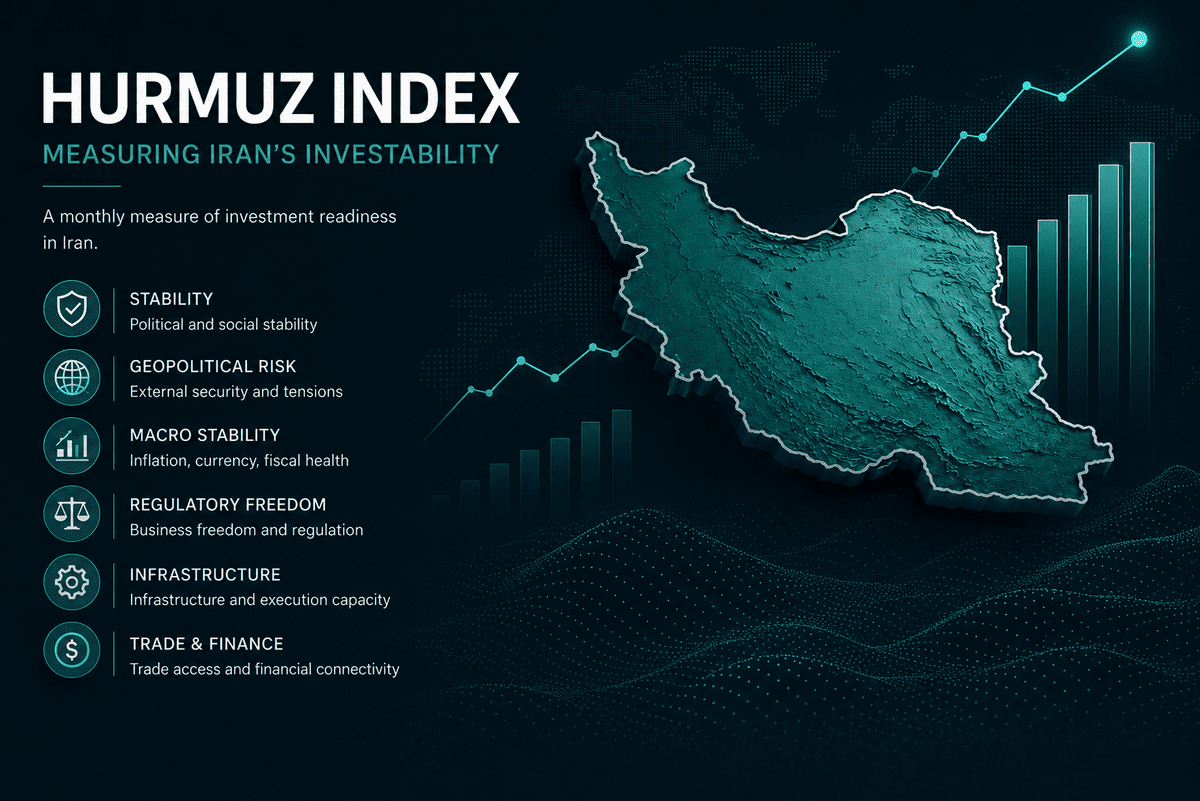
Introducing the Hormuz Index: Measuring Iran’s Investability
Iran is one of the most misunderstood investment environments in the world.
It is a large market with deep industrial capacity, natural resources, consumer demand, strategic geography, and major structural shortages across key sectors. On paper, that makes Iran attractive.
But investment is not decided on paper.
A market can be full of opportunity and still be difficult to enter. A sector can have strong demand but weak payment channels. A company can look promising but carry sanctions, currency, legal, or counterparty risk. A country can be strategically important and still lack the conditions needed for serious capital to move with confidence.
That is why we created the Hormuz Index.
The Hormuz Index is a monthly measure of Iran’s investment readiness. It is designed to answer a practical question:
Can capital realistically enter Iran, operate, protect itself, and exit under current conditions?
This question is more useful than asking whether Iran is simply “attractive” or “unattractive.” Iran is not one simple market. It is a complex investment environment where opportunity and execution risk move together.
The Hormuz Index is built to track that movement.
Why the Hormuz Index Exists
Most discussions about investing in Iran fall into two extremes.
One side focuses only on opportunity: the population, resources, industrial base, location, and under-supplied sectors. These points are real, but they are not enough. Opportunity does not automatically create investability.
The other side treats Iran as permanently closed or impossible to invest in. This view also misses something important. Even in difficult environments, some sectors, regions, and transaction structures can become selectively investable before the whole country becomes broadly open.
The Hormuz Index avoids both mistakes.
It does not promote Iran.
It does not dismiss Iran.
It measures Iran.
The purpose is to show whether the country is becoming more or less investable over time, and which conditions are driving that change.
What the Index Measures
The Hormuz Index scores Iran from 0 to 100 each month.
The final score is calculated from six core dimensions:
- Domestic Stability
- External Security & Geopolitical Risk
- Macroeconomic Stability
- Economic & Regulatory Freedom
- Infrastructure & Execution Capacity
- Trade & Financial Connectivity
Each dimension receives a score from 0 to 100. The final index is calculated through a weighted average.
The model is intentionally clear and practical. It is not a black box. It is a structured way to convert political, economic, financial, and operational signals into one monthly investment-readiness score.
The Six Pillars
Domestic Stability measures internal stability, social tension, political continuity, institutional predictability, and the risk of disruption to business activity.
External Security & Geopolitical Risk measures regional tension, war risk, diplomatic pressure, maritime security, sanctions escalation, and the broader external environment around Iran.
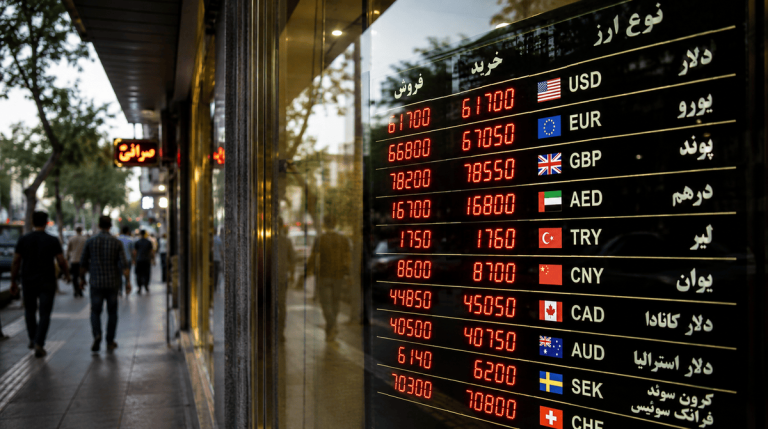
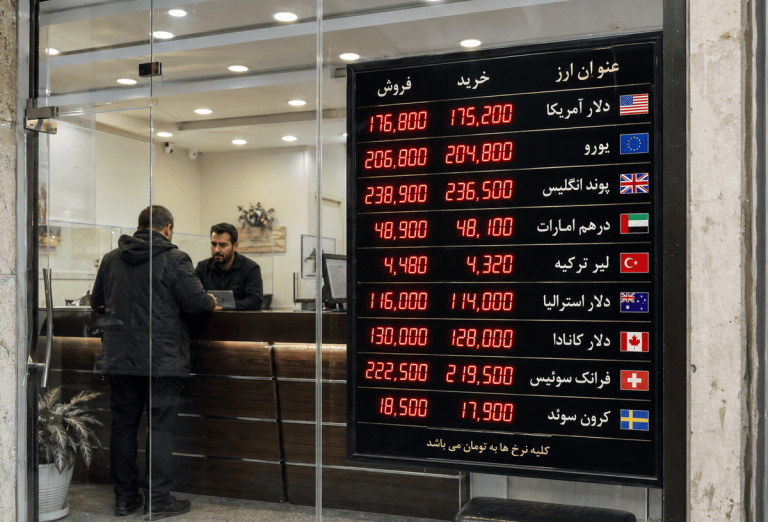
Macroeconomic Stability measures inflation, currency volatility, fiscal pressure, liquidity growth, and the ability of businesses to plan prices, costs, contracts, and margins.
Economic & Regulatory Freedom measures pricing freedom, licensing conditions, ownership constraints, state intervention, regulatory predictability, and the room available for private-sector decision-making.
Infrastructure & Execution Capacity measures electricity, gas, logistics, ports, transport, internet, workforce readiness, and the practical ability to execute projects inside the country.
Trade & Financial Connectivity measures sanctions, banking access, payment channels, insurance, shipping, tariffs, import/export restrictions, capital mobility, and the ability to repatriate profits.
This last pillar carries the highest weight because it is often the decisive constraint in Iran. A market can be attractive, but if money cannot move, shipments cannot be insured, payments cannot clear, and profits cannot be repatriated, broad investability remains limited.
How the Score Is Calculated
The Hormuz Index uses the following weights:
| Dimension | Weight |
|---|---|
| Domestic Stability | 17% |
| External Security & Geopolitical Risk | 17% |
| Macroeconomic Stability | 17% |
| Economic & Regulatory Freedom | 16% |
| Infrastructure & Execution Capacity | 13% |
| Trade & Financial Connectivity | 20% |
The final score is the weighted average of these six dimensions.
The score is then interpreted as follows:
| Score | Interpretation |
|---|---|
| 0–25 | Structurally Closed / Very High Risk |
| 26–40 | High-Risk / Watch Only |
| 41–55 | Selective Opportunity |
| 56–70 | Controlled Entry Possible |
| 71–85 | Broad Entry Window |
| 86–100 | Strong Investability |
A low score does not mean there are no opportunities in Iran. It means the environment is too risky or constrained for broad investment entry without strong controls, deep local intelligence, careful structuring, and counterparty screening.
A rising score does not mean Iran has become easy. It means the investment environment is improving.
The direction matters.
For investors, a market moving from 22 to 34 is still risky, but it sends a very different signal from a market falling from 45 to 32.
Opportunity Is Not the Same as Investability
One of the core principles behind the Hormuz Index is simple:
Opportunity and investability are not the same thing.
Iran may offer major opportunities in mining, energy, logistics, agriculture, healthcare, construction materials, tourism, industrial equipment, consumer demand, and trade infrastructure.
But every opportunity must pass through the filter of execution.
Can the investor enter?
Can the deal be structured?
Can the counterparty be trusted?
Can payments be made?
Can sanctions exposure be managed?
Can the project operate through volatility?
Can the investor exit?
The Hormuz Index does not deny Iran’s potential. It disciplines it.
It turns the conversation from “Is Iran attractive?” into a more useful question:
Under current conditions, what kind of capital can realistically move?
More Than a Number
Each monthly Hormuz Index update includes more than a score.
It explains what changed, which dimensions improved, which risks worsened, and what the latest reading means for investors.
This matters because the same final score can have different meanings.
A score of 35 caused by inflation is different from a score of 35 caused by military escalation. A score of 45 driven by better trade connectivity is different from a score of 45 driven by temporary domestic calm.
The number gives the signal.
The commentary gives the meaning.
A Tool for Timing, Not Hype
The Hormuz Index is not a prediction engine. It does not claim to forecast politics, negotiations, exchange rates, conflict, or sanctions.
It is a signal framework.
It helps investors monitor whether Iran is becoming more open, more constrained, more stable, more volatile, more connected, or more executable.
In a market like Iran, timing matters.
Entering too early can destroy capital.
Entering too late can miss the asymmetric window.
Entering without structure is not strategy.
The Hormuz Index is built for the space between fear and opportunity.
Measuring the Opening Before It Becomes Obvious
Iran’s investment environment will not change all at once.
It will change through signals: a shift in sanctions, a change in trade routes, more stable currency conditions, lower geopolitical risk, better payment channels, stronger counterparty behavior, or more predictable regulation.
The Hormuz Index is designed to track those signals month by month.
It does not claim that Iran is investable simply because it has potential.
It does not dismiss Iran simply because it carries risk.
It measures whether the conditions for serious capital are improving.
Iran does not need to become perfect to become investable.
But it must become executable.
That is what the Hormuz Index measures: the movement from theoretical opportunity to practical investability.