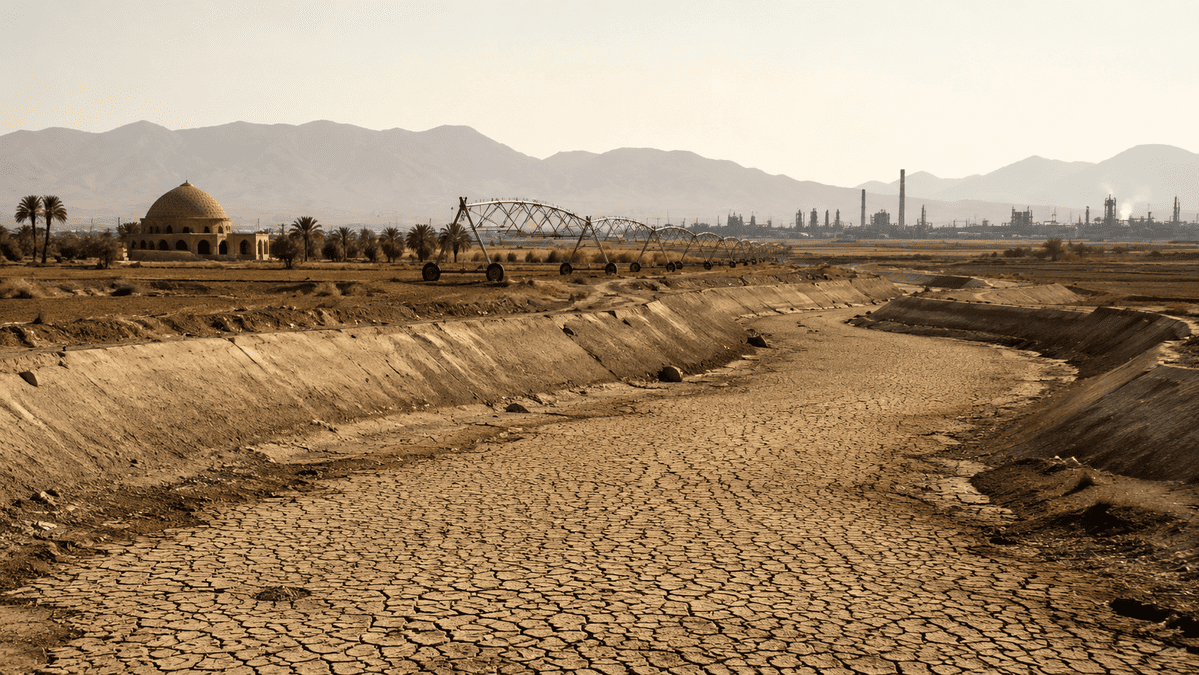
Water Scarcity in Iran Is Not Just a Drought Story
Water scarcity in Iran is often described as a natural problem: low rainfall, hot summers, dry plains, shrinking lakes. That description is true, but incomplete. For investors, operators, and policy analysts, the more useful question is not whether Iran is dry. It is where water scarcity changes the economics of production, land, infrastructure, agriculture, energy, and urban growth.
Iran’s water crisis is not a single national shortage. It is a spatial mismatch between where water is available, where people live, where food is produced, and where industry has been built.
That mismatch is now becoming one of the most important constraints on Iran’s investment map.
The country is dry. The economy was built as if it was not.
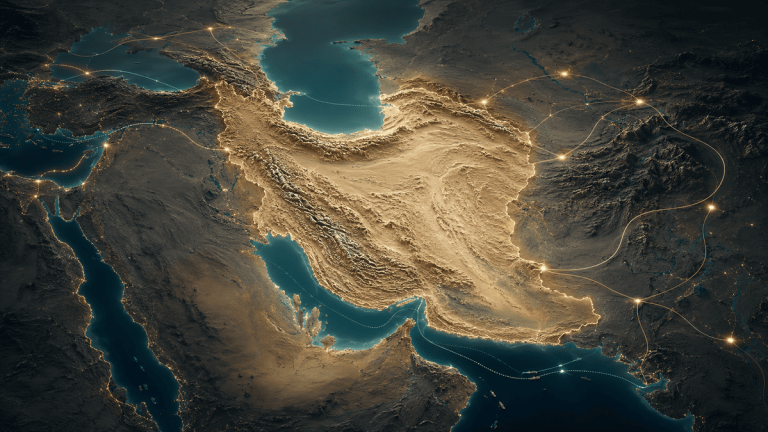
Iran’s geography sets the first boundary. Average annual rainfall is low by global standards, much of the country is arid or semi-arid, and water availability varies sharply between the Caspian north, western mountain basins, central deserts, eastern border provinces, and the Persian Gulf coast. In a country like this, water should function as a hard planning constraint.
Instead, for decades, water was treated as an expandable input.
Dams were built to store and redirect surface flows. Wells expanded access to groundwater. Irrigated agriculture moved deeper into dry regions. Heavy industries developed in parts of the central plateau where water was already limited. Cities expanded faster than their local water balances. This did not create the crisis overnight. It created a system where every dry year exposes a structural deficit that was already there.
The problem, therefore, is not simply a lack of rain. A rainy year can refill a reservoir, but it cannot easily repair an exhausted aquifer, reverse land subsidence, or change the economics of water-intensive crops in dry basins.
The real balance sheet is underground.
Reservoir levels are visible. Groundwater depletion is less visible, but more important.
When surface water becomes unreliable, farmers, cities, and industries shift pressure onto aquifers. Groundwater then becomes the hidden reserve account of the economy. The issue is that Iran has been drawing down that account faster than it can naturally recharge.
This matters because groundwater loss is not just a temporary shortage. In many basins, excessive extraction can lead to salinity, falling well productivity, higher pumping costs, and land subsidence. Once the ground compacts, part of the aquifer’s storage capacity may be permanently reduced. In investment terms, this is not a normal operating risk. It is balance-sheet damage to the physical base of the region.
That is why water scarcity must be read alongside land, logistics, power, agriculture, and urban infrastructure. A province may look attractive because it has land, labor, roads, and market access. But if its aquifer is falling, its real cost curve may be worse than it appears.
Agriculture is the center of the equation.
Any serious reading of Iran’s water problem has to begin with agriculture. Urban consumption is politically visible, and industrial projects attract attention, but agriculture remains the dominant water user.
This creates a difficult policy trap. Agriculture is not only an economic activity. It is tied to food security, rural employment, land ownership, local politics, and social stability. That is why simple arguments such as “use less water” miss the hard part. The question is not whether agriculture consumes too much water. The question is which agricultural activities can survive once water is priced, measured, and allocated more realistically.
This distinction matters for investors.
Water scarcity will not affect all agricultural segments equally. Low-margin, water-intensive crops in stressed basins face a different future from controlled-environment agriculture, greenhouse production, drip-irrigated orchards, seed technology, cold-chain infrastructure, food processing, and water-efficient inputs. The investable signal is not “agriculture is risky.” The signal is that water will separate viable agricultural clusters from legacy production zones.
Industry cannot ignore the water map.
Iran’s industrial geography also needs to be reread through water.
Steel, cement, petrochemicals, mining, refining, power generation, and industrial zones all depend on water directly or indirectly. Some use water in production. Some need it for cooling, processing, dust control, worker settlements, or environmental compliance. Others depend on electricity systems that themselves become more fragile when drought reduces hydropower or thermal plants face cooling constraints.
The old logic of industrial location was often driven by minerals, cheap energy, land, transport access, or political development goals. The next logic will be more selective. Water availability, wastewater reuse, desalination access, pipeline feasibility, and basin-level allocation risk will matter more.
This does not mean all industry must move to the coast. But it does mean inland industrial projects should be judged differently. A factory in a dry basin is not only buying land and equipment. It is buying exposure to water rationing, regulatory pressure, community conflict, and future infrastructure costs.
For some sectors, the Persian Gulf and Oman Sea coast may gain strategic weight. Coastal desalination, port access, export logistics, and industrial relocation could become part of a long-term rebalancing. But desalination is not a universal solution. It requires energy, capital, pipelines, maintenance, and clear pricing. It can solve specific industrial and urban problems, but it cannot justify unlimited inland demand.
Water scarcity is also an energy problem.
Iran’s water and power systems are increasingly connected. Pumping groundwater requires electricity. Water treatment requires electricity. Desalination requires electricity. Power plants require water for cooling. Hydropower depends on reservoir levels.
This creates a feedback loop: drought reduces water availability; water shortages increase pumping stress; pumping increases electricity demand; electricity shortages disrupt water delivery and industrial operations. In hot summers, this loop becomes especially visible.
For investors, the implication is direct. Water risk should not be assessed separately from power risk. A project that depends on stable water supply and stable electricity is exposed to two linked constraints, not two independent ones.
This is particularly important for manufacturing, mining, food processing, data centers, cold storage, logistics hubs, and any operation that cannot tolerate repeated interruptions.
Where scarcity becomes opportunity
Water scarcity is not automatically an investment opportunity. In many cases, it is simply a cost, a constraint, or a red flag. But scarcity can become investable when it creates measurable demand for efficiency, substitution, monitoring, reuse, or relocation.
The most practical opportunity areas are not abstract. They are specific.
First, water-efficient agriculture: drip irrigation, soil moisture monitoring, greenhouse systems, crop switching, fertigation, and advisory services that help farmers produce more value per cubic meter.
Second, wastewater treatment and reuse: municipal and industrial wastewater can become a strategic input for industry, landscaping, mining, and some agricultural uses if treatment quality, contracts, and distribution infrastructure are reliable.
Third, industrial water management: closed-loop systems, cooling optimization, process-water recycling, leak detection, and water audits will become more valuable as allocation tightens.
Fourth, basin intelligence: investors need better data on aquifers, reservoir dependence, water permits, well legality, subsidence, crop patterns, and local allocation politics. This is not a public-relations category. It is due diligence.
Fifth, coastal infrastructure: desalination-linked industrial zones, water pipelines, port-adjacent manufacturing, and coastal relocation strategies may become more relevant if Iran begins to correct the mismatch between water-intensive activity and dry inland geography.
The province-level view matters.
Iran’s water scarcity is not uniform. Khuzestan’s issues are not the same as Yazd’s. Isfahan’s industrial-agricultural tension is different from Sistan and Baluchestan’s vulnerability to drought and borderland underdevelopment. Kerman’s mining and agriculture pressures differ from Gilan’s humid Caspian profile. Tehran’s problem is urban scale, groundwater pressure, and concentration of demand.
This is why national averages are useful but insufficient.
A serious investor should ask five questions before reading any province as an opportunity:
- Is the project dependent on surface water, groundwater, transferred water, desalinated water, or municipal networks?
- Is the local aquifer stable, declining, saline, or already associated with subsidence?
- Does the project compete with agriculture, households, industry, or strategic public supply?
- Can the project operate with treated wastewater or recycled water?
- Is water availability protected by enforceable contracts, or is it only assumed?
These questions can change the ranking of provinces. A site with weaker logistics but reliable water may outperform a better-connected site with a fragile basin. Conversely, a province with severe scarcity may still offer opportunities if the project directly reduces water loss or substitutes non-conventional water for freshwater.
The wrong conclusion
The wrong conclusion is that Iran is “too water-stressed” for investment.
The better conclusion is that water stress will decide which investments are real.
Projects that ignore water will carry hidden risk. Projects that reduce water pressure, improve allocation, reuse wastewater, improve agricultural productivity, or relocate demand toward more sustainable geographies may become more valuable. The same crisis that weakens legacy models can strengthen disciplined models.
Water scarcity in Iran is not a side issue. It is one of the filters through which the country’s next phase of industrial, agricultural, and urban development must be read.
For investors, the question is not whether Iran has a water problem. It does.
The question is whether a project is exposed to that problem, solving part of it, or pretending it does not exist.