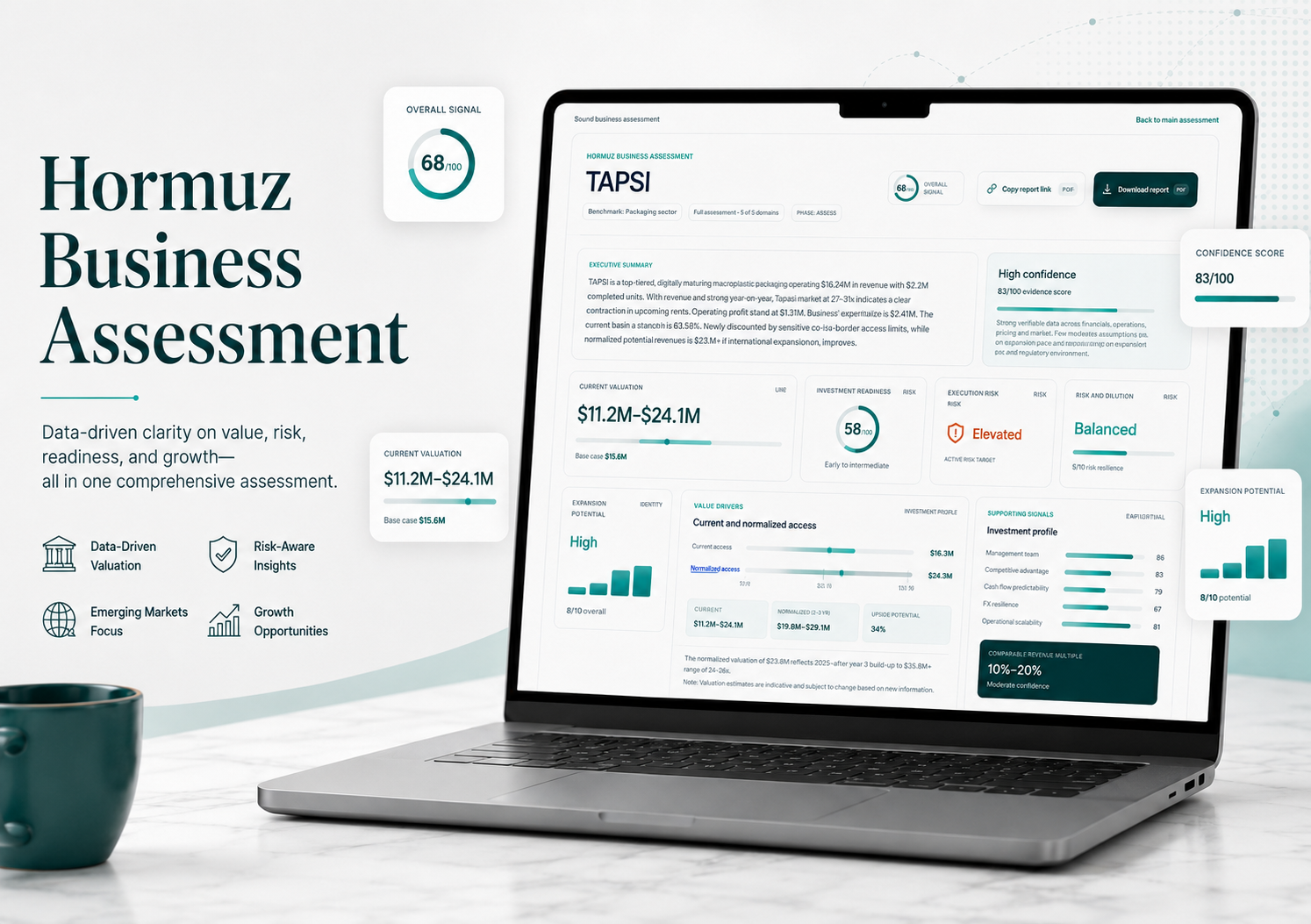
Introducing Hormuz Business Assessment
Revenue and profit alone do not provide a complete picture of a business.
Two companies with similar financial results may differ substantially in the quality of their records, ownership structure, access to capital, exposure to currency movements, counterparty risk and ability to expand. These differences can affect both the value of a business and whether a transaction involving it can be completed safely.
This is particularly important in Iran, where company performance may be shaped by inflation, exchange-rate volatility, restricted cross-border payments, financing conditions, regulatory exposure and limited access to international investors or strategic buyers.
Hormuz Business Assessment brings these factors into one structured analysis.
The tool combines financial and operating information with questions about ownership, governance, market access, resilience and expansion. It produces an indicative valuation together with the decision signals supported by the information submitted.
The result is not simply a valuation number. It is a structured view of:
- what may be driving the company’s value
- where that value may currently be constrained
- how prepared the business is for investment or a transaction
- which risks require further verification
- how exposed the company is to inflation and currency movements
- whether its operating model has credible expansion potential
The assessment can support an initial investment review, financing discussion, acquisition analysis, partnership decision, counterparty screening or expansion plan.
Start with the essentials
A useful initial assessment can begin with a relatively small amount of information:
- the company name and business model
- its current stage and competitive position
- the purpose of the assessment
- a clear description of what the company sells and to whom
- at least one meaningful financial anchor, usually revenue, operating profit, market capitalization or asset value
The optional fields allow the tool to test the initial estimate against additional financial, operational and qualitative evidence.
You do not need to complete every field. More information can improve confidence, narrow the valuation range and support additional decision lenses, but unsupported estimates may weaken the result.
What the assessment covers
Hormuz Business Assessment combines an indicative valuation view with up to five connected decision lenses.
Indicative valuation
The tool estimates a valuation range rather than presenting one artificially precise figure.
Depending on the information available, it may consider:
- revenue
- EBITDA or operating profit
- growth
- gross margin
- listed-market capitalization
- cash and financial debt
- operating and non-operating assets
- required capital expenditure
- platform activity such as GMV and transaction volume
- business stage and competitive position
The result may include two valuation views.
Current-access valuation reflects the conditions under which the company operates today.
Normalized-access valuation considers a scenario in which access to banking, investment capital, regional markets and strategic buyers improves meaningfully.
The normalized-access scenario is not a forecast of political or economic change. It is an analytical view of how company value might differ under less restrictive access conditions.
A normalized range may still appear in a focused valuation report when the available financial and market information supports a reasonable scenario. It does not require every decision lens to be completed.
Access discount
A company may operate, trade or transact below the value of a comparable business in a more accessible market.
This difference may result from:
- restricted cross-border payments
- difficulty attracting international investment
- limited acquisition or exit routes
- sanctions or restricted-party exposure
- ownership-transfer constraints
- limited access to strategic buyers
- unclear documentation
- dependence on protected domestic conditions
The Access Discount lens examines how these factors may be affecting the gap between current-access and normalized-access value.
A high access discount does not necessarily mean the underlying company is weak. It may indicate that commercially useful assets, customers, technology or operating capabilities cannot currently be financed, transferred or priced efficiently.
Investment readiness
A commercially attractive company is not always ready to receive investment.
An investor or buyer must be able to verify the company, understand its ownership, review its financial information and secure enforceable rights.
The Investment Readiness lens considers:
- reliability of financial information
- ownership and cap-table clarity
- governance arrangements
- investor rights
- key contracts
- regulatory licenses
- intellectual-property ownership
- unresolved legal or regulatory matters
This helps distinguish business potential from transaction readiness.
A company may have a strong product and growing revenue while remaining difficult to invest in because its records, rights or ownership structure are incomplete.
Counterparty risk
A company does not need to be an investment target to create material risk.
Suppliers, customers, distributors, commercial partners and payment intermediaries can affect a transaction through delayed payments, unclear ownership, regulatory exposure or unreliable obligations.
The Counterparty Risk lens considers available information about:
- payment and obligation history
- ownership transparency
- financial-data quality
- legal or regulatory issues
- sanctions exposure
- government dependence
- cross-border payment access
This is an initial screening, not a formal legal, sanctions or commercial due-diligence process. Its purpose is to identify where verification should begin.
FX and inflation resilience
Nominal revenue growth can be misleading in a high-inflation environment.
A company may report substantial growth in rials while selling the same or a smaller volume in real terms. Another business may preserve value because it earns foreign currency, adjusts prices rapidly or has mainly domestic costs.
The FX and Inflation Resilience lens considers:
- how growth was measured
- inflation during the same period
- foreign-currency revenue
- foreign-currency-linked operating costs
- foreign-currency debt
- pricing power
- gross and operating margins
- interest and financing costs
The purpose is to determine whether the company can preserve economic value as prices and exchange rates move.
Expansion potential
A successful domestic business is not automatically scalable.
Expansion depends on whether the business model can be repeated, whether customer demand exists elsewhere and how much capital is required to enter each new market.
The Expansion Potential lens considers:
- regional scalability
- evidence from previous geographic expansion
- capital required for expansion
- strength against foreign competition
- strategic-buyer appeal
- plausible target markets
- operational repeatability
This separates credible expansion evidence from broad claims about regional opportunity.
What the report includes
Each completed assessment produces a structured decision report rather than a single score.
Depending on the information provided, the report may include:
- a current-access valuation range
- a normalized-access valuation range
- a base-case estimate
- an estimated access discount
- a confidence score
- an Overall Signal
- investment-readiness findings
- counterparty-risk findings
- FX and inflation resilience
- expansion potential
- a decision snapshot
- the main drivers behind the result
- priority actions
- information that would improve the assessment
- a saved report link
- a downloadable PDF report
The report adapts to the evidence submitted.
A decision lens is shown only when enough relevant information is available to support a meaningful result. Missing inputs do not automatically produce zero scores or empty sections.
A lighter submission may produce a focused valuation report. A more complete submission may produce the full multi-lens assessment.
How to complete the assessment
The form contains two main layers.
The first collects the company context and core financial anchors. The second contains optional information that can strengthen the analysis.
Enter information that can be supported. Leaving an optional field blank is better than entering an estimate that cannot be explained.
Company and decision context
Company name
Enter the legal name or the name most commonly used by the specific company being assessed.
The financial figures, website and description should all refer to the same legal or operating entity.
This is especially important when a group operates through several subsidiaries, brands or affiliated companies.
Company website
Enter the company’s official website when one is available.
The website can help establish the company’s product, positioning and operating footprint.
Leave the field blank when no reliable website exists. An unrelated group website or social-media page should not be used unless it clearly represents the entity being assessed.
Main industry
Select the industry responsible for the company’s primary activity.
A company may operate across several sectors, but the assessment needs one principal classification because valuation methods, operating risks and useful financial benchmarks differ between industries.
Choose the activity that generates the company’s main economic value, rather than the broad language used in its marketing.
How does the company earn revenue?
This field identifies the company’s business model.
The meaning of revenue differs significantly between a manufacturer, retailer, marketplace, subscription company and professional-services business.
For example:
- a manufacturer generally records product sales as revenue
- a retailer generally records the value of goods sold
- a marketplace generally records only the commission or fees retained
- a subscription company may generate recurring monthly or annual revenue
- a service company may depend on projects, retainers or contracts
For marketplaces, the total amount transacted belongs in the GMV or GBV field, not in revenue.
Selecting the correct business model helps the tool interpret margins, assets, scalability and operating metrics.
Current stage
Choose the stage based on the company’s current operations, not simply its age.
An older company may still be early-stage if it is testing a new model. A relatively young company may already have established demand and stable operations.
The stage helps determine how much weight should be placed on current earnings, growth expectations and operating traction.
Assessment purpose
Select the decision for which the company is being assessed.
The same information may have different significance depending on whether the purpose is:
- an investment or financing review
- an acquisition
- a commercial partnership
- counterparty screening
- an expansion decision
- a general company assessment
An acquisition may require greater attention to ownership, liabilities and transferability. A partnership may depend more heavily on payment reliability and operational capability. Expansion planning places more weight on scalability and capital requirements.
Competitive position
Select a competitive position only when it can be supported by credible evidence.
Useful evidence may include:
- market share
- transaction volume
- sales
- active users
- distribution coverage
- production capacity
- customer penetration
A company should not be described as a market leader simply because it is well known.
The difference between a market leader, top-three competitor, niche player and emerging challenger can materially affect valuation and expansion assumptions.
Leave this field blank when the position is uncertain.
What does the company sell, and to whom?
Describe the business in two or three clear sentences.
A useful description identifies:
- the main product or service
- the principal customer
- the operating geography
- how the company earns money
For example:
A B2B procurement platform serving industrial buyers across Iran and earning commissions from completed orders.
Avoid broad claims such as “a leading technology company providing innovative solutions.” These statements do not explain the product, customer or revenue model.
Core financial anchors
The assessment can begin with one useful financial anchor, although additional reliable inputs generally improve the result.
All monetary figures should be entered in US dollars. When converting figures from rials or tomans, use a consistent exchange rate and measurement date.
Revenue, last 12 months
Revenue establishes the scale of the business.
Enter revenue before expenses. For marketplaces, enter only commissions and fees retained by the company.
Do not enter customer payments, transaction value or GMV as revenue unless the company records the full amount as its own sales.
Use the most recent twelve-month period available. Revenue and profit should refer to the same or a closely comparable reporting period.
Profit from core operations, last 12 months
Enter EBITDA or operating profit generated by the company’s main activity.
A loss should be entered as a negative number.
This field helps separate business scale from business economics. A company may generate substantial revenue while producing little operating profit or incurring an operating loss.
Which profit figure is this?
Identify whether the figure entered is:
- EBITDA
- operating profit or EBIT
- not clearly identified
EBITDA excludes interest, tax, depreciation and amortization.
Operating profit includes depreciation and amortization but remains before financing costs and tax.
The distinction is particularly important for asset-heavy businesses. EBITDA may appear strong even when the company requires substantial investment to maintain or replace its productive assets.
Choose “Not sure” rather than assigning an incorrect accounting label.
Usable cash and bank balances
Enter cash and bank balances that are available to the company.
Do not include:
- receivables
- inventory
- property
- machinery
- restricted cash that cannot be used
Cash strengthens the company’s net financial position and may provide flexibility during stress, investment or expansion.
Loans and financial debt
Include interest-bearing obligations such as:
- bank loans
- bonds
- mortgages
- finance leases
- shareholder loans that function as financial debt
Ordinary supplier invoices should not normally be included unless they effectively operate as financing.
Debt reduces the equity value available to owners and may create refinancing, interest-rate or currency risk.
Owned operating assets
This field is relevant for manufacturing, industrial, real-estate and other asset-heavy businesses.
Enter the estimated current market value of productive assets such as:
- land used in operations
- buildings
- factories
- machinery
- vehicles
- operational facilities
Use current market value rather than historical cost or accounting book value.
Operating assets are generally used as a valuation cross-check. They are not automatically added to an earnings-based valuation because doing so may count the same economic value twice.
Optional fields that strengthen the assessment
The optional fields are intended to improve the result, not to make the process unnecessarily difficult.
Complete only the sections that are relevant and supported by reliable information.
Financial quality and currency exposure
Revenue growth versus the previous year
Enter the percentage change in revenue from the previous comparable period.
Growth can support a higher valuation when it reflects rising demand, customer expansion, higher transaction volume or increasing market share.
Growth should not be interpreted without understanding how it was measured.
How was growth measured?
Specify whether growth was measured in:
- US dollars
- real terms after inflation
- nominal rials or tomans
- an uncertain basis
This distinction is essential for interpreting Iranian financial data.
A company whose nominal rial revenue rises by 40 percent during a period of similar inflation may have produced little or no real growth.
The tool uses the growth basis to avoid treating inflation-driven price increases as operational expansion.
Inflation during the same period
Enter inflation for the same period used to calculate revenue growth.
This field is most relevant when growth is reported in nominal rials or tomans.
It helps distinguish growth in real activity from growth caused primarily by higher prices.
Gross margin
Gross margin is the percentage of revenue remaining after direct product or service costs.
It indicates how much economic value remains before overhead, administration, financing and tax.
Two companies with the same revenue may have very different economics when one retains 60 percent after direct costs and the other retains 10 percent.
Net profit or loss
Enter the company’s final profit or loss after operating expenses, financing costs and tax.
Comparing operating profit with net income can reveal whether financing charges, taxes or non-operating items are absorbing the value created by the core business.
Interest and financing costs
Enter interest and financing costs for the same reporting period.
High financing costs may explain why a company with positive operating profit reports a net loss.
They may also indicate sensitivity to refinancing conditions, interest rates or short-term liquidity pressure.
Revenue collected in foreign currency
Enter the share of revenue actually received in foreign currency or from exports.
Foreign-currency revenue can protect the company when the rial weakens, particularly when the majority of its costs remain domestic.
An export invoice alone is not sufficient. The relevant question is whether the company can reliably collect and retain the proceeds.
Operating costs linked to foreign currency
Estimate the share of operating costs that rises when the rial weakens.
Examples include:
- imported materials
- foreign software
- machinery
- spare parts
- international services
- foreign transportation costs
A company with export revenue may still be exposed when a substantial portion of its costs is also linked to foreign currency.
Debt owed in foreign currency
Enter financial debt whose repayment is directly linked to a foreign currency.
This can create substantial risk when the company earns mainly domestic-currency revenue.
Pricing power
Pricing power measures how quickly and effectively the company can pass higher costs to customers.
A business that can adjust prices within weeks is generally more resilient than one operating under:
- fixed-price contracts
- regulated tariffs
- long approval cycles
- intense price competition
Assess practical pricing ability, not management’s preferred pricing policy.
Recurring or reliably repeated revenue
Enter the share of revenue expected to repeat through:
- subscriptions
- contracts
- renewals
- established customer behavior
Recurring revenue can improve visibility and reduce dependence on continuously acquiring new customers.
Occasional repeat purchasing should not be treated as equivalent to contractual or highly predictable revenue.
Revenue from the largest customer
Enter the percentage of total revenue generated by the company’s largest customer.
High customer concentration can create material risk.
A company that earns 45 percent of revenue from one buyer may be highly exposed to that customer’s loss, delayed payment or renegotiation.
Current stock-market value
Listed companies can enter their current market capitalization.
Market capitalization is the share price multiplied by total shares outstanding and converted into US dollars.
It provides an observable valuation benchmark, but should still be interpreted alongside:
- market liquidity
- ownership concentration
- financial performance
- free float
- current market conditions
Assets, operations and scale
Surplus or non-operating assets
Enter assets that are not required for the company’s daily operations.
Examples include:
- unused land
- investment property
- saleable financial investments
- assets held outside the core business
Unlike productive operating assets, surplus assets may be considered separately because selling them may not damage the company’s earning capacity.
Capital needed in the next 12 to 24 months
Enter essential capital expenditure required for:
- modernization
- equipment replacement
- capacity expansion
- regulatory compliance
- growth
A company may appear valuable based on current earnings but require substantial near-term investment to preserve those earnings.
Required capital expenditure can reduce the amount an investor or buyer is willing to pay today.
Customers retained after one year
Retention measures how many customers continue using the company after the initial period.
Strong customer acquisition can look attractive, but low retention may indicate:
- weak product quality
- poor customer economics
- dependence on promotions
- limited switching costs
Use a consistent definition and measurement period.
Contribution margin
Contribution margin is the amount remaining after costs that increase directly with each sale or transaction, before fixed overhead.
It is particularly useful for:
- marketplaces
- delivery businesses
- e-commerce
- transaction platforms
- usage-based services
A company may increase revenue while destroying value if every additional transaction produces a negative contribution.
Active paying customers or users
Enter the number of active paying users or customers together with a clear period and definition.
For example:
420,000 monthly transacting users.
A statement such as “more than one million users” is less useful because it may refer to all registrations accumulated over several years.
Completed transactions
Enter the number of completed orders, rides, payments or other core transactions during the last twelve months.
Transaction volume helps connect reported revenue to actual operating activity.
It can also reveal changes in:
- average transaction value
- usage frequency
- customer engagement
- monetization
One other useful scale signal
Use this field for an operating metric specific to the business.
Examples include:
- active merchants
- occupied rooms
- insured members
- production volume
- connected locations
- installed capacity
- contracted customers
Always include the measurement period and definition.
GMV or GBV
For marketplace and platform models, enter the full value transacted through the platform.
GMV is not company revenue.
It measures the total economic activity processed before the company retains its commission or fee.
Share kept as company revenue
The take rate is the percentage of GMV retained by the company as revenue.
For example, when the company retains $10 from every $100 transacted, the take rate is 10 percent.
This helps show how efficiently platform activity is converted into company revenue.
Cost to recreate the operating asset base
For industrial and asset-heavy businesses, estimate the current cost of building an equivalent productive asset base.
Replacement cost can provide a useful valuation reference, but it is not automatically the company’s value.
An old or underutilized factory may cost more to recreate than the economic value it currently produces.
Capacity utilization
Enter actual production as a percentage of practical usable capacity.
Low utilization may indicate:
- unused expansion capacity
- weak demand
- operational inefficiency
High utilization may indicate strong demand, but can also mean additional investment is required before the company can grow.
Investment readiness, counterparty risk and expansion
Reliability of financial figures
Select the strongest evidence supporting the submitted financial information.
Possible levels may include:
- audited financial statements
- reviewed or accountant-prepared statements
- management accounts
- management estimates
- limited or unverified information
Higher-quality records do not automatically mean the company is a better business. They mean its performance is easier to verify and use in a transaction.
Ownership clarity
Consider whether the following are documented and consistent:
- beneficial owners
- shareholders
- cap table
- shareholder rights
- ownership of key assets
- ownership of intellectual property
Unclear ownership can prevent an investment or acquisition even when the underlying business is attractive.
Governance and investor rights
Assess whether governance arrangements are documented.
Relevant matters include:
- board oversight
- information rights
- reserved matters
- voting rights
- minority protections
- approval procedures
A company may be operationally strong but unsuitable for outside investment when all important decisions remain informal or unenforceable.
Contracts, licenses and intellectual property
Assess whether key commercial and regulatory assets are properly documented and held by the correct company.
This may include:
- customer contracts
- supplier agreements
- licenses
- software rights
- trademarks
- patents
- distribution agreements
A business may be difficult to transfer when essential contracts or intellectual property belong personally to a founder or another entity.
Legal or regulatory issues
Report known matters that could affect:
- ownership
- licensing
- cash flow
- operations
- transferability
- reputation
Minor disputes should not automatically be treated as material. At the same time, unresolved licensing, ownership or regulatory problems should not be understated.
Sanctions or restricted-party exposure
This is a self-reported screening input.
Consider direct and indirect relationships with:
- designated entities
- restricted sectors
- sanctioned owners
- high-risk intermediaries
- ownership structures requiring additional review
The assessment is not a formal sanctions opinion and should not replace professional screening.
Payment and obligation history
Assess whether the company generally meets its commercial and financial obligations when due.
Repeated delays or defaults may indicate:
- liquidity pressure
- weak financial controls
- unreliable commercial behavior
- dependence on delayed receivables
Government dependence
Consider whether the company depends on:
- government contracts
- regulated prices
- quotas
- special permissions
- state-linked customers
- preferential access
- licenses that may be difficult to transfer
Government relationships may support revenue while also creating concentration, political or continuity risk.
Cross-border access
Assess whether the company can reliably collect, settle and transfer funds across borders through sustainable channels.
Temporary workarounds should not be treated as normal banking access.
Cross-border access affects:
- export collection
- foreign investment
- acquisitions
- supplier payments
- capital distribution
- potential exit routes
Regional scalability
Consider whether the company’s product, economics and operating model can function outside Iran.
A large domestic market does not automatically demonstrate regional demand.
Expansion may require adjustments for:
- language
- regulation
- purchasing power
- customer behavior
- logistics
- competition
- payment systems
Strategic-buyer appeal
Consider whether a strategic buyer would have a clear reason to acquire the company rather than build a competing operation.
Potential sources of strategic value include:
- distribution
- customers
- licenses
- technology
- data
- specialist talent
- productive assets
- local market access
- cost advantages
Resilience to foreign competition
Assess how the company might perform if better-funded or more experienced foreign competitors entered the market.
Some businesses possess durable local advantages. Others may benefit mainly from limited international competition.
Evidence of expansion
Select whether the business model has already been replicated in another city, province or country.
A successful operating test in a new market is stronger evidence than a management plan or a list of possible destinations.
Capital required for expansion
Assess the level of capital needed to expand.
Expansion may require:
- a local team
- working capital
- inventory
- facilities
- licenses
- technology adaptation
- customer acquisition
Capital intensity affects the speed, risk and potential return of expansion.
Most plausible expansion markets
List one to three markets only when there is a credible commercial reason to consider them.
Relevant evidence may include:
- existing customers
- trade routes
- logistics
- cultural proximity
- regulatory compatibility
- proven demand
- current partnerships
A broad list of countries does not strengthen the assessment.
Understanding the result
The report combines valuation ranges, supported decision lenses and analytical explanations based on the information submitted.
Confidence score
Confidence measures the strength, consistency and completeness of the submitted evidence.
It does not measure whether the company is attractive or unattractive.
A company can have a high valuation but low confidence when the underlying information is incomplete. Another may have a modest valuation but high confidence because the records are detailed and internally consistent.
Confidence may be affected by:
- missing financial anchors
- inconsistent reporting periods
- estimated rather than audited figures
- conflicting operating metrics
- incomplete cash or debt information
- uncertain ownership or governance data
A wider valuation range often reflects limited evidence rather than a weak business.
Overall Signal
The Overall Signal summarizes the decision lenses that are sufficiently supported by the submitted information.
It appears only when enough reliable lenses are available.
A company may therefore receive:
- a valuation range
- a normalized-access scenario
- a confidence score
without receiving an Overall Signal.
This prevents unsupported lenses from being treated as zero and avoids creating a misleading overall score from incomplete data.
Supported lenses
Each decision lens is displayed only when the relevant information supports a meaningful assessment.
For example:
- investment readiness requires governance, ownership or financial-data inputs
- FX resilience requires relevant information about inflation, pricing, foreign-currency income, costs or debt
- counterparty risk requires information about ownership, payment history, regulation or sanctions exposure
- expansion potential requires evidence about scalability, capital needs, previous expansion or target markets
The absence of a lens does not mean the company received a poor score. It means the available information did not support a defensible conclusion.
Priority actions
Priority actions identify the most important steps that could improve the company’s decision readiness.
These may include:
- completing financial disclosure
- clarifying ownership
- documenting contracts
- verifying debt
- reviewing sanctions exposure
- testing an expansion market
- improving investor rights
- validating operating metrics
Information that would improve the assessment
This section identifies the missing inputs most likely to strengthen the result.
It is often one of the most useful parts of the report because it shows what should be collected before committing resources to a deeper transaction process.
How to improve the quality of the assessment
Use financial figures from the same reporting period wherever possible.
Revenue, operating profit, net income, financing costs and operating metrics should refer to comparable dates.
Apply one exchange rate consistently when converting monetary figures into US dollars. Keep a record of the conversion date.
Do not fill optional fields with unsupported estimates.
Define operating metrics clearly and include their measurement period.
Be conservative when selecting the company’s competitive position.
Distinguish nominal local-currency growth from real or US-dollar growth.
For marketplaces, keep revenue separate from GMV.
For asset-heavy companies, distinguish productive operating assets from surplus assets.
For listed companies, use market capitalization as a benchmark rather than assuming the market price is automatically correct.
Treat the result as a decision framework, not as a final transaction opinion.
Saving, sharing and downloading the report
Each assessment is saved as a report that can be reopened without running the analysis again.
The report includes a private shareable link that can be copied for later use or shared with colleagues, advisers or other decision-makers.
A PDF version can also be downloaded for:
- internal review
- management discussions
- investment meetings
- preliminary transaction analysis
- adviser briefings
The saved report reflects the information available at the time of submission.
A new assessment should be created when the company’s financial performance, ownership, operating conditions or strategic position changes materially.
What the assessment does not replace
Hormuz Business Assessment is an analytical screening and decision-support tool.
It is not:
- a formal valuation
- an audit
- a fairness opinion
- a legal opinion
- a sanctions-clearance opinion
- a credit opinion
- an investment recommendation
- a substitute for transaction-level due diligence
Its purpose is to organize available information, identify the most important signals and show where additional verification is required.
From initial assessment to verified decision
Hormuz Business Assessment is designed for the early stages of analysis.
It helps founders, investors, buyers and commercial partners structure incomplete information before committing time and resources to a deeper process.
Some decisions require more than an online assessment.
Financial records may need to be verified. Ownership may need to be mapped. Counterparties may need to be screened. Market assumptions may need to be tested against local evidence. Relevant comparables may need to be selected and adjusted.
Hormuz Desk supports this next stage through company research, counterparty mapping, transaction preparation, market-entry analysis and decision-focused due diligence.
Use Hormuz Business Assessment to identify the questions.
Use Hormuz Desk when the answers need to be verified.