Iran Economic Alliances: Where Membership Has Commercial Weight
Iran is often described as economically isolated.
That description is only partly correct.
Iran sits outside important parts of the Western-led financial and trading system, faces extensive sanctions, and remains outside the World Trade Organization. At the same time, it belongs to a wide network of trade agreements, energy organisations and transport corridors. It has a full free trade agreement with the Eurasian Economic Union, belongs to BRICS and the Shanghai Cooperation Organisation, helped establish OPEC and the Gas Exporting Countries Forum, and sits across some of Eurasia’s most discussed transit routes.
Yet these connections do not add up to seamless economic integration.
Iran’s external economic architecture is therefore neither empty nor complete. It is selective.
The commercially relevant question is not how many organisations include Iran, but where those arrangements alter the actual terms of trade: the tariff charged, the route available, the certificate recognised, the currency accepted or the risk carried by the parties.
That is where membership begins to have economic weight.
The Agreement That Matters at the Border
The clearest example is Iran’s free trade agreement with the Eurasian Economic Union.
The EAEU includes Russia, Armenia, Belarus, Kazakhstan and Kyrgyzstan. Its full agreement with Iran entered into force on 15 May 2025, replacing the narrower interim arrangement that had operated since 2019. According to the Eurasian Economic Commission, the agreement provides preferential access across 90 percent of the commodity nomenclature. The Commission also estimates that the average Iranian import duty applied to EAEU goods will fall from roughly 20 percent to 4.5 percent.
That is a material change.
For a Russian producer selling machinery into Iran, or an Iranian food processor exporting to Kazakhstan, the agreement can alter the landed price of the product. It can also make an Iranian manufacturer more competitive against a supplier from a country that does not receive the same treatment.
But the headline coverage figure does not mean that 90 percent of shipments automatically enter duty-free.
The benefit depends on the product’s exact customs classification, the tariff schedule, rules of origin and the documentation accepted by the importing authority. An item shipped from Iran is not necessarily considered Iranian-origin. Imported materials, processing thresholds and value added can all affect eligibility.
There is also a difference between a tariff advantage and a successful sale.
A lower duty cannot compensate for an unusable payment route. It cannot make a product compliant with Russian food standards, provide a refrigerated wagon or shorten a customs delay at the Caspian border. The parties signed a three-year implementation roadmap in September 2025 covering areas such as customs, electronic transit, standards and transport—an indication that the agreement’s practical infrastructure still has to be built around the legal text.
The agreement is nevertheless Iran’s most substantial current trade arrangement. It gives companies something measurable: a product-level preference that can be entered into an actual cost model.
For investors, its strongest implications are likely to appear in businesses that combine Iranian production economics with Eurasian market access:
- processed food and agriculture,
- pharmaceuticals and medical products,
- petrochemicals and polymers,
- construction materials,
- metals and industrial inputs,
- logistics around the Caspian,
- and manufacturing that can satisfy the agreement’s origin requirements.
The case must still be tested by HS code, route and customer. “Access to the EAEU” is too broad to be an investment thesis.
Preferential Trade That Remains Narrow
Iran also participates in the D-8 Preferential Trade Agreement and the Trade Preferential System among OIC members.
Both are real trade instruments. Neither currently has the depth or predictability of the EAEU agreement.
The D-8 agreement entered into force for Iran and several other participating states in 2011. Its purpose is to reduce tariffs on selected products traded among members such as Türkiye, Pakistan, Malaysia, Indonesia and Nigeria. Yet the organisation was still holding supervisory meetings in March 2026 to deepen implementation, while member states were debating whether to expand the instrument into a broader trade or economic partnership.
That history matters.
It means the D-8 framework should not be presented as open access to a large multinational market. Its value is narrower: a company trading a specific product with a specific participating country may be able to claim a tariff preference.
The same caution applies to TPS-OIC.
Iran has ratified the relevant instruments and submitted tariff-concession lists. But the system depends on participating states completing domestic implementation, maintaining compatible concession schedules and applying the required certificates of origin. COMCEC documents in 2025 and 2026 continued to discuss the practical steps needed for effective operation.
These arrangements are worth checking. They are not worth assuming.
For a food exporter sending goods to Oman, a pharmaceutical producer looking at Pakistan or a manufacturer dealing with Türkiye, a preference may exist. The buyer or exporter still has to establish:
- that both countries are implementing the arrangement;
- that the product is included;
- that the preference is better than the ordinary tariff;
- and that origin can be proved.
This is useful work at the level of a transaction. It is not evidence of broad regional integration.
ECO: A Strong Map and a Weak Market
The Economic Cooperation Organization should, in theory, be one of Iran’s most important economic institutions.
Its members connect Türkiye, Iran, Pakistan, Afghanistan, Azerbaijan and Central Asia. The region contains large energy producers, major consumer markets, landlocked economies and natural north–south and east–west trade routes. The organisation’s secretariat is in Tehran.
Yet ECO has struggled to turn geography into a functioning commercial area.
Its trade agreement, ECOTA, was designed to support regional liberalisation. In practice, implementation has remained incomplete. At the organisation’s Regional Planning Council in May 2026, officials were still discussing the “full implementation and possible expansion” of ECOTA in the coming years.
This does not make ECO irrelevant. It changes where its relevance lies.
ECO has more practical weight in transport coordination, border links, railway planning, energy cooperation and customs dialogue than in guaranteed tariff access. For Iran, it supports a long-term role as the southern outlet for Central Asian economies and as a bridge between Pakistan, Türkiye, the Caucasus and the Caspian.
The persistent weakness is execution.
A map may show a direct rail connection. The commercial route still depends on border hours, locomotive changes, wagon availability, customs documents, insurance, transit charges and return cargo. A formal regional framework can help governments address those problems, but it does not remove them.
ECO is therefore best read as a platform for building connectivity, not as a regional market that already exists.
BRICS and the SCO: Political Access Before Commercial Access
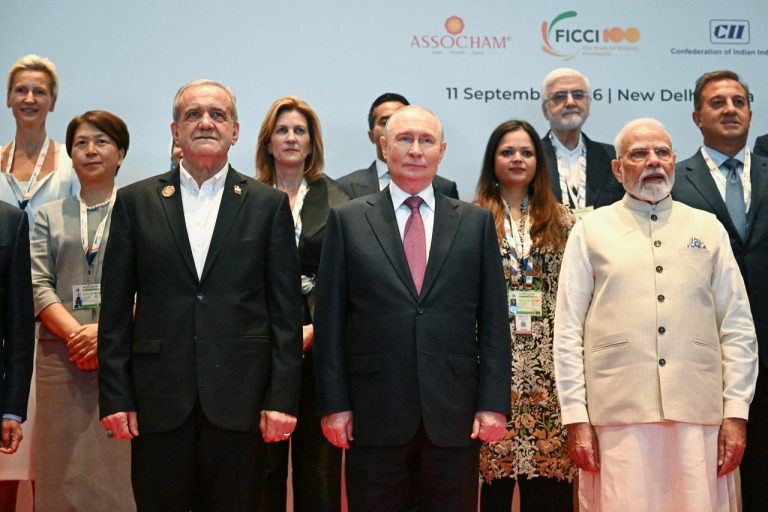
Iran’s entry into BRICS and the Shanghai Cooperation Organisation has attracted more attention than its preferential trade agreements. That attention is understandable. These groups place Iran in regular forums with China, India, Russia, the United Arab Emirates and other important economic partners.
Their immediate commercial effect is often overstated.
BRICS describes itself as a political and diplomatic coordination forum. Iran is one of its full members, but the group is not a customs union, a free trade area or a common payment system.
The SCO also includes economic cooperation in its agenda, alongside security and regional coordination. Iran has been a full member since 2023. But SCO membership does not grant preferential tariffs, capital mobility or automatic access to finance.
Their value is less mechanical and more relational.
Membership gives Iranian ministries, state-owned companies and business organisations more frequent access to counterparts across Asia. It can support bilateral negotiations, place Iranian corridor projects on regional agendas and make cooperation on local-currency settlement, technology, energy and infrastructure easier to discuss.
Those channels matter in an economy where state relationships influence large projects.
They do not change the compliance decision of a bank.
A Chinese company considering an Iranian industrial project still has to determine whether it can transfer funds, insure equipment, obtain export licences and manage sanctions exposure. An Indian trader does not receive a lower Iranian tariff because both countries belong to a strategic forum. A Russian investor still needs enforceable contracts, a settlement route and an exit mechanism.
BRICS and the SCO increase Iran’s diplomatic room. Their commercial value emerges only when that access produces a bilateral agreement, a financed project, a functioning payment arrangement or a reliable trade route.
Membership itself is not the transaction.
Energy Organisations: Influence Without Bankability
Iran’s role in OPEC is of a different order.
Iran was one of the five countries that established OPEC in Baghdad in 1960. Unlike the broader political forums, OPEC has a defined economic purpose: coordination among oil-producing states and management of the petroleum market.
For Iran, that provides institutional influence over a market central to its public finances and geopolitical position.
The limit is physical and financial capacity.
A state’s influence within the oil market is shaped not only by reserves or formal membership, but by how much it can produce, export, insure and sell. Sanctions, ageing fields, investment constraints and restricted access to technology reduce the amount of commercial power Iran can draw from its resource base.
A durable opening would alter this balance. Restoring production, widening the buyer base and attracting upstream capital would give Iran greater practical weight inside a structure where it already has a formal seat.
The Gas Exporting Countries Forum is more consultative.
Iran is a founding member, and the forum’s first ministerial meeting was held in Tehran in 2001. GECF data illustrate the central contradiction of Iran’s gas economy: the country has a vast reserve base and high production, but most of that gas is absorbed domestically. The forum reports marketed production of about 276 billion cubic metres and domestic consumption of roughly 260 billion cubic metres in its current Iran profile.
This leaves limited room for exports compared with the scale of the resource.
GECF gives Iran access to producer dialogue, market analysis and long-term gas strategy. It does not create pipelines, LNG capacity or exportable surplus. Those depend on investment, domestic pricing, consumption efficiency, field development and regional contracts.
OPEC and GECF confirm Iran’s structural importance in energy. They do not make an individual energy project financeable.
Transport Agreements: Where Geography Becomes an Asset—or Fails To
Iran’s location gives it a plausible role in several trade routes, but corridor economics are often described too casually.
The International North–South Transport Corridor is the most important. India, Iran and Russia signed the founding agreement in 2000, creating a multimodal framework linking the Indian Ocean to Iran, the Caspian, Russia and markets farther north.
The corridor does not consist of one railway.
Cargo may move by sea to Bandar Abbas, by road or rail through Iran, across the Caspian, through Azerbaijan or along other branches. Each option has its own border procedures, missing links, schedules and handling costs.
This creates real opportunities in Iranian ports, dry ports, warehouses, rail terminals, customs services and freight forwarding. It also creates a risk of investing against a line on a map rather than a functioning cargo flow.
The relevant evidence is operational:
- annual tonnage,
- frequency of service,
- terminal dwell time,
- border delay,
- cost per container,
- reliability by season,
- and the availability of return cargo.
The Rasht–Astara rail link matters because it can close an important gap on the western branch. Even after physical completion, however, commercial performance will depend on coordination across several jurisdictions.
Chabahar presents a more concrete case.
In May 2024, India Ports Global signed a ten-year contract to equip and operate the Shahid Beheshti terminal. By March 2026, India’s Ministry of External Affairs stated that India had met its commitment to contribute $120 million for port equipment.
The port gives eastern Iran direct access to the Gulf of Oman and offers India a route toward Afghanistan and Central Asia that does not depend on Pakistan. It could support container traffic, bulk commodities, food shipments, mining logistics and industrial development around the Makran coast.
Its strategic logic is stronger than its current commercial scale.
Chabahar’s performance will depend on inland rail and road connections, shipping frequency, regional stability, cargo aggregation, customs efficiency and the sanctions treatment applied by outside governments. A ten-year operating contract provides continuity. It does not guarantee volume.
The Ashgabat Agreement and related Central Asian transit frameworks follow the same pattern. They provide legal and diplomatic support for routes connecting landlocked economies to Iranian ports. Their value is realised only when the Iranian route is faster, cheaper or more reliable than alternatives through China, Russia, the Caucasus or Türkiye.
Geography offers Iran several possible businesses. Operations determine whether they become one.
The Missing Institution
Iran’s expanding regional network has not brought it into the World Trade Organization.
Iran applied to join the WTO in 1996. A working party was established in May 2005, but the WTO’s current accession page states that it has not yet met.
That absence is more consequential than it may appear.
Regional agreements grant selected preferences between selected partners. WTO membership would place Iran inside a broader legal system of tariff commitments, transparency, non-discrimination and dispute settlement.
It would not remove sanctions or guarantee investment. It would make trade policy more legible.
Without membership, foreign companies remain more dependent on Iran’s domestic regulations, bilateral arrangements and the terms of each regional agreement. Tariff treatment and market-access conditions can carry more administrative discretion, while Iranian exporters cannot rely on the same institutional protections available to WTO members.
Iran has widened its regional relationships without completing its integration into the main legal architecture of global trade.
That is the central shape of the system: more diplomatic and regional access, but incomplete global predictability.
How to Read an Agreement Before Building a Business Case
The first page of an agreement is rarely the part that determines profitability.
A serious commercial assessment should identify five things.
First, the legal benefit. Does the arrangement reduce a tariff, recognise a certificate, protect an investment or merely establish cooperation?
Second, the exact coverage. A trade agreement may apply to goods but not services, or to a list of tariff lines rather than the entire market.
Third, the conditions. Rules of origin, quotas, licensing, standards and documentation can determine whether the benefit is usable.
Fourth, implementation. A ratified agreement may still be applied inconsistently at customs offices or remain incomplete between participating states.
Fifth, the surrounding transaction. Payment, insurance, logistics and sanctions can erase an advantage created at the tariff level.
This is why Iran’s EAEU agreement deserves more commercial attention than its larger strategic memberships. It changes the formal treatment of identifiable goods.
BRICS and the SCO deserve attention for another reason: they may shape the relationships through which later agreements, projects and settlement arrangements are negotiated.
The distinction is not between important and unimportant organisations. It is between different kinds of value.
Where the Commercial Weight Sits
For a manufacturer or agricultural exporter, the EAEU agreement offers the clearest present benefit. The D-8 and OIC systems may add narrower advantages where both states and the product qualify.
For a port, railway or logistics investor, the relevant structures are the INSTC, Chabahar and the Central Asian transit agreements. Their value should be measured through cargo rather than diplomatic statements.
For oil and gas investors, OPEC and GECF establish Iran’s strategic position, while project economics remain governed by production capacity, contracts, technology, sanctions and domestic energy policy.
BRICS and the SCO matter most in state-led sectors where political access can open negotiations. They matter less in transactions that require automatic legal rights or ordinary bank financing.
ECO remains a long-term regional proposition: geographically persuasive, commercially unfinished.
The WTO remains the missing layer that no collection of regional memberships fully replaces.
Conclusion
Iran has not solved its economic isolation by joining more organisations. Nor is it cut off from every structure that shapes trade and investment.
Its external economic architecture is selective.
The EAEU agreement can lower a customs bill.
A corridor agreement can support a new freight route.
OPEC can strengthen Iran’s position in oil diplomacy.
BRICS can bring Iranian officials into the same room as major emerging powers.
Each is useful within its limits.
The mistake is to turn membership into a general claim about access.
For business, an international agreement matters when it changes a line in the transaction: the duty paid, the certificate accepted, the route available, the payment permitted or the risk allocated.
Everything else is context.
Sometimes valuable context, but not yet commerce.