Iran’s Exchange Rate System: Preferential, Commercial and Free-Market Rates
Iran does not have one exchange rate.
It has several rates serving different transactions: importing goods, returning export proceeds, paying for travel or services, calculating customs duties, supporting selected essential products, and buying currency outside official allocation channels.
This is not a semantic distinction. It determines:
- how much an importer actually pays,
- how much an exporter receives,
- whether a company’s reported margins are sustainable,
- how inventory should be priced,
- how foreign investors should value earnings,
- and whether profits can eventually be converted and transferred.
The wrong question is:
What is the dollar rate in Iran?
The useful question is:
Which rate applies to this transaction, who can access it, and what is the final cost after allocation, settlement, delay, and transfer friction?
That is the only reliable way to read Iran’s exchange-rate system.
The Current System in One View
As of mid-2026, Iran’s currency system can be understood through six practical layers:
| Exchange-Rate Layer | Main Purpose | Typical Users | What It Actually Tells You |
|---|---|---|---|
| Commercial remittance rate | Financing approved imports and settling export proceeds | Importers and exporters | The main formal trade rate |
| Essential-goods and medicine channel | Supporting selected priority imports | Approved importers of specific goods | A targeted policy rate or support mechanism |
| Cash, travel and service rates | Approved non-trade foreign-currency needs | Travelers, students, patients and service users | The regulated retail or service cost |
| Reference and administrative rates | Accounting, reporting or regulatory calculations | Government, banks and regulated entities | An administrative value, not always an executable rate |
| Customs calculation rate | Calculating import duties and related charges | Importers and customs authorities | The rial value used for customs, not the purchase price of currency |
| Free-market rate | Cash demand, savings, unallocated imports and market expectations | Households, traders and businesses | The market’s view of currency scarcity and political risk |
A seventh rate often exists in practice:
the effective settlement rate.
This is the all-in rate after considering commissions, intermediaries, settlement currency, transfer restrictions, delays and compliance costs. For many commercial transactions, this is the rate that matters most.
First: Rial or Toman?
Iran’s legal currency is the rial.
In ordinary business conversation, prices are usually expressed in tomans.
One toman equals ten rials.
Therefore:
- 1,500,000 rials per dollar
- equals 150,000 tomans per dollar.
This remains one of the most common sources of confusion in international discussions about Iran.
A foreign buyer may receive a quotation showing “150,000” without being told whether the figure is in rials or tomans. That is a tenfold difference.
Every quotation, contract, valuation or financial model should specify:
- whether the amount is in IRR or tomans,
- the exchange-rate source,
- the date of the rate,
- whether it is a buying or selling rate,
- and whether it refers to cash or remittance.
Writing only “Iranian currency” or using the symbol “Rial” while quoting toman figures creates avoidable ambiguity.
Why Iran Has More Than One Exchange Rate
Iran’s multi-rate system is the product of three pressures.
Foreign-currency scarcity
Sanctions, restricted banking access and difficulty transferring oil and export revenues reduce the amount of fully usable foreign currency available through ordinary channels.
Iran may earn foreign currency but still face restrictions over:
- where it is held,
- which banks can move it,
- which currencies are available,
- and which foreign beneficiaries can receive it.
A nominal dollar balance in a restricted account is not economically identical to a freely transferable dollar.
Inflation and currency depreciation
High domestic inflation creates continuous demand for dollars, euros, gold and other hard assets.
Households use foreign currency as a store of value. Businesses use it to protect inventory and replacement cost. Importers need it for goods. Migrants, travelers and students need it for external expenses.
Demand therefore extends well beyond formal imports.
Government price management
The government has repeatedly tried to reduce the domestic cost of food, medicine, agricultural inputs and other politically sensitive goods by allocating foreign currency below the open-market rate.
It has also required exporters to return foreign-currency earnings through approved channels.
The result is not one market, but a hierarchy of access.
Some transactions receive priority.
Some receive regulated currency.
Some must use commercial rates.
Some receive no allocation and are priced against the free market.
The rate is therefore partly a price and partly an administrative entitlement.
1. The Commercial Remittance Rate
The most important formal rate for ordinary trade is now the commercial remittance rate published through the Iran Center for Exchange.
This market connects approved foreign-currency supply with documented import demand.
Currency supply may come from:
- oil and petrochemical exports,
- metals and mining exporters,
- non-oil exporters,
- state-linked foreign-currency revenues,
- or other sources recognized by the Central Bank.
Demand generally comes from registered imports such as:
- machinery,
- raw materials,
- components,
- intermediate goods,
- industrial inputs,
- and approved finished products.
The transaction is normally a remittance rather than a purchase of physical banknotes.
This distinction matters. The price of transferring currency to an overseas supplier is not the same as the price of buying physical dollars in Tehran.
Until January 2025, many formal trade transactions were processed through the NIMA system; that system was discontinued and its role transferred to the Commercial Foreign Exchange Market.
The commercial rate should now be treated as the main formal trade benchmark.
But a published commercial rate does not guarantee immediate access.
An importer may still need:
- a valid import registration,
- product approval,
- foreign-currency allocation,
- banking documentation,
- an approved source of currency,
- and a workable payment route to the foreign beneficiary.
The actual cost may therefore exceed the displayed rate.
The Difference Between the Published and Effective Commercial Rate
Suppose the official commercial selling rate is 150,000 tomans per dollar.
That does not necessarily mean the importer’s economic cost is exactly 150,000 tomans.
The effective cost may include:
- bank or exchange-office commission,
- intermediary charges,
- settlement fees,
- a premium for a specific destination,
- loss from converting through another currency,
- the cost of delayed allocation,
- document and compliance expenses,
- and working-capital financing during the waiting period.
The real calculation is closer to:
**published rate
- transfer costs
- intermediary costs
- delay cost
- settlement friction
= effective exchange cost**
This is why two importers can nominally use the same market but face different final costs.
One may have access to a clean dirham settlement route in the UAE. Another may need several intermediaries. A third may wait weeks for allocation while financing inventory and supplier deposits.
The displayed rate is a benchmark. The effective rate is a business cost.
A Current Snapshot
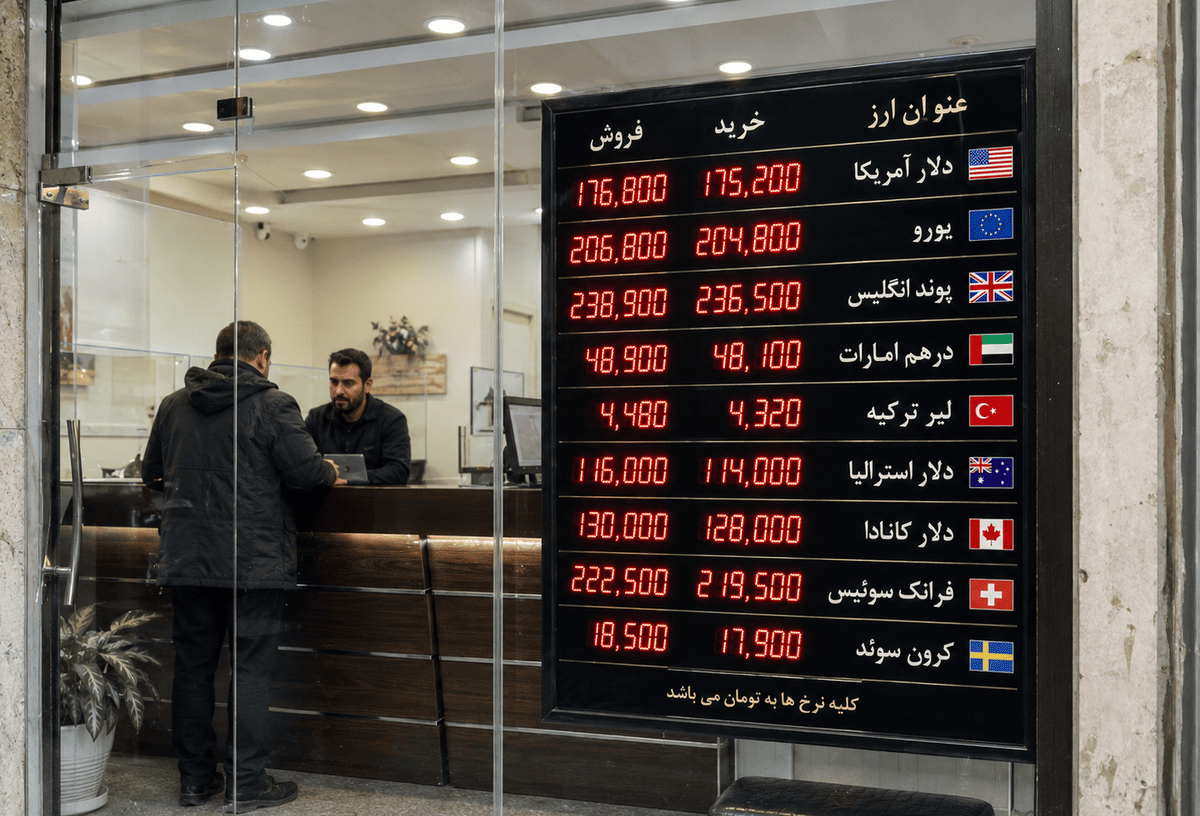
On 11 July 2026, the published selling rate for a U.S. dollar remittance at the Iran Center for Exchange was approximately 149,149 tomans.
At roughly the same time, public free-market trackers placed the dollar closer to 178,000–180,000 tomans.
The precise numbers change daily. What matters is the structure: the open-market dollar was trading at a meaningful premium to the formal commercial remittance rate.
This gap affects pricing throughout the economy, even when a company officially receives currency through the commercial market.
2. Essential Goods, Medicine and Targeted Currency Support
Iran previously used the fixed 28,500-toman dollar for a wider range of basic goods, medicine and agricultural inputs.
That broad mechanism was substantially removed during the transition into 2026.
However, the removal of the fixed 28,500-toman rate does not mean that all essential imports now receive exactly the same treatment as ordinary commercial goods.
The Iran Center for Exchange continues to distinguish the foreign-exchange category used for basic goods and medicine from ordinary commercial remittances.
Targeted support can take several forms:
- a lower or separately calculated currency rate,
- direct budget support,
- import subsidies,
- controlled consumer prices,
- reduced customs duties,
- reimbursement to insurers or distributors,
- or compensation paid to households.
The policy mechanism may change while the political objective remains the same: limiting the final price of selected essential goods.
For an investor or importer, broad statements such as “preferential currency has been removed” are not enough.
The relevant questions are:
- Does the exact HS code receive targeted treatment?
- Is support attached to the product or the importer?
- Is the support provided through currency, customs, tax or direct subsidy?
- Is the final selling price regulated?
- How long does allocation take?
- What happens if the policy changes after the import order is placed?
A business should not assume that access to targeted support will continue permanently.
The key investment lesson
A company that is profitable only because it receives cheaper currency is exposed to policy risk.
The investment case should be stress-tested at three levels:
- the current supported rate,
- the ordinary commercial rate,
- a stressed market-linked rate.
If the company becomes uneconomic when preferential treatment disappears, its advantage is political rather than operational.
3. Cash, Travel and Service Rates
Not all foreign-currency demand is linked to imports.
Iran also has regulated channels for service-related needs, including categories such as:
- travel,
- education,
- overseas medical treatment,
- international registration fees,
- professional and technical services,
- transport,
- insurance,
- exhibitions,
- and other approved external expenses.
The applicant normally needs to provide documentation showing the purpose of the payment.
The applicable price may differ from the commercial remittance rate because:
- the transaction may involve physical banknotes,
- retail handling costs are different,
- quotas may apply,
- the currency source may differ,
- and the transaction may be priced through a different official mechanism.
Travel currency is also not unlimited.
Eligibility, annual quotas, destination, travel documents and the authorized distribution channel may affect access.
For companies, this category matters when budgeting for:
- employee travel,
- foreign training,
- exhibitions,
- overseas certifications,
- professional subscriptions,
- and small external service payments.
A real expense does not automatically create access to regulated currency. It must fit an approved category and satisfy documentation requirements.
4. Reference and Administrative Rates
The Central Bank publishes rates that are sometimes described in media coverage as “official exchange rates.”
That phrase can be misleading.
A rate may be official because it is published or used by a public institution. It does not follow that companies can buy unlimited foreign currency at that rate.
Reference rates may be used for:
- financial reporting,
- regulatory calculations,
- statistical conversion,
- valuation of public accounts,
- banking operations,
- or other administrative purposes.
They should not automatically be used to estimate:
- the cost of importing goods,
- the market value of an Iranian company,
- the dollar value of a household income,
- or the amount a foreign shareholder can repatriate.
A rate can be official but not executable.
This distinction is crucial when international reports convert Iranian rial values into dollars. Using a low administrative rate can make the Iranian economy, company revenues or asset values appear much larger in dollar terms than they are at a commercial or market rate.
The correct conversion depends on the purpose of the analysis.
5. The Customs Calculation Rate
The customs exchange rate is a separate concept.
It is used to convert the foreign-currency customs value of imported goods into rials for calculating:
- customs duties,
- commercial profit charges,
- certain import taxes,
- and related government charges.
It is not necessarily the rate at which the importer purchases foreign currency.
For the Iranian year 1405, the customs calculation basis was linked to the average approved exchange rate from Bahman 1404 rather than being updated every day with the free market.
This can create a situation where an importer faces several different currency references in the same transaction:
- one rate for purchasing the foreign currency,
- another rate for customs valuation,
- another rate for accounting,
- and the free-market rate for replacement-cost pricing.
This is why import-cost analysis cannot stop at the invoice value.
The full landed cost should include:
**foreign invoice value
- effective currency cost
- freight and insurance
- customs valuation
- duty rate
- VAT and charges
- warehousing and clearance
- financing cost**
A company may receive commercial currency at one rate but pay customs charges calculated using another administrative basis.
6. The Free-Market Rate
The free-market rate is the price formed outside the main official allocation system.
It reflects demand from:
- households protecting savings,
- travelers without sufficient official allocation,
- small or unregistered imports,
- migration-related transfers,
- capital outflows,
- informal cross-border trade,
- businesses without access to commercial allocation,
- and investors responding to political or inflation risk.
Supply may come from:
- private export earnings,
- remittances,
- tourism,
- cash holdings,
- cross-border transactions,
- and informal settlement networks.
The free market is not a perfect or frictionless financial market.
It can be:
- fragmented,
- legally restricted,
- sensitive to enforcement,
- less liquid during crises,
- and highly reactive to political news.
But it remains economically important because it captures expectations.
It responds quickly to:
- inflation,
- monetary expansion,
- budget deficits,
- oil-export prospects,
- sanctions enforcement,
- regional conflict,
- nuclear negotiations,
- release of foreign assets,
- and public confidence in the government’s currency policy.
The free-market dollar is therefore more than a cash price.
It is one of Iran’s most visible measures of political and monetary confidence.
Why Businesses Use the Free-Market Rate Even When They Receive Official Currency
An importer may obtain currency through the commercial market and still price its goods partly against the free-market rate.
This can happen because the company is thinking about replacement cost.
Suppose an importer bought inventory using a commercial rate of 150,000 tomans per dollar.
If the company believes its next shipment may cost 180,000 tomans per dollar, selling the current stock based only on the historical rate may leave it unable to replace the inventory.
The same logic affects:
- manufacturers holding imported raw materials,
- distributors of spare parts,
- pharmacies,
- electronics retailers,
- machinery dealers,
- and companies with foreign-currency liabilities.
The free-market rate therefore influences prices far beyond transactions directly completed in the free market.
7. The Effective Settlement Rate
For foreign investors and international traders, the most important rate may not be publicly displayed anywhere.
It is the effective settlement rate.
Iran-related transactions are often settled through currencies and jurisdictions such as:
- UAE dirhams,
- Chinese yuan,
- euros,
- Turkish lira,
- Russian rubles,
- Iraqi dinars,
- or other regional payment routes.
A contract may be denominated in U.S. dollars, but the actual payment may move through dirhams or yuan.
This creates additional costs:
- cross-currency conversion,
- intermediary spreads,
- limited bank availability,
- compliance review,
- transfer delays,
- and restrictions over where the funds can ultimately be used.
One dollar-equivalent is not always equivalent to one freely usable dollar.
The economic value depends on:
- the bank holding the funds,
- the country of settlement,
- convertibility,
- transferability,
- counterparty acceptance,
- and compliance restrictions.
A foreign investor should therefore ask:
- In which currency will the transaction actually settle?
- Where will the funds be held?
- Can they be transferred onward?
- Which bank or intermediary is involved?
- What deduction will occur between gross and net receipt?
- How long will settlement take?
The contractual exchange rate may look attractive while the actual settlement economics are weak.
The Rate Gap and What It Means
The gap between the commercial rate and the free-market rate is one of the most important indicators in Iran.
Assume:
- commercial rate: 150,000 tomans per dollar,
- free-market rate: 180,000 tomans per dollar.
The free-market dollar is approximately one-fifth more expensive.
This gap affects economic behavior.
For importers
Access to the commercial rate reduces the rial cost of imports relative to businesses that must price against the free market.
For exporters
Selling export earnings through a lower formal rate may reduce the rial proceeds compared with the open-market value of the currency.
For consumers
The lower rate may reduce prices if the benefit reaches the consumer. If not, part of the difference becomes margin or rent elsewhere in the supply chain.
For government
A wide gap creates incentives for:
- over-invoicing imports,
- under-invoicing exports,
- obtaining allocation for non-priority use,
- delaying return of export proceeds,
- and shifting transactions between channels.
For investors
The gap reveals how far the administered commercial system remains from the price formed by unrestricted demand.
A narrowing gap can indicate:
- improved currency availability,
- greater confidence,
- policy convergence,
- or stronger control of demand.
A widening gap can indicate:
- allocation delays,
- inflation expectations,
- political stress,
- capital flight,
- or declining confidence in the official market.
How the System Affects Importers
Iranian importers face more than simple currency-price risk.
Eligibility risk
The product or importer may not qualify for the expected allocation category.
Allocation risk
Approval does not always mean immediate access to currency.
Timing risk
The exchange rate may change between:
- supplier quotation,
- import registration,
- allocation,
- payment,
- shipment,
- and customs clearance.
Settlement risk
The overseas supplier may be unable or unwilling to receive money through the available route.
Price-control risk
The importer’s domestic selling price may be controlled even when its actual foreign-exchange cost rises.
Replacement-cost risk
The next shipment may require a higher rate than the current one.
Working-capital risk
Delays can lock up deposits and increase financing needs.
The right import model should therefore include several exchange-rate scenarios rather than one fixed assumption.
How the System Affects Exporters
Exporters earn foreign currency, but the amount of economic value they retain depends on how export proceeds must be returned.
Relevant questions include:
- What portion of proceeds must be repatriated?
- Within what period?
- Through which market?
- At what rate?
- Can the exporter use the currency for its own imports?
- Can it transfer the currency to another eligible importer?
- Is the currency held abroad or brought into an approved domestic channel?
- What documentation is required to discharge the repatriation obligation?
If the formal commercial rate is below the free-market rate, exporters may view the difference as an implicit cost.
But the full picture varies by sector.
An exporter may also benefit from:
- subsidized domestic energy,
- locally priced labor,
- lower rial costs,
- imported inputs obtained through official channels,
- or the ability to retain part of its foreign-currency earnings.
Export competitiveness must therefore be evaluated at the company level, not only through the headline rate.
How the System Affects Iranian Companies
A single Iranian company may face several exchange rates at once.
Consider a manufacturer that:
- earns some revenue in rials,
- exports part of its output,
- imports machinery,
- buys imported raw materials from a domestic distributor,
- holds foreign-currency debt,
- and reports its accounts under local rules.
The company may:
- convert export earnings through the commercial market,
- obtain machinery currency through an approved allocation,
- buy some inputs priced against the free market,
- calculate customs duties using the customs rate,
- and value certain balances using an accounting rate.
There is no single exchange rate that fully describes the business.
The analyst must map each flow separately.
How Foreign Investors Should Value an Iranian Company
A simple conversion of rial earnings into dollars is rarely sufficient.
At minimum, an investor should use four exchange-rate perspectives.
1. Reporting rate
The rate used in the company’s financial statements.
This explains the reported accounts but may not represent economic convertibility.
2. Operating rate
The rate governing the company’s real revenues, imported inputs and export proceeds.
This determines margins.
3. Replacement-cost rate
The rate at which inventory, machinery or imported inputs would need to be replaced.
This matters during rapid depreciation.
4. Repatriation rate
The rate and route through which dividends, sale proceeds or invested capital could actually be converted and transferred.
This matters most to a foreign shareholder.
An Iranian company may appear inexpensive when translated at an administrative rate but much less attractive when valued at the rate through which cash can realistically leave the country.
The investor should therefore calculate:
cash legally available for distribution
÷ executable conversion rate
− transfer and intermediary costs
− expected delay
= economically accessible foreign-currency return
This is more useful than converting reported net income at a headline rate.
The Repatriation Problem
For a foreign investor, earning a profit in rials is not the same as receiving a hard-currency return.
The investor must determine:
- whether the original investment was formally registered,
- whether dividends are legally transferable,
- which documents are required,
- which foreign-currency source can be used,
- which rate applies,
- which banking route is available,
- and how sanctions affect the transfer.
A company may be profitable, liquid and capable of paying dividends domestically, while the foreign shareholder remains unable to transfer the proceeds efficiently.
Repatriation should therefore be examined before investment, not after profits are generated.
What Happened to the First and Second Halls?
During the development of the Commercial Foreign Exchange Market, transactions were divided between a first and second hall.
The second hall was introduced to provide more market-linked pricing for selected exporters, smaller transactions and categories that did not fit comfortably within the more controlled first-hall framework.
By early 2026, policy moved toward convergence and integration of these rates.
For current analysis, the historical hall label is less useful than four practical questions:
- What transaction category is being used?
- Is the currency remittance or cash?
- What rate is actually quoted?
- Can the applicant access it?
A company should not rely on old descriptions of first-hall and second-hall rates without checking the current transaction process.
The public market view now places greater emphasis on the commercial remittance rate, import financing and separate categories such as basic goods and medicine.
Can Iran Unify Its Exchange Rates?
A single exchange rate would reduce:
- arbitrage,
- unequal access,
- administrative complexity,
- rent-seeking,
- accounting confusion,
- and distortions between exporters and importers.
But unification is not achieved by simply announcing one number.
If the government removes a lower rate without controlling inflation or compensating vulnerable households, the price of essential goods can rise sharply.
If the unified rate is set below the market-clearing level, shortages and a parallel market can reappear.
Sustainable unification would require:
- lower and more stable inflation,
- stronger fiscal discipline,
- reliable foreign-currency revenues,
- access to usable reserves,
- more functional banking channels,
- targeted rather than exchange-rate-based subsidies,
- and confidence that the new rate can be defended.
Without these conditions, a formally unified system may soon become multi-rate again.
A Practical Framework for Reading Any Iranian Exchange Rate
Whenever an Iranian rate is quoted, ask seven questions.
1. What unit is being used?
Rial or toman?
2. What type of rate is it?
Commercial remittance, cash, service, customs, targeted support, reference or free market?
3. Who can access it?
Any buyer, an approved importer, an exporter, a traveler or a government entity?
4. What transaction does it cover?
Imports, exports, travel, services, customs, accounting or physical cash?
5. Is the rate executable?
Can the company actually obtain or sell the required amount at that price?
6. How long will settlement take?
A lower rate with a long delay may be economically worse than a higher immediate rate.
7. What is the all-in cost?
Include commissions, intermediaries, conversion loss, financing cost, compliance and transfer restrictions.
If these seven questions are not answered, the quoted exchange rate is incomplete information.
Common Analytical Mistakes
Treating Iran as having one official rate
Several regulated rates exist for different purposes.
Treating every Central Bank rate as tradable
A reference rate may not be accessible for a commercial transaction.
Treating the former NIMA rate as current
NIMA was discontinued in January 2025.
Using the free-market rate for every company flow
Many commercial imports and export proceeds use regulated channels.
Ignoring the free-market rate entirely
It still influences expectations, replacement cost, asset pricing and household behavior.
Confusing the customs rate with the currency purchase rate
Customs valuation and foreign-currency settlement are separate calculations.
Ignoring the settlement currency
A dollar-denominated invoice may be paid through dirhams, yuan or another channel.
Ignoring time
The applicable rate can change between contract, allocation, shipment and payment.
Forgetting rial and toman conversion
A tenfold error can invalidate the entire analysis.
What Investors Should Monitor
A useful Iran exchange-rate dashboard should track:
- commercial remittance rate,
- free-market rate,
- the premium between them,
- foreign-currency allocation times,
- oil-export revenue and accessibility,
- inflation,
- monetary growth,
- fiscal deficits,
- export-repatriation rules,
- changes to essential-goods support,
- customs valuation rules,
- and sanctions or geopolitical developments.
The direction of the rate gap is often as important as the level of the rates.
A stable commercial rate alongside a rapidly weakening free-market rate may indicate that administrative pricing is lagging behind economic pressure.
A narrowing gap may indicate improved supply — or stronger restrictions on open-market demand. The cause must be investigated.
Final Assessment
Iran’s exchange-rate system is not best understood as a list of competing dollar prices.
It is a system of differentiated access.
The commercial remittance rate serves formal trade.
Targeted mechanisms support selected essential goods.
Cash and service rates cover approved non-trade needs.
Customs rates determine import charges.
Reference rates serve administrative functions.
The free market captures unrestricted demand and expectations.
The effective settlement rate determines what a transaction truly costs.
The most important exchange rate is therefore not always the highest, the lowest or the most official.
It is the rate that the transaction can actually use.
For an importer, that means the all-in cost of delivering foreign currency to the supplier.
For an exporter, it means the net value of foreign earnings after repatriation.
For an Iranian company, it means the rates governing revenue, input costs, inventory replacement and debt.
For a foreign investor, it means the rate at which cash can legally and practically be converted and transferred.
The headline dollar price is only the surface.
The real analysis begins with access, timing, settlement and use.