Introducing Hormuz Business Assessment
Revenue and profit alone do not provide a complete picture of a business.Two companies with similar financial results may differ substantially in the quality…
Read article →
Capital Markets covers Iran’s listed equity, debt, commodity, energy, and exchange-based pricing infrastructure. For investors, this market matters because it provides visible price signals in an economy where many private-market numbers are opaque, fragmented, or difficult to verify.
Use these segments to move from the parent market into more specific investable routes, operating constraints, and demand pockets.
Commodity Exchange covers Iran’s formal exchange-based trading of industrial, mineral, petrochemical, agricultural, and other physical commodities. It is important because it links…
SegmentDebt Market covers Iran’s formal financing instruments such as government, corporate, municipal, and project-linked debt securities. It matters because it shows how…
SegmentEnergy Exchange covers Iran’s exchange-based trading and pricing channels for energy-related products, including electricity, oil-linked products, gas-linked products, and related contracts where…
SegmentFunds covers Iran’s pooled investment vehicles, including equity funds, fixed-income funds, commodity-linked funds, mixed funds, and other professionally managed capital-market products. It…
SegmentIPOs covers the process through which Iranian companies enter public markets and become visible to investors through formal disclosure, pricing, and exchange…
SegmentIran Fara Bourse is Iran’s over-the-counter and multi-board market for securities, debt instruments, funds, and companies that may not fit the main…
SegmentTehran Stock Exchange is Iran’s main public equity market and one of the clearest formal windows into listed corporate activity, sector pricing,…
SegmentVenture Capital is mapped as a focused part of the wider Capital Markets market.
Iran’s capital markets are one of the few places where investors can observe structured financial data, sector pricing, corporate disclosures, commodity flows, and market sentiment at scale. The opportunity is not only direct exposure to listed securities; it is using public-market signals to understand inflation hedging, sector strength, rial risk, industrial demand, commodity cycles, and the valuation gap between Iran’s real assets and its investable channels. Capital markets also help separate narrative from measurable activity. In any future opening scenario, listed companies, exchange infrastructure, brokers, data providers, and market-access channels could become central to foreign investor discovery.
The market is built around listed equities, over-the-counter securities, fixed-income instruments, commodity contracts, energy trading, brokers, asset managers, market data providers, disclosure systems, and exchange-linked institutions. Public companies cover banks, petrochemicals, metals, mining, automotive, pharmaceuticals, food, telecom, construction materials, and other sectors. The market reflects both real industrial value and macro distortions from inflation, currency volatility, liquidity cycles, and policy intervention. It is not a clean proxy for the whole economy, but it is one of the strongest available windows into formal corporate Iran.
Capital Markets are useful for valuation benchmarks, sector screening, public-company mapping, inflation analysis, currency-risk interpretation, and identifying industries with measurable revenue and asset bases. Even when direct investment access is limited, the market helps investors read which sectors have pricing power, export sensitivity, input-cost pressure, or hard-asset protection. For Hormuz, this market can anchor data-driven analysis and connect public signals to private opportunity maps.
Investment ideas connected to this market through buyer demand, entry routes, supply gaps, and execution constraints.
Research, briefs, and analysis assigned to this market will appear here automatically.
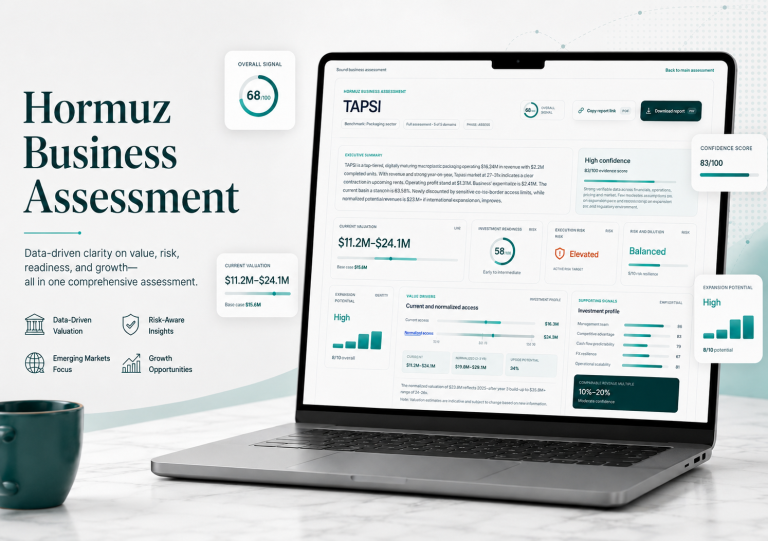
Revenue and profit alone do not provide a complete picture of a business.Two companies with similar financial results may differ substantially in the quality…
Read article →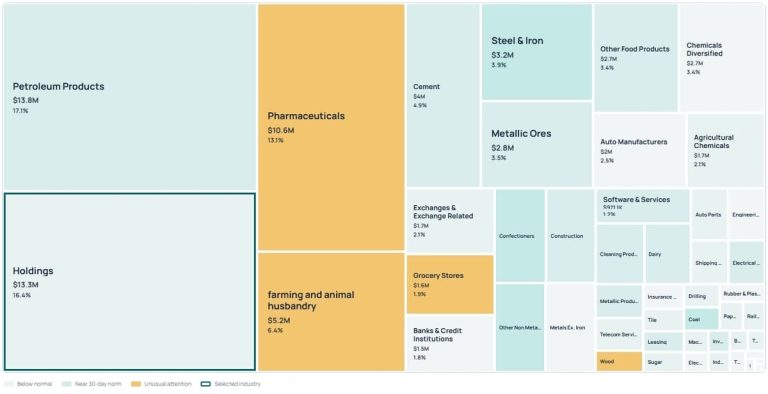
An industry can be visible in the stock market without being well understood in the real economy. Market capitalization may show where listed value…
Read article →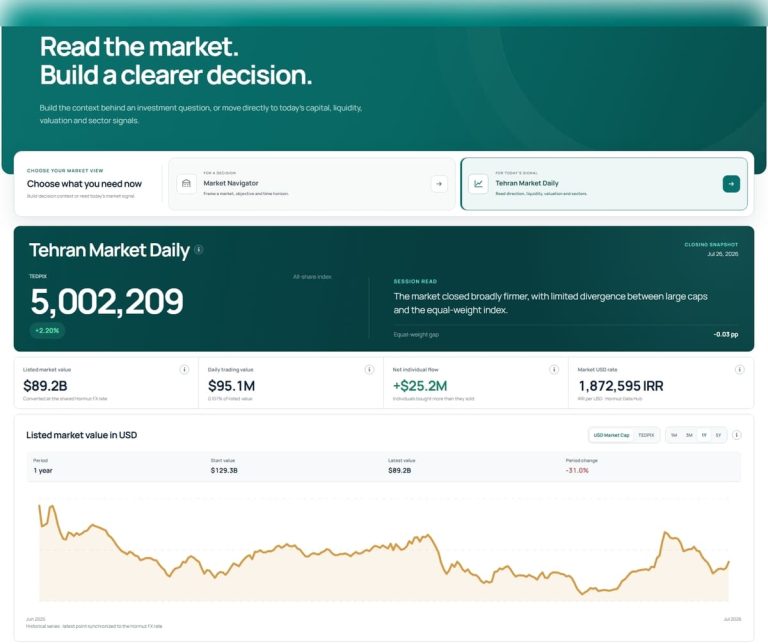
A practical guide to current market signals, USD valuations and decision-oriented intelligence Iran’s market is not difficult to understand because information is entirely absent.…
Read article →
The modern economy is built around dispersion. Companies use several suppliers. Governments diversify reserves. Traders move commodities across continents. Investors spread risk among markets.…
Read article →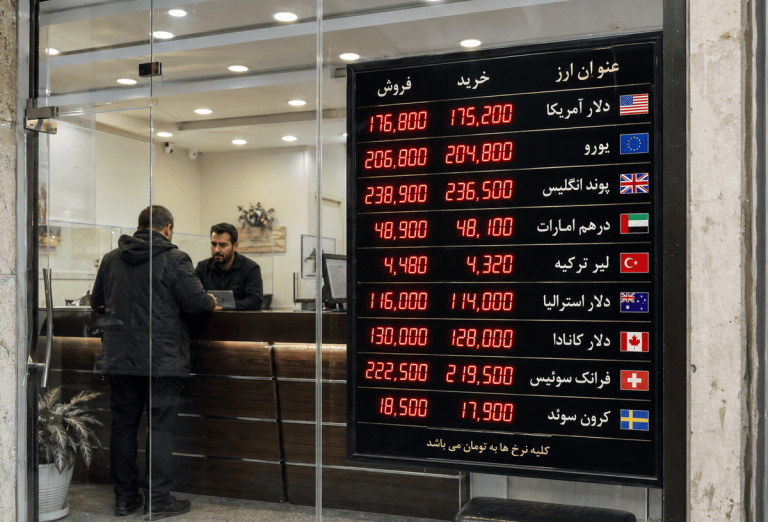
Iran does not have one exchange rate. It has several rates serving different transactions: importing goods, returning export proceeds, paying for travel or services,…
Read article →
The Tehran Stock Exchange is one of the most important windows into Iran’s formal economy. It does not show the whole country, and it…
Read article →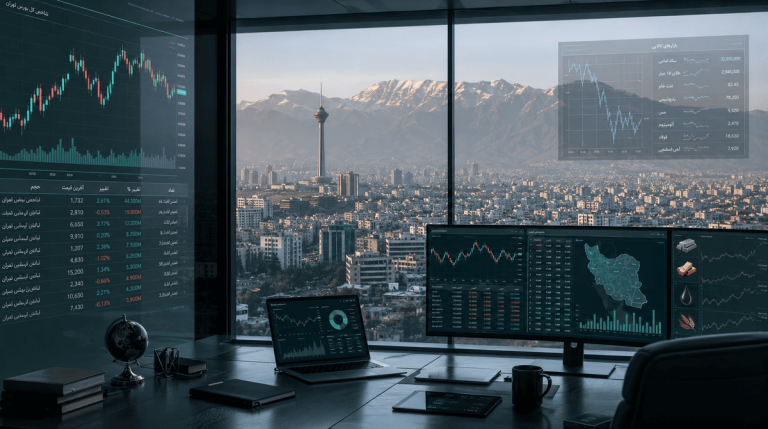
Iran is not an easy market to price. For foreign investors, the first problem is rarely the absence of opportunity. Iran has large industries,…
Read article →