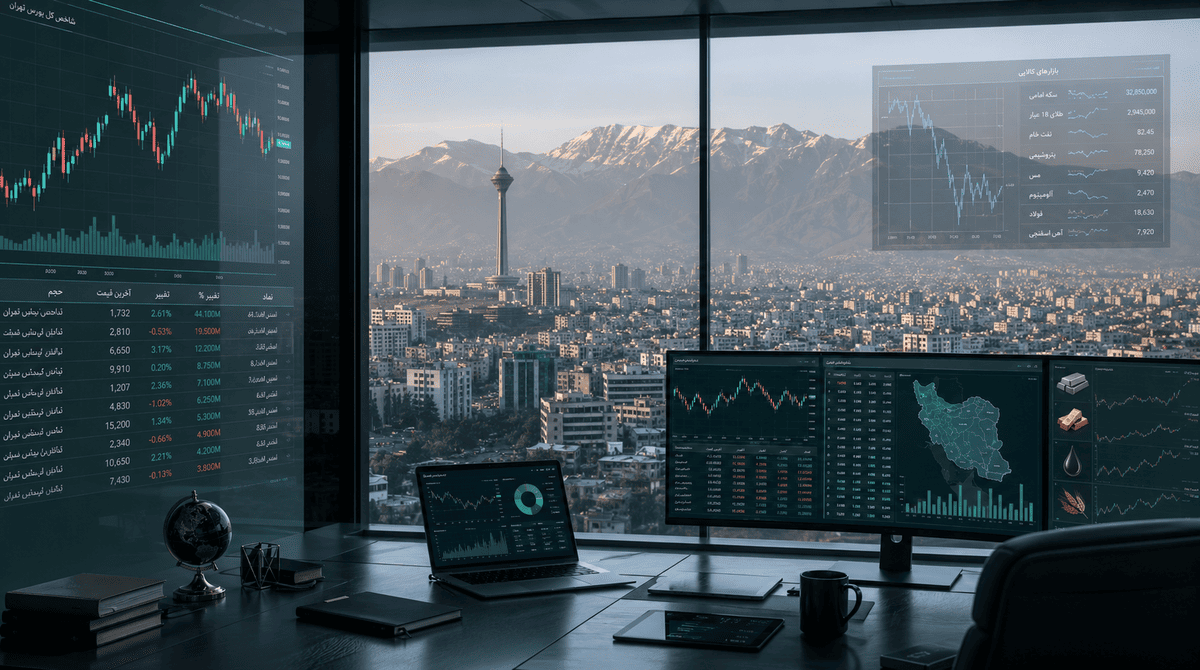
Where Price Is Visible: How Public Markets Help Investors Read Iran
Iran is not an easy market to price.
For foreign investors, the first problem is rarely the absence of opportunity. Iran has large industries, real assets, export-linked companies, strategic geography, and deep domestic demand. The harder problem is visibility. Private company data is limited. Reliable transaction records are fragmented. Official prices often differ from operational prices. Asset values can be distorted by inflation, currency depreciation, regulation, sanctions, and incomplete disclosure.
This creates a basic investor question: when private data is scarce, where can Iran be read?
One answer is public markets.
Iran’s public markets are not perfect mirrors of the economy. They are shaped by liquidity cycles, policy intervention, inflation expectations, local investor behavior, currency pressure, and regulatory limits. But they remain among the few places where prices, balance sheets, revenue trends, sector structure, commodity flows, and market expectations become partly visible.
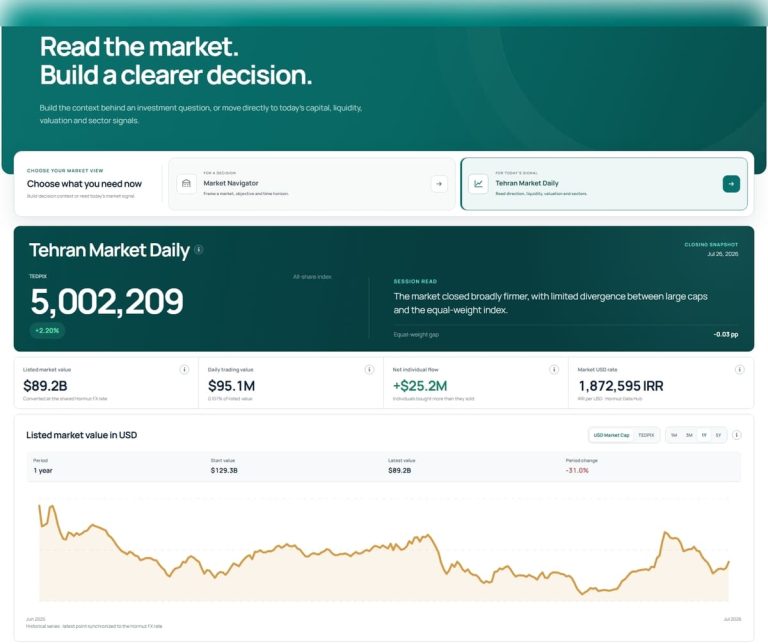
The Tehran Stock Exchange, Iran Fara Bourse, Iran Mercantile Exchange, Iran Energy Exchange, CODAL disclosures, and daily market data platforms do more than support trading. They create windows into the economy.
For a foreign investor, this is the central point: public markets are not only investment venues. They are data windows.
Even if an investor never buys a listed Iranian share, public-market data can help answer deeper questions: which sectors are profitable, which assets are inflation-sensitive, which companies earn in hard-currency-linked markets, which industries are under margin pressure, where liquidity moves during uncertainty, and how domestic investors price risk when formal data is incomplete.
Why pricing is difficult in Iran
Pricing Iran is difficult because there is no single clean reference point.
In developed markets, investors often rely on a dense information layer: audited private data, transaction databases, credit reports, analyst coverage, M&A comparables, property registries, standardized corporate filings, and liquid public benchmarks. Iran has parts of this system, but the layers are uneven.
The first challenge is private data scarcity. Many meaningful businesses are privately held, family-controlled, state-linked, semi-public, or embedded inside holding structures. Their real margins, liabilities, contracts, ownership risks, and cash flows are not always visible from outside.
The second challenge is price distortion. Iran often has more than one price for the same economic reality. There can be official prices, market prices, regulated prices, preferential prices, negotiated prices, and informal operational prices. This is especially important in currency, energy, commodities, land, credit, and import-dependent sectors. A valuation built on the wrong price can produce the wrong investment thesis.
The third challenge is inflation. In an inflationary economy, historical cost accounting can become misleading. A factory bought years ago may appear modest on the balance sheet while its replacement cost has multiplied. A company may report rising revenue in rials, but that growth may reflect inflation rather than real volume expansion. A land parcel may look expensive in local terms but cheap in hard-currency terms, or the reverse, depending on the exchange-rate assumption.
The fourth challenge is the gap between book value, market value, and replacement value. These three values can diverge sharply. Book value reflects accounting history. Market value reflects current investor sentiment, liquidity, and expected earnings. Replacement value asks what it would cost to rebuild the same asset today. In Iran, replacement value can be especially important because imported machinery, land, construction materials, and industrial infrastructure may become difficult or expensive to reproduce.
The fifth challenge is incomplete verification. A price may exist, but the investor still needs to know what sits behind it. Is the asset clean? Is ownership clear? Are receivables collectible? Are margins sustainable? Is the company exposed to regulated input prices, export restrictions, sanctions risk, or foreign-exchange settlement issues?
This is why public-market data should not be treated as complete truth. It should be treated as structured evidence.
Why public markets matter
Public markets matter because they produce repeatable signals.
The most obvious signal is daily price. Listed shares show how local investors value companies across sectors. Prices move with earnings expectations, currency pressure, inflation, policy shifts, liquidity conditions, and political news. These movements are not always rational, but they are informative.
The second signal is volume. Trading volume shows where attention and liquidity are moving. In a market where private transactions are hard to observe, public-market volume can reveal which sectors domestic investors are using to express inflation concerns, currency expectations, or confidence in policy change.
The third signal is disclosure. Listed companies publish financial statements, monthly activity reports, board decisions, capital-increase notices, material information disclosures, general meeting reports, and auditor reports. These disclosures are not a substitute for full due diligence, but they provide a structured starting point.
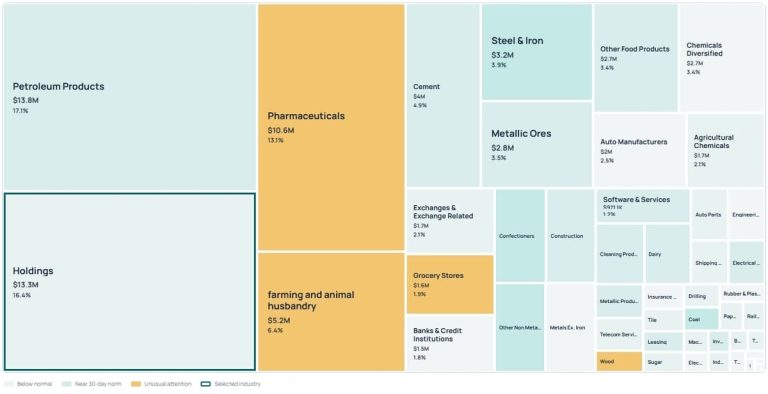
The fourth signal is sector behavior. Public markets allow investors to compare exporters with domestic sellers, asset-heavy companies with service businesses, banks with industrial firms, food producers with petrochemical companies, and regulated sectors with more market-priced sectors. These comparisons help investors understand how Iran’s economy absorbs pressure.
The fifth signal is market reaction. When the rial moves, commodity prices shift, policy changes, sanctions news emerges, or inflation expectations rise, public markets react. The reaction may be volatile or delayed, but it reveals how domestic capital interprets risk.
For a foreign investor, this matters because public markets can help form a baseline before deeper local verification begins. They can show where value may exist, where distortion may be severe, and where further research is required.
What the Tehran Stock Exchange reveals
The Tehran Stock Exchange is one of the most important places to observe Iran’s corporate economy.
It does not represent all of Iran. Many important companies are private, unlisted, state-linked, or outside transparent reporting structures. Still, the exchange gives investors a partial map of major industrial, financial, and consumer sectors.
Several listed groups are especially useful for reading Iran.
Petrochemical companies can reveal export exposure, feedstock sensitivity, global commodity linkage, and the relationship between local cost structures and hard-currency-linked revenues. They are important because Iran’s industrial economy is deeply connected to energy, hydrocarbons, and downstream chemical production.
Metals and mining companies can show how global commodity prices, domestic energy costs, export policy, infrastructure constraints, and currency assumptions affect large industrial producers. Steel, copper, iron ore, aluminum, and related industries are not only listed sectors; they are indicators of industrial capacity and physical-asset value.
Banks reveal something different. They reflect credit conditions, balance-sheet stress, interest-rate dynamics, regulatory pressure, and the health of financial intermediation. Bank valuations need caution because reported numbers may not fully capture asset quality or hidden risk. But the sector is still useful for understanding liquidity and financial-system pressure.
Automotive companies are useful because they expose the complexity of Iran’s regulated industrial economy. They sit at the intersection of consumer demand, price controls, imported parts, domestic supply chains, labor, state policy, and inflation. Their performance may reveal less about pure efficiency and more about policy constraints.
Food and consumer-goods companies help investors read household demand. Their revenue, margin, pricing power, and inventory behavior can show how inflation affects essential consumption. In many cases, these companies reveal whether demand is real, repeatable, and affordable.
Pharmaceutical and healthcare-related companies help show demand that is less discretionary. But they also expose import dependence, regulated pricing, currency allocation, and working-capital pressure.
Construction, cement, real estate, and building-material companies help investors understand hard-asset cycles. They can provide clues about land values, infrastructure demand, construction costs, and the inflation-hedging behavior of domestic capital.
The key is not to read each listed company as an isolated stock. The better approach is to read each sector as a signal.
Which companies benefit from a weaker rial? Which are hurt by imported inputs? Which have pricing power? Which own valuable land or fixed assets? Which are only growing because of inflation? Which generate cash? Which are trapped by regulation? Which sectors trade below replacement value? Which sectors are expensive because domestic capital has already crowded into them?
These questions turn the stock market into a research tool.
Beyond stocks: commodity and energy signals
Equities are only one part of the public-market picture.
Iran’s commodity and energy markets can be even more useful for reading the real economy because they connect financial prices to physical production.
The Iran Mercantile Exchange is important because it covers industrial, mineral, petrochemical, agricultural, and other commodity categories. For investors, this can provide signals about domestic supply, demand, input costs, export-linked pricing, and pressure on manufacturers.
If steel, petrochemical products, cement, copper, agricultural goods, or other materials are traded through organized commodity channels, their prices can help investors understand cost structures across the economy. A manufacturer’s margin is not only visible in its income statement. It is also shaped by the price of raw materials, energy, transport, packaging, and inventory replacement.
Commodity data can therefore help answer practical questions:
Are industrial inputs becoming more expensive? Are producers passing costs to buyers? Are prices closer to domestic policy levels or international parity? Are export-linked commodities creating a valuation floor for certain producers? Are downstream industries under pressure from upstream price increases?
The Iran Energy Exchange adds another layer. Energy is central to Iran’s economy, but energy pricing is not always fully market-based. Even partial signals from energy-related trading can help investors understand supply, demand, policy direction, and the economics of energy-intensive industries.
This matters because many Iranian investment opportunities are indirectly tied to commodities and energy. A factory, port, warehouse, logistics company, construction-material producer, food processor, or exporter may not look like a commodity trade at first glance. But its economics can depend heavily on commodity prices, feedstock access, energy reliability, transport costs, and currency-linked inputs.
Public commodity and energy signals help investors move from abstract macro analysis to operating reality.
What public markets cannot reveal
Public markets are useful, but they are not enough.
The first limitation is private transactions. Many of the most interesting opportunities in Iran may never appear in listed markets. Private businesses, distressed assets, land deals, industrial sites, family-owned companies, and local partnerships require separate verification.
The second limitation is asset quality. A listed company may own land, factories, subsidiaries, equipment, or receivables, but public filings may not fully reveal their practical value. The investor still needs to know whether the land has clean title, whether the factory is operational, whether the machinery is current, whether receivables are collectible, and whether liabilities are understated.
The third limitation is ownership complexity. In Iran, understanding who controls an asset can matter as much as understanding what the asset is. Ownership chains, related parties, state-linked entities, pension funds, holding companies, banks, and quasi-public groups can influence governance and risk.
The fourth limitation is legal and regulatory exposure. Public data can show financial performance, but it may not fully capture contract enforceability, sanctions exposure, licensing risk, import restrictions, price controls, tax disputes, or political sensitivity.
The fifth limitation is foreign-investor access. A market may be visible without being practically accessible. A foreign investor may be able to observe prices but still face obstacles in custody, settlement, repatriation, compliance, sanctions screening, local brokerage access, banking channels, and capital exit.
The sixth limitation is crisis liquidity. A listed price is useful only if liquidity survives stress. In periods of panic, war risk, regulatory intervention, capital controls, or exchange closures, the difference between quoted value and realizable value can widen sharply.
This is why public-market data should be used as a signal layer, not a final investment decision.
It can show where to look. It cannot replace local due diligence.
How investors should use public-market data
The right way to use public-market data in Iran is to triangulate.
Start with prices, but do not stop there. A stock price, commodity price, or index level is only one piece of the picture. It should be compared with currency trends, inflation, replacement cost, sector margins, volume data, and company disclosures.
The first comparison should be against the exchange rate. A company may look expensive in rials but cheap in dollars, or cheap in rials but structurally vulnerable in hard-currency terms. For foreign investors, every valuation must eventually be translated into a hard-currency framework.
The second comparison should be against inflation. Revenue growth, asset growth, and profit growth must be separated from inflation pass-through. A company that grows sales by raising nominal prices may not be expanding in real terms. Investors should look for volume growth, margin resilience, and real purchasing-power indicators.
The third comparison should be against margins. Gross margin and operating margin can reveal whether a company has pricing power, input-cost pressure, or regulatory constraints. Margin compression may indicate that inflation is not being passed through. Margin expansion may signal currency advantage, commodity linkage, or temporary pricing benefits.
The fourth comparison should be between domestic and export revenue. Export-linked companies may offer partial protection against currency depreciation, but they may also face sanctions, logistics, settlement, and policy risks. Domestic companies may have more stable local demand but weaker hard-currency protection.
The fifth comparison should be against fixed assets. In Iran, land, buildings, industrial sites, machinery, warehouses, and infrastructure can become central to valuation. A company’s earnings may look weak while its asset base is valuable. But asset value must be tested against title, location, utility access, liquidity, and replacement cost.
The sixth comparison should be debt and working capital. Inflation can hide balance-sheet stress. Companies with large receivables, expensive inventory cycles, imported inputs, or short-term debt may face pressure even when revenue appears to rise. Working-capital needs are especially important in sectors exposed to currency volatility or regulated pricing.
The seventh comparison should be across sectors. Public markets allow investors to build a relative map: exporters versus importers, asset-heavy versus asset-light, regulated versus market-priced, essential consumption versus discretionary demand, commodity-linked versus wage-driven.
The result should not be a single answer. It should be an investor map.
Where is value visible? Where is it distorted? Where does the market already price the risk? Where is the market ignoring risk? Where is local verification required?
Investor checklist
Before using public-market data to read Iran, investors should ask four groups of questions.
1. What is priced?
Which assets, revenues, risks, and expectations are already reflected in public prices?
Is the market pricing inflation protection, currency exposure, commodity linkage, land value, earnings growth, or policy change?
Is the valuation based on real operating strength, or is it mainly a reaction to liquidity and inflation expectations?
2. What is distorted?
Which prices are affected by regulation, official rates, price controls, subsidies, restricted imports, export rules, or weak liquidity?
Is the market using the right exchange-rate assumption?
Are earnings inflated by nominal growth?
Are assets recorded at old book values while replacement cost has changed?
Is the sector popular because it is genuinely strong, or because domestic capital has limited alternatives?
3. What is missing?
What information cannot be seen from market data?
Are there hidden liabilities, related-party risks, unclear ownership structures, legal disputes, sanctions exposure, or governance problems?
Does the public data show the asset, but not the ability to control, sell, use, or exit from it?
4. What needs local verification?
Which assumptions require on-the-ground checks?
Can the company’s assets be physically verified?
Are customers real and paying?
Are receivables collectible?
Are permits valid?
Are counterparties reliable?
Can a foreign investor legally and practically access the opportunity?
Can capital enter, operate, and exit?
What to watch
Public markets should be watched continuously because Iran’s pricing environment can change quickly.
Investors should monitor listed-company disclosures, monthly activity reports, sector margins, capital increases, dividend behavior, trading volume, commodity prices, exchange-rate assumptions, inflation indicators, policy announcements, and liquidity movement between sectors.
Special attention should go to sectors that connect several signals at once: petrochemicals, metals, banks, food, pharmaceuticals, automotive, construction materials, real estate-linked companies, and export-oriented producers.
Commodity-market data should be used to understand input costs and industrial pressure. Energy-market signals should be watched for their impact on energy-intensive sectors. CODAL disclosures should be read not only for earnings, but for risk language, related-party transactions, capital needs, auditor notes, and management explanations.
The goal is not to treat public-market prices as a clean answer. Iran is too complex for that.
The goal is to use public markets as the first visible layer of price discovery.
In a market where private data is scarce, visibility itself has value. Public markets show where domestic capital is moving, where companies are earning, where inflation is passing through, where assets may be mispriced, and where deeper verification should begin.