The Trade Door: What Is the Most Practical Way to Enter Iran?
For many foreign investors, the first question about Iran should not be “Where should we invest?”
It should be: “How should we enter?”
Direct investment is rarely the first practical step in a complex market. It requires legal structure, capital movement, partner selection, regulatory clarity, tax planning, banking access, due diligence, and a credible exit route. In Iran, these issues matter even more because the market is large, fragmented, under-documented, and shaped by sanctions, currency volatility, policy shifts, and local operating practices.
Trade is often the first operational layer before capital commitment.
It allows a company to test demand, understand pricing, identify reliable partners, observe customs procedures, map payment channels, and learn how goods actually move. A trade route can reveal more about a market than a presentation deck. It shows who buys, who pays, who delays, who controls distribution, and where friction appears.
For Iran, this is especially important because the country is not only a domestic market. It is also a regional node. Iran connects the Persian Gulf, the Gulf of Oman, Iraq, Turkey, the Caucasus, Central Asia, Afghanistan, Pakistan, and the Caspian region. Its geography matters as much as its population.
The Trade Door is therefore not only about importing or exporting goods. It is about using trade as a controlled way to read Iran before making a larger commitment.
Why trade is often the first entry point
Direct investment asks the investor to commit before fully understanding the operating environment.
Trade allows the investor to learn before committing.
A company that exports equipment into Iran, sources goods from Iran, works with a distributor, tests a port route, or operates through a free zone can gather practical information at a lower level of exposure. It can see whether demand is real, whether prices are workable, whether the local partner performs, whether documentation is manageable, and whether payment settlement is possible.
This matters because Iran’s investment difficulty is not only macroeconomic. It is operational.
A market may look attractive on paper, but the real question is whether the product can enter, clear customs, reach buyers, be paid for, and scale. Trade tests each step.
It tests demand. Are customers actually buying, or is the opportunity only theoretical?
It tests distribution. Can the product move from port to warehouse to buyer without excessive leakage, delay, or cost?
It tests the partner. Does the local company understand documentation, regulation, and market access, or is it only a broker with limited control?
It tests pricing. Can the product compete after currency conversion, duties, logistics, insurance, commissions, and local margins?
It tests compliance. Can the transaction be structured without unacceptable sanctions, banking, or counterparty risk?
This is why trade is often the most practical first layer. It gives the investor market knowledge before requiring large capital exposure.
Iran as a domestic market and regional node
Iran’s trade logic begins with geography.
To the south, Iran faces the Persian Gulf and the Gulf of Oman. This gives it maritime access to the UAE, Oman, Qatar, Kuwait, Saudi Arabia, India, East Africa, and broader Asian shipping routes.
To the west, Iran connects to Iraq and Turkey. Iraq is especially important because it has long been a major destination for Iranian exports, including food products, construction materials, consumer goods, electricity-related flows, engineering services, and other cross-border trade categories.
To the east, Iran borders Afghanistan and Pakistan. These routes matter for food, fuel, construction materials, transit, consumer goods, and regional logistics, but they require careful reading of border risk, security, settlement, and local trade practices.
To the north, Iran connects to the Caucasus, the Caspian Sea, and Central Asia. This makes northern corridors relevant for transit, agriculture, industrial goods, energy-related movement, and the broader north-south trade imagination.
This creates two different entry logics.
The first is Iran as a destination market. A foreign company enters Iran to sell machinery, food products, medical equipment, components, consumer goods, technology, or industrial inputs to Iranian buyers.
The second is Iran as a corridor or supply base. A company uses Iran to source products, reach neighboring markets, connect through ports and borders, or participate in regional trade flows.
These two logics should not be confused.
Selling into Iran requires understanding local demand, purchasing power, regulation, currency, distribution, and payment.
Using Iran as a corridor requires understanding ports, customs, transit rules, border reliability, insurance, sanctions exposure, and the quality of logistics partners.
The same geography creates both opportunity and friction.
Ports that matter
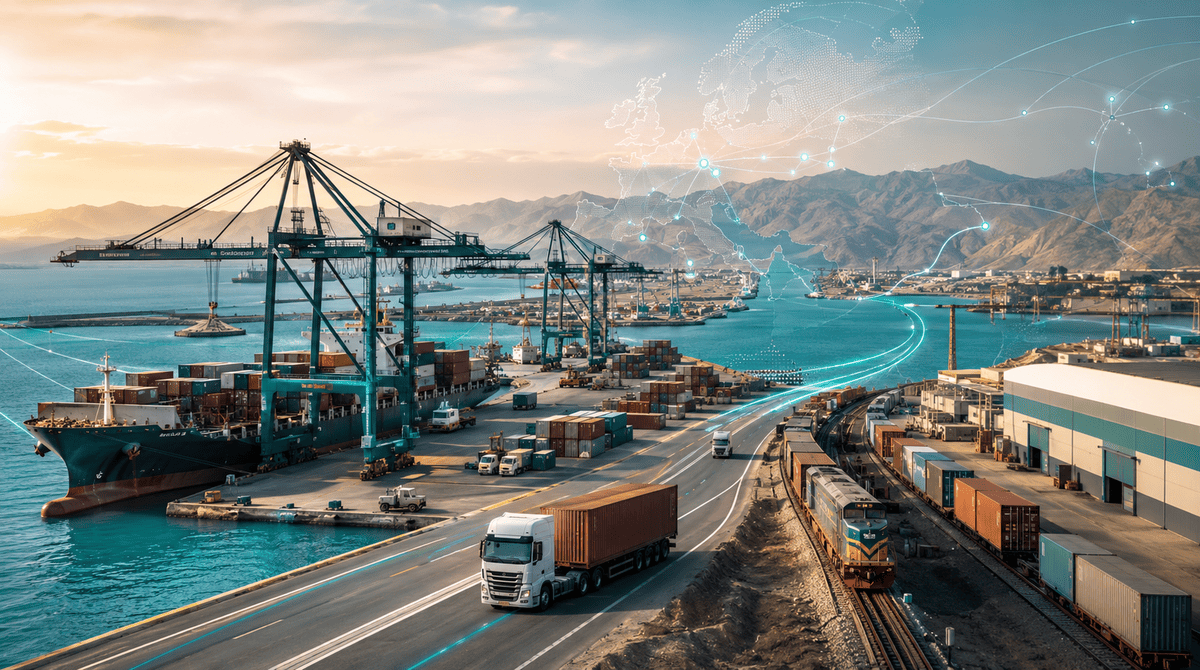
Iran’s ports are central to the Trade Door because they determine how goods enter, leave, and move through the country.
Bandar Abbas is the main southern gateway. It is strategically important because it connects Iran to the Persian Gulf and wider maritime trade routes. For many importers and exporters, Bandar Abbas is the first port to study because of its scale, location, and role in container and general cargo movement.
Imam Khomeini Port is important for bulk cargo, essential goods, industrial inputs, and large-scale trade flows. Its position in Khuzestan connects it to Iran’s energy, petrochemical, agricultural, and industrial geography.
Bushehr matters for southern trade, Gulf access, and regional commercial movement. It can be relevant for consumer goods, food products, industrial supplies, and trade with nearby Gulf routes.
Chabahar is different. It sits on the Gulf of Oman and is often discussed as Iran’s ocean-facing strategic port. Its significance is not only domestic. It is tied to transit logic, eastern Iran, Afghanistan, Central Asia, and the idea of reducing dependence on Persian Gulf chokepoints. For investors, Chabahar is less about current volume alone and more about strategic optionality.
Caspian ports such as Anzali, Noshahr, and Amirabad matter for northern trade. They connect Iran to Caspian routes, Russia, Kazakhstan, Azerbaijan, and broader north-south trade possibilities. Their relevance depends on the product, destination, seasonality, shipping availability, and inland logistics.
The practical point is simple: there is no single “Iran port strategy.”
A machinery importer may need one route. A grain trader may need another. A petrochemical exporter may use a different channel. A company targeting Iraq may care more about western land routes than southern ports. A business looking at Central Asia may need to compare Chabahar, northern corridors, and inland border routes.
The port question should always follow the product question.
What is moving? Where is it coming from? Where is it going? How sensitive is it to time, temperature, insurance, sanctions, duties, and working capital?
Only then does the correct port become visible.
Free zones and special zones
Free zones and special economic zones can help foreign companies test Iran, but they should be approached with discipline.
The basic appeal is clear. Free zones are usually marketed around trade facilitation, company registration, customs advantages, warehousing, re-export, logistics, and lighter administrative procedures. Special economic zones are often more industrial or production-oriented, with a focus on manufacturing, processing, storage, export, and infrastructure.
In practice, the distinction matters.
A free zone may be useful for market entry, warehousing, re-export, distribution, logistics, or establishing a limited local presence before entering the mainland market.
A special economic zone may be more relevant for industrial activity, assembly, processing, petrochemicals, mining-related logistics, manufacturing, or export-oriented production.
But investors should not rely only on promotional material.
A zone is useful only if it matches the business model. The investor must examine location, customs treatment, access to suppliers, road and port connectivity, utility reliability, labor availability, warehousing quality, tax and legal treatment, dispute handling, and the actual performance of local administrators.
For example, a zone near a port may help with logistics but may not give access to the right customer base. A zone near a border may be useful for transit but weak for domestic distribution. A zone with attractive rules may still suffer from limited infrastructure or poor partner quality.
Free zones and special zones are tools. They are not guarantees.
The right question is not “Which zone has the best incentives?”
The better question is: “Which zone reduces friction for this specific trade route or operating model?”
What can enter through trade?
Trade entry works best when the product solves a real operating need.
Machinery is one of the most important categories because many Iranian industries require modernization, replacement, repair, and productivity upgrades. But machinery imports are highly sensitive to sanctions, financing, spare parts, after-sales service, and technical installation.
Industrial components and spare parts can be attractive because production lines often need maintenance and replacement parts. These goods may have repeat demand, but they require precise documentation, reliable buyers, and strong compliance checks.
Raw materials and intermediate goods can support manufacturing, food processing, packaging, pharmaceuticals, construction, agriculture, and industrial production. Their attractiveness depends on currency, import rules, local substitutes, and price controls.
Food products can enter when there is clear demand, pricing power, or supply shortage. But food trade requires attention to standards, shelf life, cold chain, distribution, labeling, permits, and affordability.
Medical equipment and healthcare supplies can be relevant because healthcare demand is persistent. Yet this sector also requires regulatory approval, documentation, distributor quality, maintenance capacity, and payment discipline.
Technology can enter in several forms: software, industrial automation, business systems, logistics tools, agricultural technology, energy-efficiency systems, medical technology, and education platforms. The challenge is monetization, local support, sanctions compliance, and customer ability to pay.
Logistics services can also be an entry point. Warehousing, freight management, cold chain, customs support, last-mile delivery, and route optimization may become investable if they solve measurable bottlenecks.
The common thread is not category. It is need.
A product can enter Iran successfully when it has a real buyer, a clear route, acceptable compliance risk, practical payment terms, and a local partner who can execute.
What can leave Iran?
Iran is not only an import market. It is also a source market.
Petrochemicals are one of the most important export-linked categories. They connect Iran’s energy base to regional and global industrial demand. Investors should watch not only production capacity but also sanctions exposure, settlement channels, logistics, feedstock policy, and buyer reliability.
Minerals and metals are also central. Iran has significant industrial and mining capacity in steel, copper, iron ore, cement, stone, and related materials. These categories can be attractive where production cost, logistics, and regional demand align.
Agricultural products can be relevant in selected categories such as fruits, nuts, dates, saffron, vegetables, and processed food. But water scarcity, quality consistency, packaging, certification, cold chain, and export standards matter.
Construction materials can move into neighboring markets where price, proximity, and demand support trade. Cement, steel products, tiles, ceramics, stone, and related materials may benefit from regional reconstruction, housing, or infrastructure demand.
Food products and consumer goods can also reach nearby markets, especially where Iranian producers have price advantage, brand familiarity, or distribution relationships.
Technical and engineering services are an under-discussed export category. Iran has engineering capacity in construction, energy, industrial maintenance, software, design, and project execution. Services export is harder to measure than goods trade, but it can be commercially meaningful.
Specialized industrial products may also find regional demand when they are cheaper, available, or adapted to neighboring markets.
The key question is whether Iran’s advantage is real.
Is it price? Proximity? Product quality? Energy cost? Labor skill? Existing buyer relationships? Regional familiarity? Or simply a temporary currency advantage?
Only durable advantages can support repeatable trade.
The partner question
In Iran, the trade route is only as strong as the local partner.
A foreign company can choose the right product and still fail because the partner cannot execute. This is why partner selection belongs at the center of the Trade Door.
A serious partner should have more than relationships. It should have operational capacity.
Can it handle customs documentation?
Does it understand permits and product standards?
Does it have warehousing or access to reliable logistics?
Can it reach actual buyers rather than only introduce intermediaries?
Can it provide transparent pricing?
Can it manage after-sales service?
Can it document payments?
Can it work under compliance restrictions?
Can it perform when conditions change?
The investor should also distinguish between four types of local actors.
The first is the broker. A broker may know people, but often does not control infrastructure, distribution, or end buyers.
The second is the distributor. A distributor can move product and manage channels, but may lack strategic alignment.
The third is the operator. An operator has assets, staff, systems, and execution ability.
The fourth is the strategic partner. This is the rarest type: a party that combines market access, operating capacity, financial discipline, and long-term alignment.
For trade entry, the wrong partner can create more risk than the wrong product.
This is why trade should begin with limited, measurable steps before deeper commitment.
Risks in trade entry
Trade reduces some risks, but it does not remove them.
Sanctions exposure is the first filter. The investor must understand whether the product, counterparty, bank, shipping route, insurer, documentation, or end use creates unacceptable risk. This cannot be treated casually.
Customs friction is the second. Goods may face classification issues, valuation disputes, documentation errors, delays, inspections, warehousing costs, or unexpected regulatory requirements.
Payment settlement is the third. A buyer may want the product, but the transaction still needs a workable payment route. Settlement terms, currency, timing, guarantees, and enforcement must be defined before shipment.
Partner risk is the fourth. A local party may exaggerate demand, misrepresent access, delay payment, hide costs, or lack capacity. Verification is essential.
Documentation risk is the fifth. Trade depends on paperwork: invoices, certificates, permits, customs codes, standards, insurance, shipping documents, inspection reports, and end-user information. Weak documentation can destroy a transaction.
Insurance and shipping are the sixth. Routes, carriers, cargo type, sanctions restrictions, port delays, and risk premiums can change the economics.
Product standards are the seventh. Food, medicine, medical equipment, industrial machinery, electronics, chemicals, and agricultural goods may require approvals, labeling, testing, or certification.
Price controls and import restrictions are the eighth. Some goods may be politically sensitive or regulated. A product can be commercially attractive but administratively difficult.
The purpose of trade entry is not to avoid all risk. It is to expose risk in smaller, controlled transactions before larger capital is committed.
The trade-entry framework
A practical Iran entry strategy should move through six questions.
1. What is the product or service?
Start with specificity. “Entering Iran” is too broad. The investor must define the product, HS code if relevant, technical requirements, customer segment, unit economics, and compliance sensitivity.
2. Who is the buyer?
Is the buyer a consumer, distributor, industrial company, hospital, government entity, contractor, farmer, factory, retailer, or exporter?
Is the buyer able to pay?
Is demand repeatable?
Is the buyer purchasing because of real need or temporary shortage?
3. What is the route?
Which port, border, free zone, warehouse, inland route, or distribution channel makes sense?
Does the product need cold chain, special handling, insurance, inspection, or fast delivery?
4. Who executes locally?
Is the local partner a broker, distributor, operator, or strategic partner?
What can they prove?
Have they handled similar goods?
Can their claims be verified?
5. How does payment work?
What currency is used?
When is payment made?
What guarantees exist?
Can funds move safely and legally?
What happens if payment is delayed?
6. What is learned before investing more?
Every trade test should produce intelligence.
What was the real landed cost?
How long did clearance take?
Which documents caused friction?
Did the buyer reorder?
Did the partner perform?
Was the margin real?
Did the route scale?
If the first transaction does not teach anything, it was only a sale. A proper trade-entry strategy turns each transaction into market intelligence.
Investor checklist
Before using trade as an entry route into Iran, investors should answer the following questions.
What exactly is the product or service?
Is the opportunity import, export, transit, distribution, sourcing, or local partnership?
Which route matters: Persian Gulf, Gulf of Oman, Iraq, Turkey, Afghanistan, Pakistan, the Caucasus, Central Asia, or the Caspian?
Which port, border, free zone, or special zone fits the product?
Who is the real buyer?
Who controls distribution?
Who handles customs?
Which permits, standards, certificates, or product approvals are required?
How is payment settled?
Which currency is used?
What sanctions, insurance, shipping, or banking risks apply?
Is the local partner verified?
Can the route scale after the first transaction?
What would justify moving from trade to direct investment?
What to watch
Trade conditions in Iran can change quickly. Investors should monitor customs rules, import restrictions, export controls, port performance, free-zone regulations, exchange-rate movements, payment routes, sanctions enforcement, insurance availability, and regional border conditions.
They should also watch trade data by product and partner country. Merchandise trade databases, customs releases, port authority information, chamber of commerce reports, company disclosures, and interviews with logistics operators can show where trade is actually moving.
The most useful signal is repeat behavior.
One shipment may be an experiment. Repeat orders show demand. Stable payment shows trust. Smooth clearance shows operational feasibility. Improved margins show learning. A reliable partner shows platform potential.
The Trade Door is not the final investment thesis. It is the way to test whether a thesis deserves capital.
For many foreign investors, Iran should not begin with a large acquisition, a factory, or a long-term joint venture. It should begin with a route, a product, a buyer, a partner, and a transaction that can be verified.
Trade is not the opposite of investment.
In Iran, it is often the first serious step toward it.