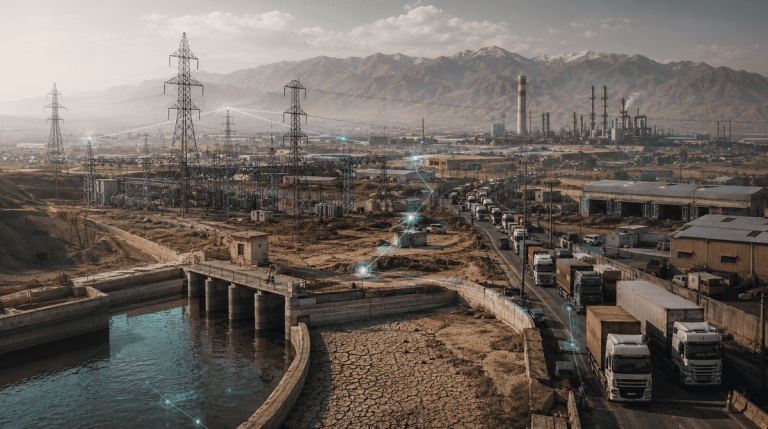

9 Sectors Where Iran Has Structural Undersupply
Iran’s investment opportunity is often described through size: a large population, natural resources, industrial depth, geographic location, and a long history of trade. That is true, but incomplete.
The deeper investment thesis is not simply that Iran is large. It is that Iran has structural undersupply across several essential sectors.
Structural undersupply is different from ordinary shortage.
A normal shortage can be temporary: one bad harvest, one delayed shipment, one currency shock, one import restriction. Structural undersupply is deeper. It means the economy has a persistent gap between what households, companies, cities, and industries need — and what the existing system can reliably provide.
That gap may come from sanctions, underinvestment, distorted prices, aging infrastructure, weak finance, poor regulation, water stress, energy losses, import dependence, corruption, or state control. The result is the same: demand does not disappear. It becomes unmet, delayed, substituted, informal, or overpriced.
For investors, this is where Iran becomes interesting.
Not every shortage is investable. Some shortages are trapped inside subsidies, political control, weak payment capacity, or legally sensitive counterparties. But some shortages can become serious investment opportunities if four conditions exist:
- the need is structural, not temporary;
- the buyer can pay or the state must pay;
- the solution reduces a real bottleneck;
- the project can be executed without unacceptable compliance, currency, or counterparty risk.
This article identifies nine sectors where Iran has structural undersupply — and where a serious investor would look first if the country becomes more open, more bankable, or more commercially connected.
The Core Thesis
Iran is not short of demand. It is short of reliable supply.
It is not short of engineers. It is short of modern capital equipment, financing, and stable operating conditions.
It is not short of cities. It is short of affordable, efficient, serviced urban space.
It is not short of water use. It is short of water productivity.
It is not short of energy resources. It is short of reliable power at the point of consumption.
It is not short of doctors or hospitals. It is short of trusted medical supply chains, advanced equipment, consistent drug quality, and affordable access.
The investable Iran thesis begins when the analyst stops asking, “What does Iran have?” and starts asking, “Where does Iran’s system fail to supply what the economy already needs?”
That is the map of structural undersupply.
Quick Overview
| Sector | Structural Undersupply | Why It Matters | Investor Angle |
|---|---|---|---|
| Power & Grid Reliability | Electricity deficits, outages, weak flexibility | Industry cannot scale without reliable power | Distributed generation, solar, storage, grid services, industrial backup |
| Water & Resource Efficiency | Scarcity, leakage, overuse, weak reuse systems | Water is becoming a hard limit on cities and agriculture | Treatment, reuse, desalination, irrigation tech, monitoring |
| Healthcare & Medical Supply Chains | Drug shortages, equipment gaps, quality issues | Demand is non-discretionary and politically sensitive | Medical devices, diagnostics, pharma inputs, hospital equipment |
| Industrial Machinery & Maintenance | Aging capital stock and spare-parts scarcity | Existing factories need modernization before expansion | Machinery, MRO, automation, sensors, parts distribution |
| Logistics, Warehousing & Cold Chain | Route friction, weak storage, high spoilage risk | Trade and food systems depend on movement | Warehousing, cold chain, customs support, corridor logistics |
| Affordable Housing & Urban Infrastructure | Rent pressure, aging stock, weak affordability | Housing absorbs household income and creates social stress | Rental housing, prefab, retrofitting, urban services |
| Food Systems & Agricultural Productivity | Water-intensive agriculture, input constraints | Food security depends on productivity, not just output | Greenhouses, irrigation, seeds, storage, processing |
| Digital Infrastructure & Enterprise Connectivity | Internet instability, weak cloud depth, cyber risk | Modern services need resilient connectivity and data systems | Cloud, cybersecurity, enterprise networks, backup connectivity |
| Trade Finance, Compliance & Trust Infrastructure | Banking friction, weak counterparty transparency | Capital cannot move without trust and verification | Due diligence, escrow, trade finance, insurance, compliance platforms |
1. Power and Grid Reliability
Iran has enormous energy resources, but that does not mean it has reliable electricity.
This is one of the central paradoxes of the Iranian economy. A country with major gas and oil reserves still faces recurring electricity shortages, industrial power cuts, and seasonal stress. The problem is not only generation capacity. It is the whole power system: fuel allocation, plant efficiency, grid constraints, peak demand, transmission losses, aging equipment, pricing distortions, and underinvestment.
For investors, power undersupply is not only an energy-sector issue. It is an economy-wide constraint.
Factories cannot plan production if electricity is interrupted. Cold chains cannot function if refrigeration fails. Data centers cannot operate without redundancy. Hospitals, elevators, water pumps, retail systems, and logistics hubs all depend on power reliability.
This makes energy reliability one of the highest-value bottlenecks in Iran.
The opportunity is not limited to large power plants. In fact, the more realistic early opportunities may be smaller and distributed:
- industrial solar systems,
- hybrid solar-gas backup,
- battery storage,
- energy management systems,
- efficient cooling,
- demand-response software,
- private microgrids,
- industrial backup power,
- smart meters,
- power-quality equipment,
- and maintenance for existing generation assets.
The key investor insight is that Iran’s power shortage is not just a supply problem. It is also a flexibility problem.
The grid needs more reliable capacity at peak hours, more efficient consumption, better pricing signals, and more private-sector participation where regulation permits.
Investment thesis: reliable electricity becomes a premium service in an economy where outages impose hidden costs across every sector.
Main constraint: energy pricing, regulation, state control, fuel allocation, and payment discipline.
Best early angle: business-to-business power reliability for industrial parks, logistics centers, hospitals, cold storage, and high-value manufacturing.
2. Water and Resource Efficiency
Water is Iran’s most strategic domestic constraint.
It is not a narrow environmental issue. It is an economic, agricultural, industrial, urban, and political issue. Water stress affects food production, city growth, industrial siting, migration, social stability, and public infrastructure.
The problem is structural because demand patterns were built around assumptions that no longer hold. Agriculture consumes too much water relative to its economic productivity. Groundwater has been over-extracted. Urban networks lose water. Some industries are located in water-stressed provinces. Drought cycles are harsher. Climate pressure is rising. The system needs productivity, not just supply.
This creates a difficult but powerful investment map.
The opportunity is not simply “water projects.” It is water productivity:
- drip and precision irrigation,
- greenhouse agriculture,
- wastewater treatment and reuse,
- industrial water recycling,
- desalination in coastal areas,
- leak detection,
- smart metering,
- groundwater monitoring,
- water-efficient crop systems,
- pumping efficiency,
- urban network rehabilitation,
- and water-risk analytics for investors and industrial operators.
Water is also a location filter. Some provinces may look attractive because of land, labor, or mineral resources but become weak once water availability is priced properly. Investors who ignore water risk may buy into stranded capacity.
The strongest water-related opportunities are likely to sit at the intersection of agriculture, industry, and municipal infrastructure. The buyer may be a city, a factory, a food producer, a mining company, or a public-private project.
Investment thesis: water scarcity forces demand for efficiency, reuse, monitoring, and new production models.
Main constraint: tariffs, public procurement, fragmented authorities, and political sensitivity around water allocation.
Best early angle: water-saving technologies with direct cost reduction for agriculture, industry, and urban utilities.
3. Healthcare and Medical Supply Chains
Iran has a relatively deep healthcare system compared with many emerging markets. It has doctors, hospitals, universities, pharmaceutical companies, and broad insurance coverage. The problem is not absence of healthcare infrastructure. The problem is reliability, quality, access, and supply-chain resilience.
This is why healthcare in Iran should be read as structural undersupply rather than simple underdevelopment.
The country can provide a wide range of services, but patients and providers still face shortages of certain medicines, imported raw materials, medical devices, diagnostics, advanced hospital equipment, and high-quality consumables. Currency restrictions, sanctions-related payment friction, procurement problems, price controls, and liquidity stress all weaken the supply chain.
Demand is non-discretionary. People delay many purchases in a crisis, but they do not stop needing cancer drugs, insulin, dialysis equipment, diagnostic imaging, surgical tools, lab materials, cardiac devices, dental care, and hospital consumables.
The investable opportunity is not only in hospitals. It is in the infrastructure behind healthcare:
- medical equipment distribution,
- diagnostics labs,
- imaging equipment,
- hospital maintenance,
- pharma raw materials,
- cold-chain pharma logistics,
- quality-controlled generics,
- medical consumables,
- telemedicine for underserved areas,
- digital hospital systems,
- and specialized care centers.
But healthcare is also politically sensitive. Pricing, reimbursement, import licensing, insurance coverage, and foreign-currency allocation can shape profitability more than demand itself.
Investment thesis: healthcare demand is structural, but supply is constrained by finance, import friction, quality control, and aging equipment.
Main constraint: reimbursement, pricing controls, sanctions compliance, and regulatory approvals.
Best early angle: diagnostics, equipment maintenance, consumables, pharma logistics, and specialized supply chains where quality and reliability matter.
4. Industrial Machinery, Spare Parts, and Maintenance
Iran has a real industrial base. That is precisely why machinery undersupply matters.
Many emerging markets need factories. Iran already has factories — in steel, petrochemicals, food processing, cement, automotive, household appliances, mining, textiles, pharmaceuticals, and construction materials. The issue is that much of this base has operated for years under sanctions, capital scarcity, import substitution pressure, and maintenance improvisation.
The first industrial opportunity after any improvement in access is not always building new factories. It is making existing factories work better.
Structural undersupply exists in:
- spare parts,
- CNC machinery,
- pumps and compressors,
- industrial automation,
- control systems,
- sensors,
- bearings and precision components,
- packaging machinery,
- quality-control systems,
- energy-efficiency upgrades,
- predictive maintenance,
- and modern production software.
This is a high-quality opportunity because the buyer is often already operating. The business case can be calculated: less downtime, lower energy use, higher yield, better quality, lower waste, and export readiness.
The investor does not need to bet only on future demand. The demand already exists inside inefficient production lines.
This sector is also a bridge between Iran’s old economy and a future opening. If sanctions ease or trade channels improve, factories will need modernization quickly. If sanctions remain, local repair, reverse engineering, and substitute components still remain valuable.
Investment thesis: Iran’s industrial base creates recurring demand for modernization, repair, spare parts, and efficiency.
Main constraint: import licensing, sanctions-sensitive equipment, currency access, and state-linked counterparties in heavy industry.
Best early angle: private-sector factories needing measurable productivity upgrades, especially in food processing, packaging, chemicals, building materials, and light manufacturing.
5. Logistics, Warehousing, and Cold Chain
Iran’s geography is valuable, but geography alone does not create logistics efficiency.
The country sits between the Persian Gulf, the Caspian Sea, Central Asia, Turkey, Iraq, Afghanistan, the Caucasus, and the Indian Ocean route through Chabahar. On a map, this looks like a natural logistics platform. In practice, logistics depends on roads, rail, ports, customs, warehousing, cold storage, insurance, documentation, and payment systems.
Iran has corridor potential, but it also has corridor friction.
Structural undersupply appears in:
- modern warehousing,
- cold-chain capacity,
- container handling,
- dry ports,
- bonded logistics,
- customs brokerage,
- fleet modernization,
- route visibility,
- logistics software,
- temperature-controlled transport,
- port-linked storage,
- and last-mile distribution outside major cities.
This matters because logistics is the connective tissue of an opening. If trade rises, logistics bottlenecks appear before factories are built. If food exports grow, cold chain becomes essential. If pharma imports rise, temperature control matters. If e-commerce expands, warehousing and distribution must improve.
Logistics is also one of the cleanest ways to participate in Iran’s corridor thesis without directly taking commodity, political, or industrial risk.
The most important corridors to watch are:
- Chabahar for Indian Ocean and eastern transit,
- Bandar Abbas and Qeshm for Gulf-linked trade,
- Anzali and Mazandaran for Caspian routes,
- Aras and Maku for northwest trade,
- Arvand, Mehran, and Qasr-e Shirin for Iraq-facing flows,
- Sarakhs and Incheh Borun for Central Asia,
- and Imam Khomeini Airport City for high-value air cargo.
Investment thesis: Iran’s trade potential cannot be realized without logistics modernization.
Main constraint: customs complexity, sanctions, insurance, fragmented operators, and public-sector port/rail coordination.
Best early angle: cold chain, bonded warehousing, corridor-specific logistics, pharma logistics, and export-ready food supply chains.
6. Affordable Housing and Urban Infrastructure
Iran does not simply have a housing market problem. It has an affordability and urban infrastructure problem.
Housing has become a defensive asset, an inflation hedge, a social pressure point, and a cost burden for households. In large cities, especially Tehran, rent and purchase prices have moved far beyond the income growth of ordinary households. At the same time, much of the existing stock is aging, inefficient, and poorly matched to the needs of younger families, renters, students, workers, and migrants.
Structural undersupply exists in the middle of the market: not luxury towers, not state slogans, but efficient, affordable, serviced, durable housing.
The opportunity is not only building units. It includes:
- rental housing platforms,
- affordable apartment construction,
- prefab and modular building systems,
- energy-efficient retrofits,
- building insulation,
- elevator and safety upgrades,
- district utilities,
- water-saving building systems,
- student housing,
- worker housing,
- senior housing,
- and urban regeneration around transport corridors.
The deeper issue is that housing absorbs capital that could otherwise go into productive investment. When households use housing as a survival hedge against inflation, capital becomes trapped in land and concrete. A healthier housing supply would not only improve living conditions; it would reduce one of the economy’s defensive distortions.
But this is also one of the hardest sectors. Land, permits, municipal finance, inflation, construction-material costs, rent controls, and political sensitivity can destroy returns if the model is poorly structured.
Investment thesis: Iran has a structural shortage of affordable, efficient, serviced urban housing, especially for renters and middle-income households.
Main constraint: land access, inflation, municipal approvals, financing, rent regulation, and construction-cost volatility.
Best early angle: targeted rental housing, retrofitting, worker housing, modular construction, and energy/water-efficient building systems.
7. Food Systems and Agricultural Productivity
Iran produces a wide range of agricultural goods, but the system is under pressure because it uses too much water, loses too much value, and depends on vulnerable inputs.
The issue is not that Iran lacks agricultural capacity. The issue is that parts of the system are structurally misallocated: water-intensive crops in stressed regions, insufficient cold storage, weak post-harvest handling, fragmented farms, input constraints, and limited value-added processing.
Iran’s food opportunity is not simply “more agriculture.” In many cases, producing more in the old way would make the water crisis worse.
The investable opportunity is productivity per unit of water, land, energy, and logistics cost.
This includes:
- greenhouse agriculture,
- controlled-environment farming,
- drip irrigation,
- drought-resistant crops,
- seed technology,
- soil management,
- precision agriculture,
- cold storage,
- sorting and grading,
- packaging,
- food processing,
- export-quality standards,
- traceability,
- and regional food brands.
Iran has strong product-chain potential in saffron, pistachios, dates, pomegranates, medicinal herbs, barberry, citrus, seafood, dairy, grains, and processed foods. But to become more investable, these chains need consistency, quality control, packaging, logistics, and market access.
The big picture is that Iran’s food system must move from volume logic to value logic.
Investment thesis: food demand is stable, but the system needs water productivity, storage, processing, packaging, and export readiness.
Main constraint: water stress, fragmented production, price controls, input imports, and weak cold-chain infrastructure.
Best early angle: water-efficient production, greenhouse clusters, cold chain, packaging, and export-grade processing.
8. Digital Infrastructure and Enterprise Connectivity
Iran has talent. It has engineers, developers, universities, startups, online merchants, digital consumers, and technical capacity. But the digital economy is structurally undersupplied in a different way: it lacks reliable openness, resilient connectivity, trusted payment integration, modern cloud depth, and predictable access to global tools.
Internet instability and restrictions impose a hidden tax on the whole economy. Digital businesses lose revenue. Freelancers lose clients. Exportable services become harder to deliver. Cloud and cybersecurity planning becomes defensive. Companies build around uncertainty instead of scale.
This creates two different kinds of opportunity.
The first is ordinary digital opportunity:
- cloud services,
- cybersecurity,
- enterprise software,
- ERP systems,
- payment infrastructure,
- data centers,
- business automation,
- logistics software,
- hospital software,
- industrial IoT,
- and e-commerce infrastructure.
The second is resilience opportunity:
- backup connectivity,
- domestic cloud redundancy,
- secure enterprise networks,
- offline-capable software,
- data protection,
- cyber-risk management,
- and continuity systems for banks, hospitals, logistics firms, and factories.
Iran’s digital market is not only constrained by sanctions. It is constrained by governance. That makes consumer internet bets more exposed. Enterprise infrastructure may be more investable because businesses still need continuity even in restricted environments.
Investment thesis: Iran has technical talent and digital demand, but weak connectivity reliability and enterprise infrastructure create structural undersupply.
Main constraint: internet controls, sanctions on software and cloud services, payment isolation, and regulatory unpredictability.
Best early angle: enterprise software, cybersecurity, cloud resilience, industrial systems, and B2B digital infrastructure.
9. Market Intelligence, Compliance, and Trust Infrastructure
The ninth undersupplied sector is not a conventional industry. It is the layer that sits above all industries.
Iran does not only have shortages in power, water, healthcare, logistics, machinery, housing, food systems, and digital infrastructure. It also has a shortage of reliable market intelligence.
This is one of the least visible but most decisive constraints for investors.
A foreign investor can identify demand in Iran relatively quickly. The harder questions come afterward:
Who controls the company behind the opportunity?
Which counterparties are commercially real and which are politically connected shells?
Which routes actually work?
Which provinces are investable for a specific sector?
Which shortages are temporary and which are structural?
Which companies can deliver?
Which risks are sanctions-related, which are currency-related, and which are simply execution risk?
Which local partner is useful, and which one is dangerous?
Which opportunity is real, and which one only exists in a presentation?
This is where Iran becomes difficult.
The country has many opportunities, but the information environment is fragmented. Public data is incomplete. English-language analysis is thin. Official statistics often need interpretation. Company ownership can be opaque. Local business networks are relationship-driven. Sector knowledge is scattered across ministries, provincial actors, trade groups, brokers, industrial companies, and informal channels.
As a result, investors face a trust gap before they face a capital gap.
The missing layer is not another consulting brochure. It is a disciplined intelligence system that can connect geography, sectors, companies, infrastructure, policy, sanctions exposure, and commercial reality into one usable map.
This layer matters because every other opportunity depends on it.
Power projects require counterparty clarity.
Water projects require local political and geographic understanding.
Healthcare supply chains require regulatory and import knowledge.
Industrial modernization requires factory-level verification.
Logistics requires route intelligence.
Housing requires land and municipal understanding.
Food systems require product-chain mapping.
Digital infrastructure requires regulatory and connectivity analysis.
Without this intelligence layer, investors either move too slowly or take the wrong risks.
This is why Iran’s most important market gap may not be inside one sector. It may be the absence of a trusted gateway for understanding the whole opportunity map.
For serious investors, Iran is not a market to enter through assumptions. It is a market to enter through verification.
The real need is for:
- sector-level opportunity mapping,
- province-by-province investment intelligence,
- company and counterparty screening,
- infrastructure and corridor analysis,
- sanctions and compliance awareness,
- local partner evaluation,
- market-entry preparation,
- commercial terms support,
- and continuous monitoring of policy and risk.
This is the role Hormuz Group is built around: not to sell a simple Iran opportunity story, but to make Iran legible for serious capital.
Iran has no shortage of narratives. What it lacks is structured intelligence that separates signal from noise.
That distinction is critical.
In an opaque market, the first advantage is not money. It is understanding. Capital comes later. The investor who understands the map before others can move selectively, avoid weak counterparties, and recognize which shortages are genuinely investable.
Investment thesis: Iran’s opportunity map is structurally under-covered, under-analyzed, and difficult for outsiders to verify. Serious capital needs a trusted intelligence layer before it can move.
Main constraint: fragmented data, opaque ownership, sanctions exposure, weak English-language coverage, and limited investor-grade analysis.
Strategic role: not a sector to be chased blindly, but the enabling layer that determines whether other sectors can become investable.
Hormuz interpretation: market intelligence is not a side service around Iran investment. It is the first infrastructure serious investors need.
The Difference Between Shortage and Investable Undersupply
A shortage is not automatically an opportunity.
A country may lack something because people cannot pay for it. That is not always investable. A country may lack something because the government controls the price below cost. That may be socially important but commercially weak. A country may lack something because supply is blocked by law, not by market failure. That requires policy change, not just capital.
The best opportunities appear where five conditions overlap:
- demand is structural;
- the buyer has money or political urgency;
- the solution reduces a measurable bottleneck;
- the sector has room for private execution;
- compliance risk can be controlled.
This is why power reliability, healthcare supply chains, logistics, water efficiency, industrial maintenance, and trust infrastructure are more attractive than many obvious consumer stories.
They solve constraints rather than simply chase demand.
Where the First Capital Would Likely Go
If Iran becomes more open, capital will not enter all sectors equally.
The likely sequence is:
First: Trade and Repair
Spare parts, machinery, medical supplies, food inputs, logistics, and industrial maintenance move first because they address existing pain.
Second: Infrastructure Services
Power reliability, water efficiency, warehousing, cold chain, and enterprise connectivity become attractive once payments and contracts become clearer.
Third: Productive Capacity
Manufacturing modernization, food processing, pharma production, and industrial clusters become more bankable.
Fourth: Consumer and Real Estate Expansion
Consumer brands, retail, housing platforms, tourism, and lifestyle sectors expand later, after currency and purchasing power stabilize.
Fifth: Financial Deepening
Banking, insurance, investment vehicles, and capital markets become attractive only when compliance and macro stability improve.
This sequencing matters. Investors who jump straight to consumer scale may be early in the wrong way. Investors who start with bottlenecks may capture the real opening.
The Most Attractive Investment Logic
The strongest Iran opportunities are likely to have three features:
They reduce dependency.
This includes domestic production of critical inputs, local maintenance, spare parts, water reuse, power backup, and medical supply resilience.
They improve productivity.
This includes industrial automation, efficient irrigation, cold chain, packaging, energy management, and logistics software.
They make transactions more trustworthy.
This includes compliance, counterparty mapping, certification, quality control, trade finance, insurance, and data infrastructure.
These are not glamorous themes. But they are the themes that decide whether Iran’s economic potential becomes investable.
The Main Risks
Policy Risk
Some undersupplied sectors are politically sensitive. Energy, water, healthcare, housing, and food cannot be treated as ordinary markets. Pricing may be controlled. Public opinion may matter. Government intervention may be sudden.
Currency Risk
Many solutions require imported technology or foreign inputs, while revenues may be in rial. Without hedging or indexed contracts, margins can be destroyed.
Payment Risk
Even when demand exists, payment discipline may be weak. Public-sector buyers, semi-state companies, and liquidity-stressed firms must be screened carefully.
Counterparty Risk
Iran’s business environment contains opaque ownership structures and politically exposed entities. A good opportunity can become uninvestable because of the wrong partner.
Sanctions and Compliance Risk
Even in an opening scenario, not all sectors or counterparties become clean. Investors must separate legal possibility from compliance acceptability.
Execution Risk
Infrastructure, permits, customs, utilities, and local politics can slow projects even when the commercial case is strong.
Final Assessment
Iran’s big investment story is not only oil, minerals, tourism, or population size.
The deeper story is structural undersupply.
The country has persistent gaps in power reliability, water productivity, healthcare supply chains, industrial equipment, logistics, housing, food systems, digital infrastructure, and trust mechanisms. These gaps are not accidental. They are the result of years of sanctions, underinvestment, distorted incentives, aging infrastructure, policy control, and macro instability.
That makes Iran difficult. It also makes it unusually interesting.
A shallow investor sees shortage and assumes profit. A serious investor asks whether the shortage can become a lawful, bankable, insurable, scalable, and exit-capable business.
That distinction is everything.
The most attractive opportunities in Iran will not necessarily be the sectors with the loudest demand. They will be the sectors where solving a bottleneck unlocks other parts of the economy.
Power unlocks industry.
Water unlocks agriculture and cities.
Healthcare supply chains unlock access and trust.
Machinery unlocks factory productivity.
Logistics unlocks trade.
Housing unlocks household stability.
Food systems unlock resilience.
Digital infrastructure unlocks services.
Trust infrastructure unlocks capital.
That is the big picture.
Iran’s opportunity is not just what the country can sell. It is what the country cannot yet reliably supply — but must.