Iran’s Energy Paradox Is Redrawing Its Industrial Geography
Iran has one of the world’s largest energy resource bases. It holds the second-largest proved natural gas reserves and is one of the world’s largest gas producers. For decades, that abundance helped support the expansion of steel, cement, aluminium, petrochemicals and other energy-intensive industries.
Yet the operating reality increasingly looks different.
Factories face electricity restrictions during summer peaks. Gas becomes constrained during colder months as residential demand rises. Water scarcity is affecting some of the country’s most established industrial regions. The result is an apparent contradiction: Iran is rich in energy resources, but industrial access to reliable energy is increasingly scarce.
The distinction matters. For a new industrial project, the relevant question is no longer simply whether Iran has cheap gas or electricity. It is whether a particular location can deliver electricity, gas and water reliably throughout the year.
That change is beginning to redraw Iran’s industrial geography.
Resource abundance is not the same as usable energy
Iran’s energy problem is not primarily a lack of resources underground.
The U.S. Energy Information Administration estimates that Iran holds around 16% of the world’s proved natural gas reserves. Natural gas also dominates the power system, accounting for about 85% of electricity generation in 2022. But high domestic consumption, limited seasonal flexibility, ageing generation assets and insufficient investment have created persistent supply constraints.
The electricity system illustrates the problem clearly. Iran’s summer peak demand exceeded available supply by roughly 12 GW in 2023, according to the EIA, and rolling shortages have affected residential and industrial consumers in most summers since 2020. More recent restrictions show that the imbalance has not disappeared: industrial power supply remained enough of a concern in July 2026 for the government to approve emergency measures aimed at reducing cuts to manufacturers and allocating additional generation capacity to industry.
Energy-intensive producers feel these constraints disproportionately because steel furnaces, aluminium smelters, cement kilns and chemical plants are not ordinary electricity consumers. Interruptions can reduce utilisation rates, disrupt continuous processes and spread costs across the rest of the production chain.
This changes the meaning of “cheap energy.” A low regulated tariff has limited value if the power itself is unavailable when production needs it.
Water is becoming an industrial variable
Electricity and gas are only part of the shift.
Several of Iran’s major industrial centres were developed when water availability was treated as a manageable infrastructure problem rather than a hard geographic constraint.
That assumption is becoming increasingly difficult to maintain.
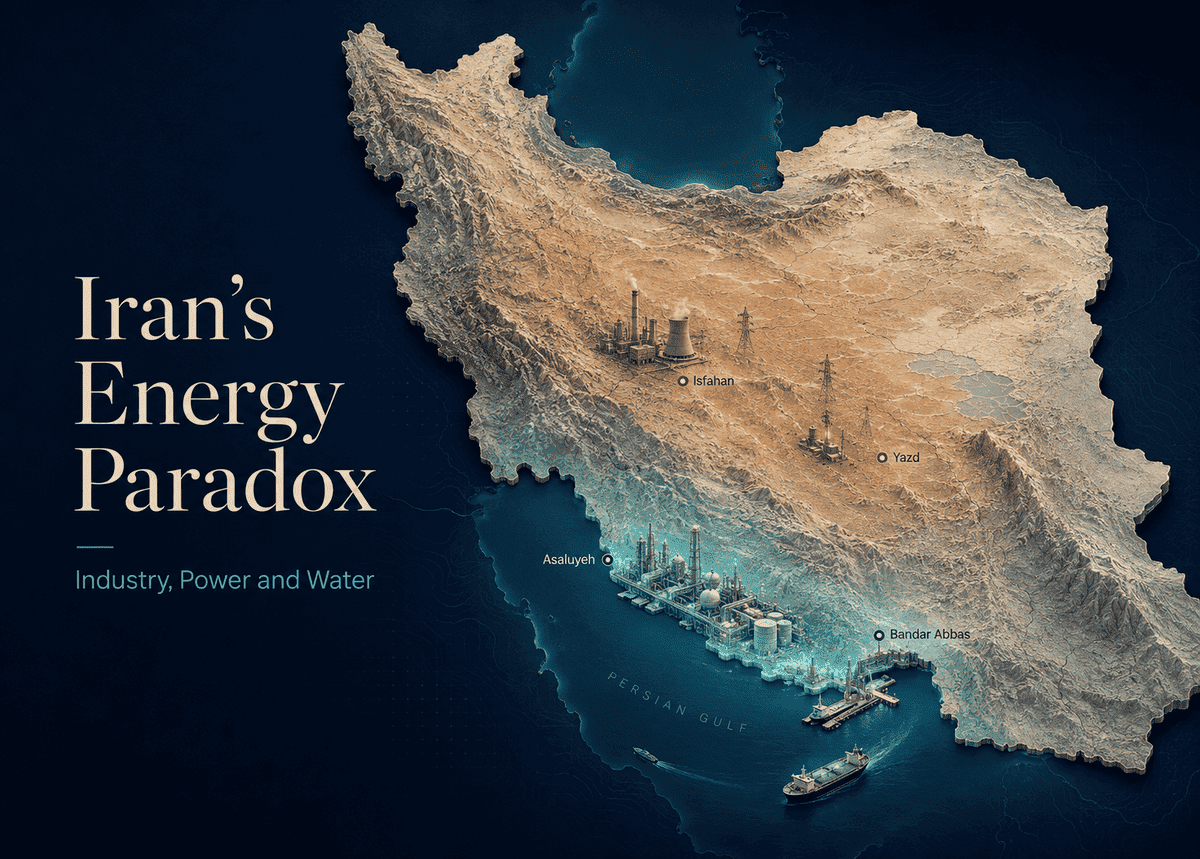
Isfahan is the clearest example. It remains one of Iran’s most important steel and manufacturing centres, but the Zayandeh Rud basin is under severe pressure. Large industrial users have consequently moved toward wastewater reuse, internal recycling and, increasingly, desalinated seawater transported over long distances. Hormuz’s existing research on the Isfahan corridor documents this transition from conventional freshwater toward engineered supply.
In December 2025, an approximately 800-kilometre pipeline carrying desalinated water from southern Iran to industries in Isfahan entered operation. The project is significant not only because of the water it supplies, but because of what it says about industrial geography: Iran is now spending substantial capital to move seawater hundreds of kilometres inland to support industrial assets that were built far from the sea.
For existing industrial clusters, that may be economically justified. Rebuilding an entire steel ecosystem elsewhere would also be expensive.
For a new greenfield plant, however, the calculation is different.
Why transport desalinated water 800 kilometres inland if the plant could, in principle, be located closer to seawater in the first place?
That is one reason the geography of new energy-intensive industry is likely to diverge from the geography of Iran’s legacy industrial base.
The emerging industrial map
There is no single location in Iran that eliminates energy and water risk. Even southern provinces experience electricity or gas restrictions. The difference is relative resilience.
Four types of industrial geography are emerging.
1. The Persian Gulf energy corridor
The strongest natural location for gas- and feedstock-intensive industry remains the southern energy belt, particularly around Asaluyeh and Kangan.
South Pars places enormous gas resources close to the industrial system, while decades of petrochemical development have created pipelines, processing facilities, storage, utility systems and export infrastructure.
This makes the area structurally difficult to replicate inland.
For petrochemicals, gas processing and industries directly integrated with hydrocarbon feedstocks, proximity to the resource base remains a major advantage.
But proximity does not mean immunity. National gas balancing, electricity shortages and infrastructure constraints can still affect coastal operators. New projects therefore need to consider dedicated utilities and power supply rather than assuming the national system will always provide them.
The advantage of the south is increasingly about the possibility of integration: feedstock, utilities, seawater, industrial infrastructure and exports can be designed as one system.
2. Bandar Abbas and the Hormozgan industrial coast
For a broader range of new heavy industry, Hormozgan may have one of Iran’s strongest long-term geographic cases.
The Bandar Abbas area already combines port infrastructure with steel, aluminium, mineral processing and energy facilities. Industrial zones in the region have access to natural gas pipelines, high-voltage infrastructure and desalination, while the province also has strong solar potential. Research on the Persian Gulf Mining and Metal Industries Special Economic Zone shows how energy, water and industrial flows are already interconnected within the cluster.
The strategic advantage becomes clearer when water is included.
A coastal plant can desalinate seawater close to the point of consumption. An inland plant may require desalination plus hundreds of kilometres of pumping infrastructure, adding both capital cost and electricity demand.
Ports provide another advantage. Energy-intensive industries often move large volumes of ore, intermediate products or finished material. Locating closer to maritime infrastructure can reduce the logistics penalty associated with moving those volumes through the interior.
That makes the Bandar Abbas corridor particularly relevant for industries such as metals processing, export-oriented steel, aluminium and selected mineral-processing projects.
3. Khuzestan and Mahshahr
Khuzestan remains strategically important, but for different reasons.
The province combines oil and gas production, refining, petrochemicals, steel, ports and a large installed industrial base. Mahshahr in particular benefits from one of Iran’s deepest petrochemical ecosystems.
Existing infrastructure creates strong brownfield economics. Expanding or upgrading an established complex can make more sense than creating an entirely new production ecosystem elsewhere.
But Khuzestan also demonstrates why the new industrial map cannot be defined by energy alone. Extreme heat, environmental pressure, water stress and electricity constraints all affect operating conditions.
The province is therefore likely to remain highly competitive for industries tied to its existing energy and petrochemical ecosystem, while becoming a more selective choice for unrelated greenfield heavy industry.
4. The central mining and metals belt
The most complicated case is Isfahan, Yazd and Kerman.
These provinces contain enormous sunk industrial value: mines, steel plants, copper operations, engineering capabilities, suppliers, rail connections and skilled labour. Moving all of that industry south would make little economic sense.
They will remain major industrial centres.
But the logic for adding new capacity is changing.
Inland energy-intensive projects increasingly need to justify their location through something stronger than historically cheap electricity or water. Being close to a major ore body may provide that justification. Being integrated into an existing steel or copper complex may provide another.
New projects may also need their own infrastructure: recycled or desalinated water, captive generation, renewable capacity, storage or contractual access to more secure energy supplies.
The shift can already be seen in the behaviour of major industrial companies. Iranian mining and metals groups are investing in their own generation, while research on Mobarakeh Steel increasingly treats hybrid and self-supplied power systems as an industrial operating question rather than a peripheral sustainability measure.
In other words, central Iran is not becoming industrially irrelevant. It is becoming more expensive to justify for the wrong kind of project.
The new model: infrastructure autonomy
The most important change may therefore be less about moving every factory south and more about changing how industrial projects are designed.
The old model assumed access to three large public systems:
grid electricity + pipeline gas + local freshwater
The emerging model is more likely to combine:
grid connection + captive generation + renewables + secured gas + recycled or desalinated water
That changes project economics.
A location offering nominally cheaper electricity but frequent curtailment may be less competitive than a location where the project pays more upfront for dedicated generation but achieves much higher utilisation.
Likewise, water should no longer be treated as a minor utility line in a feasibility study. For some projects it becomes part of the core infrastructure investment.
This means future industrial site selection in Iran should increasingly measure utility resilience, not just utility price.
Where does energy-intensive industry still make sense?
A useful distinction is between three situations.
Coastal greenfield projects have the strongest structural case when they require large amounts of energy, water or export logistics. The Hormozgan coast and established Persian Gulf energy clusters are the most obvious candidates.
Existing inland industrial clusters can remain highly competitive when they benefit from sunk infrastructure, nearby raw materials and the ability to secure independent water and power.
New inland water- and energy-intensive plants without a strong resource or cluster reason face the weakest proposition. They inherit the risks of the national power system while potentially requiring expensive new water infrastructure on top of it.
This does not mean Iran’s entire industrial base will migrate to the coast.
Industrial geography changes slowly. Mines cannot move. Existing steel complexes represent billions of dollars of sunk capital. Supplier ecosystems and skilled labour cannot simply be recreated.
But the marginal investment decision can change much faster.
A new steel line, smelter, chemical complex or mineral-processing plant being planned today does not have to follow the same map that shaped Iranian industrialisation forty years ago.
The real energy paradox
Iran is unlikely to stop being an energy-rich country.
The paradox is that resource abundance by itself no longer guarantees industrial abundance.
What matters increasingly is whether resources can be converted into reliable electricity, process heat and water at the place and time an industrial plant needs them.
That distinction is already influencing industrial strategy.
The commissioning of long-distance desalinated-water infrastructure for central industry, the push for industrial self-generation, recurring power restrictions and the continued expansion of southern energy clusters all point in the same direction.
Iran’s industrial map is not disappearing.
It is being repriced.
And for the next generation of energy-intensive projects, geography may become as important as energy itself.