The Infrastructure Iran Will Need for Economic Reconnection
Iran does not need to be rebuilt from zero. It needs to convert a large but increasingly isolated economic system into one that is reliable, measurable and capable of connecting with the outside world.
An economy does not reconnect when an agreement is signed.
It reconnects when a foreign supplier is willing to accept a payment from an Iranian buyer. When customs can clear a shipment without unpredictable intervention. When an industrial plant can commit to a delivery date because its power, water and imported components are secure. When an airline can insure its aircraft, a bank can verify its counterparty and an investor can understand where its money will go.
Political reopening can happen quickly. Economic reconnection is slower because it depends on systems that cannot be restored by declaration.
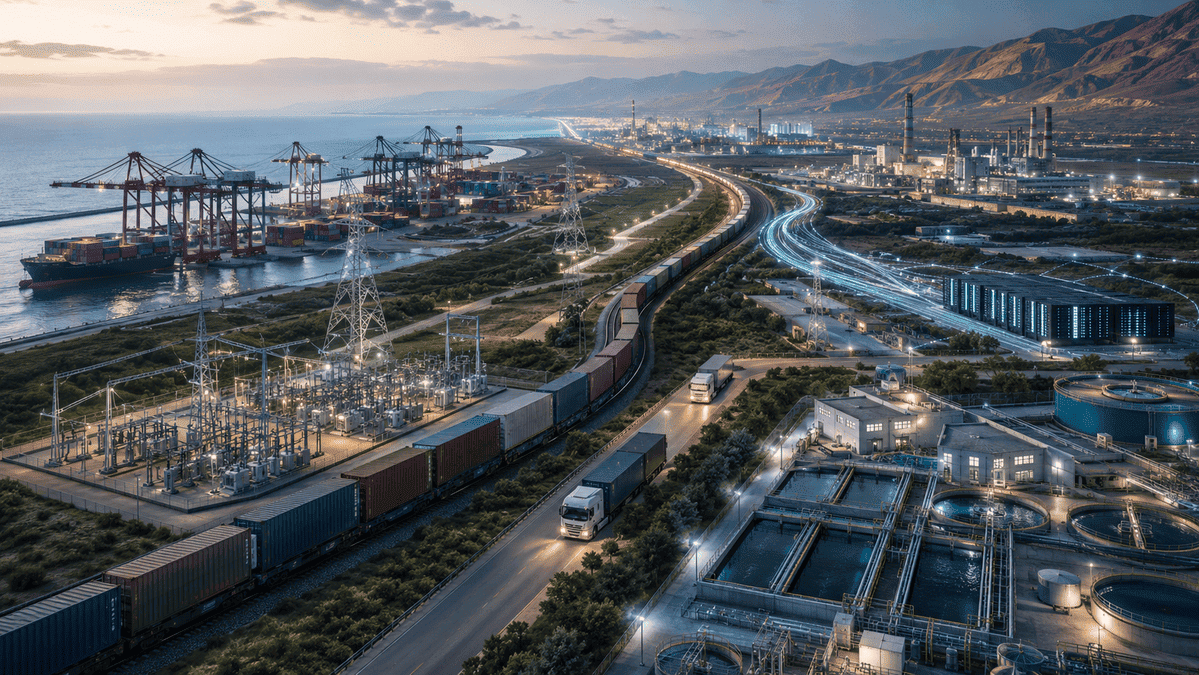
Iran already possesses much of the physical outline of a connected economy: ports on two seas, an extensive road network, rail links to several neighbouring countries, large industrial clusters, nationwide electricity and gas systems, a sizeable domestic banking sector and broad mobile connectivity. The country is not an empty construction site waiting for foreign capital.
The problem is that many of these systems were designed, expanded or adapted under prolonged isolation. They have learned to operate through domestic allocation, subsidies, informal workarounds, restricted technology access and limited exposure to international service standards.
That model can keep activity moving. It cannot support rapid reintegration into global trade and investment.
The World Bank’s latest outlook for Iran identifies damaged infrastructure, persistent water and energy shortages, financial sanctions and difficulty obtaining international transport and insurance services as constraints on non-oil activity and trade. These are not separate problems. They form a connected execution system: weakness in one layer reduces the value of investment in all the others.
Economic reconnection will therefore require more than repairing what has been damaged or finishing long-delayed projects. Iran will need an infrastructure strategy built around reliability, interoperability and commercial trust.
Reopening and reconnection are not the same thing
A reopened economy is legally permitted to transact.
A reconnected economy can complete the transaction.
The difference appears in practical questions:
- Can an overseas bank process and settle the payment?
- Can the buyer document the source and destination of funds?
- Can imported equipment enter through a predictable customs process?
- Can a factory obtain power throughout its production cycle?
- Can an exporter meet international testing and certification requirements?
- Can commercial disputes be resolved without political intervention?
- Can an investor repatriate dividends or exit the investment?
- Can managers travel, communicate and access the digital services required to operate the business?
A country can remove formal barriers while leaving these questions unanswered.
That produces an initial wave of announcements, memoranda and exploratory visits without sustained investment. Companies assess the market, discover that execution remains difficult and reduce their exposure before major capital is committed.
Iran experienced versions of this gap during previous periods of diplomatic opening. The next reconnection, if it occurs, will be judged less by the number of delegations arriving in Tehran than by the number of ordinary commercial transactions completed without exceptional arrangements.
Infrastructure policy must be designed around that standard.
Iran’s task is conversion, not construction alone
The usual discussion about Iranian infrastructure focuses on capacity: more power plants, more railways, more port terminals, more airports and more industrial zones.
Capacity matters, but much of Iran’s future requirement is about converting existing assets into dependable services.
A megawatt of installed capacity has limited value if fuel is unavailable during peak demand. A railway line has limited commercial value without reliable timetables, cargo terminals and functioning border procedures. A port expansion does not shorten delivery times if customs documents, truck dispatch and payment approvals remain disconnected.
The same is true of digital infrastructure. Coverage figures can look strong while businesses still face unstable international connectivity, limited cloud access and difficulty integrating with global platforms.
Iran had 127 active mobile-broadband subscriptions per 100 people in 2024, while ITU data placed internet use at 85.3 percent of the population. LTE or equivalent coverage reached more than 94 percent, but 5G coverage remained limited to around 8 percent. The country has a substantial digital user base; the missing layer is not basic adoption but reliable, competitive and internationally interoperable infrastructure for business.
Economic reconnection should therefore begin by asking what each system can deliver consistently—not what has been physically installed.
1. A power system that can support contracts
Electricity is the first infrastructure test because every other network depends on it.
Iran has broad access to electricity and large generating capacity, yet industrial users face recurring curtailment during periods of high demand or fuel shortage. Factories compensate by reducing shifts, moving production schedules or installing private generation. These adaptations keep plants operating but make delivery dates, costs and capacity difficult to guarantee.
That becomes a larger problem after reconnection.
New industrial projects, data centres, electric transport, cold chains, hotels, warehouses and modern retail facilities would add demand before major new capacity could be completed. Existing plants seeking to increase utilisation would create an additional load. A system already managing seasonal shortages could face a sudden increase in commercially sensitive consumption.
Iran’s electricity mix also concentrates risk. Natural gas accounts for approximately 85 percent of electricity generation, according to the US Energy Information Administration. When winter heating demand competes with power stations for gas, electricity generation becomes vulnerable even when installed capacity appears adequate.
The required response is not simply to build more gas-fired plants.
Iran will need:
A stronger transmission network
Generation must be moved from where it is available to where industrial demand is growing. Transmission bottlenecks can create local scarcity even when national capacity is technically sufficient.
Modern distribution and metering
World Bank data placed Iranian transmission and distribution losses at approximately 10 percent of output in 2023. Reducing technical losses, improving metering and modernising local networks can release usable electricity faster than some large generation projects.
Better coordination between gas and electricity systems
Fuel allocation, storage, pipeline maintenance and power dispatch should be planned as one system. Iran’s current energy structure often treats them as adjacent sectors even though failure in one quickly becomes failure in the other.
Industrial power contracts
Large users need bankable supply agreements with defined curtailment rules, pricing formulas and compensation mechanisms. A foreign manufacturer cannot commit to export orders if electricity is allocated through discretionary restrictions.
Distributed generation and storage
Solar power, industrial cogeneration, battery storage and microgrids should reduce local pressure rather than function as symbolic additions to the national energy mix.
Tariffs that finance maintenance
Extremely low administered prices encourage consumption and weaken the financial position of utilities. Reform does not require exposing households to abrupt market prices. It requires separating social support from the commercial price signal and allowing industrial users to pay for higher reliability.
The objective is not electricity at the lowest nominal price. It is electricity that allows a company to make and keep a commitment.
2. Water infrastructure that limits economic displacement
Water is often treated as an agricultural or environmental issue. For Iran, it is an industrial-location issue.
Economic reconnection would increase demand from manufacturing, mining, food processing, tourism, urban construction and logistics. Directing that growth into already stressed basins would intensify shortages and create conflict between cities, farms and industry.
The economic exposure is substantial. A World Bank assessment cited modelling in which a 20 percent reduction in water supply could lower Iran’s GDP by as much as 7.2 percent relative to 2016 levels, with industrial activity among the areas most heavily affected.
Iran cannot solve this problem by transferring more water across longer distances.
It needs a different water infrastructure model:
Wastewater as an industrial resource
Large industrial users should increasingly rely on treated urban and industrial wastewater rather than freshwater allocations. This requires collection networks, modern treatment plants, quality monitoring and long-term purchase agreements.
Reduction of losses
Urban and agricultural networks often lose water before it reaches the user. Pipe rehabilitation, pressure management, measurement and maintenance can produce more reliable supply without finding a new source.
Metered and enforceable abstraction
Groundwater cannot be managed through permits that are weakly measured or enforced. Digital metering and transparent basin-level data are basic economic infrastructure in a water-scarce country.
Coastal desalination with disciplined economics
Desalination can support coastal industry and selected urban systems. Moving desalinated water deep into the interior for low-value uses is far more difficult to justify. The location of future industry should follow water economics rather than the expectation that water will be transported to every project.
Industrial relocation incentives
Some production should expand closer to the coast or to regions with recoverable water resources. Reconnection offers an opportunity to alter Iran’s industrial geography rather than reproducing existing concentration.
The relevant question for an investor is no longer whether a facility has a water allocation. It is whether that allocation can survive the next decade of competing demand.
3. A multi-gateway trade network
Iran’s geography should provide redundancy.
The country connects the Persian Gulf and Gulf of Oman to the Caspian Sea, Central Asia, the Caucasus, Turkey, Iraq, Afghanistan and Pakistan. In principle, this creates several trade directions. In practice, cargo movement remains concentrated around a limited number of major gateways and inland corridors.
Economic reconnection would increase both trade volume and route diversity. Iranian manufacturers would import more machinery and specialised inputs. Exporters would seek more predictable links to regional and overseas customers. Foreign companies would require routes that can be priced, insured and scheduled in advance.
The answer is not to choose one national hub. It is to create a system in which several gateways perform distinct roles.
Iran will need:
Commercially differentiated ports
Bandar Abbas, Chabahar, Imam Khomeini, Bushehr, the Caspian ports and smaller regional facilities should not be developed as replicas. Each needs a defined cargo base, hinterland, shipping network and investment thesis.
Inland dry ports and freight terminals
Containers should move rapidly out of coastal terminals and into inland customs and distribution centres. This reduces congestion, brings clearance closer to industrial users and allows rail to carry a larger share of long-distance cargo.
Reliable freight rail
The value of rail comes from frequency, loading facilities, border coordination and wagon availability—not kilometres of track. Investment should prioritise complete cargo services along commercially active corridors.
Road maintenance before road expansion
Heavy freight depends on bridge strength, pavement quality, service areas, safety enforcement and predictable travel times. Maintaining strategic corridors can generate a higher return than adding new roads with weak utilisation.
Modern border crossings
Iran’s land borders will become more important even under normal maritime conditions. Customs, parking, inspection, warehousing and electronic data exchange should operate as one border system rather than a collection of separate agencies.
Air cargo capacity
Pharmaceuticals, electronics, spare parts, perishables and high-value exports require reliable air freight. Cargo terminals, cold storage, screening, ground handling and customs clearance deserve more attention than prestige passenger-terminal projects.
The purpose of redundancy is not to maintain identical spare infrastructure everywhere. It is to ensure that the failure or congestion of one route does not interrupt the national economy.
4. Customs infrastructure that makes time measurable
Customs reform may create more immediate value than several large transport projects.
A new port terminal can add physical capacity. A functioning digital trade system can reduce the time and uncertainty attached to every shipment moving through the existing capacity.
Iranian trade currently involves multiple authorities, permits, classifications, inspections, payment procedures and documentation layers. Businesses often rely on experienced brokers because the practical path through the system is not fully visible from the written rules.
That dependence becomes expensive when trade volumes increase.
Iran will need a genuine national trade single window through which importers and exporters submit data once, receive coordinated decisions and track the status of a shipment. The WTO Trade Facilitation Agreement describes the same principle: trade documentation should enter through one point and should not be repeatedly requested by separate agencies except under limited circumstances.
A workable system would connect:
- Customs declarations
- Port and terminal data
- Shipping manifests
- Foreign-exchange approvals
- Standards and laboratory certificates
- Health and agricultural permits
- Insurance documents
- Tax records
- Transit guarantees
- Truck and railway dispatch
Technology alone will not produce this outcome. Agencies must agree on authority, data ownership, service deadlines and appeal procedures.
The reform should also include pre-arrival processing, risk-based inspection, post-clearance audit and authorised-operator programmes. Low-risk, well-documented cargo should move quickly. Enforcement resources should concentrate on higher-risk transactions. These are central elements of modern trade facilitation, not concessions to importers.
The most important performance indicator would be simple: the time between cargo arrival and commercial release, reported by port, border, commodity and inspection type.
Once release time becomes measurable, delay becomes manageable.
5. Financial infrastructure that makes Iran bankable
No infrastructure layer matters more to reconnection than payments.
A foreign company can tolerate a longer road journey or an imperfect warehouse. It cannot operate at scale without a lawful, traceable and repeatable way to receive and send money.
Iranian businesses have built alternative payment structures through exchange houses, intermediaries, netting arrangements, offshore companies and regional trading partners. These methods preserve trade under isolation. They are too expensive and opaque to support a broad inflow of institutional investment.
Normal cross-border commerce still relies heavily on correspondent banking. Correspondent banks provide the accounts, clearing and settlement services through which banks in different jurisdictions complete payments and finance trade.
Restoring this access requires infrastructure inside the financial system:
Credible AML and counter-terrorist-financing controls
As of June 2026, FATF continued to list Iran among high-risk jurisdictions subject to a call for action. This is not a symbolic classification. It directly affects the risk calculations of banks, insurers, payment companies and compliance departments.
Reliable customer and beneficial-ownership data
Banks must be able to identify the individuals and entities controlling a transaction. Company registries, shareholder records, tax identities and sanctions screening need to be searchable and consistent.
Audited and comparable financial statements
Foreign lenders and investors require accounts that can be reconciled with recognised standards. Weak disclosure raises the cost of every transaction and excludes many institutions completely.
Modern payment messaging
Iranian banks need systems capable of producing structured, complete and machine-readable payment information. Reconnection cannot depend on manually explaining each transaction to an overseas compliance team.
Trade-finance capability
Letters of credit, guarantees, export finance, equipment leasing and project finance need to return as ordinary banking products rather than exceptional government arrangements.
A workable foreign-exchange market
Multiple rates and discretionary access make contracts difficult to price. Investors need transparent conversion rules, predictable settlement and a credible path for dividend and capital repatriation.
Sanctions relief without financial integrity and payment infrastructure would create permission without bankability.
6. Digital infrastructure connected to the global economy
Iran has developed a large domestic digital ecosystem partly because international platforms and services have been restricted or unreliable.
That ecosystem is an asset. Domestic payment networks, online marketplaces, software companies, cloud providers and telecommunications operators have achieved meaningful scale. Reconnection should not replace them with foreign services. It should make them interoperable.
The required infrastructure includes:
Redundant international connectivity
Iran needs several geographically separate international routes, sufficient capacity and transparent service restoration. International connectivity should not depend excessively on a limited number of physical or administrative gateways.
Competitive fixed broadband
Mobile access is widespread, but advanced businesses, factories, research centres and data-intensive services require stable fibre connectivity with predictable latency and service levels.
Data centres with reliable power
Cloud and AI infrastructure cannot scale on unstable electricity. Data-centre policy must integrate power contracts, cooling, cybersecurity, international bandwidth and disaster recovery.
Trusted digital identity and signatures
Businesses should be able to sign contracts, submit government documents, verify representatives and open accounts through interoperable digital credentials.
Cross-border data standards
Customs documents, invoices, certificates, bank messages and logistics records should use internationally recognised formats. Paperless trade depends as much on common standards as on internet access.
Cybersecurity and operational continuity
Reconnection expands the attack surface of banks, utilities, ports and companies. Cybersecurity must be built into infrastructure procurement rather than added after systems are connected.
Predictable access to international business services
Cloud tools, software updates, security certificates, app stores, source-code platforms and technical databases are now part of basic commercial infrastructure. Businesses cannot remain internationally competitive if access to them is intermittent or politically uncertain.
The objective is not an unrestricted digital market with no national safeguards. It is a digital environment in which legitimate commercial activity can rely on continuity.
7. Industrial infrastructure built around execution
Iran has numerous industrial estates, special economic zones and free zones. Their quality varies widely.
Some provide access to ports, feedstock, utilities and established suppliers. Others offer land and tax incentives without the services required to operate a competitive business.
Economic reconnection could trigger another wave of zone development. Repeating the old model would scatter investment across underutilised locations and create new obligations for utilities and transport.
Future industrial infrastructure should be concentrated around viable clusters and provide:
- Prepared and legally clear land
- Reliable electricity, gas and water
- Wastewater treatment
- Fibre connectivity
- Internal roads and freight access
- Bonded warehousing
- Customs services
- Testing and certification laboratories
- Fire and emergency services
- Maintenance and repair providers
- Worker transport and housing
- Transparent environmental requirements
Foreign investors rarely judge a site by the nominal price of land. They calculate the time between choosing the site and beginning commercial production.
A properly serviced industrial zone can reduce that period by years.
Iran also needs shared infrastructure for domestic suppliers. Many local companies can manufacture components or provide services but lack international certification, testing equipment, tooling, quality-control systems or access to industrial finance.
Supplier-development centres, common laboratories and specialised manufacturing services would allow local firms to enter the supply chains of returning international companies. Without that layer, reconnection would increase imports without producing enough domestic upgrading.
8. Aviation and business mobility
A connected economy depends on the movement of people as well as goods.
Executives, technicians, auditors, insurers, investors and project managers need direct and dependable access. Business activity weakens when every visit requires indirect routing, uncertain schedules or limited insurance coverage.
Iran’s aviation infrastructure therefore needs more than additional terminal space.
The priorities are:
- Renewal of the commercial aircraft fleet
- Access to certified spare parts and maintenance
- Internationally recognised safety oversight
- Modern air-navigation systems
- Reliable aviation insurance
- Competitive ground handling
- Cargo and cold-chain facilities
- Direct regional and long-haul routes
- Predictable visa and entry procedures for business travellers
Iran’s own 2025 submission to ICAO identified hub designation, fleet composition and route expansion among the strategic issues in long-term airport-network planning. These questions will become more urgent under economic reconnection.
Opening routes will not by itself restore connectivity. Airlines must be able to operate them safely, insure the aircraft, maintain the fleet and generate commercially sustainable traffic.
9. Standards, laboratories and certification
Infrastructure is often imagined as concrete and steel. For exporters, a recognised laboratory can be as important as a railway.
Iranian companies seeking access to global markets must demonstrate that products meet technical, sanitary, environmental and safety standards. Buyers need test results they can trust. Regulators need traceable production and inspection records.
Where domestic certificates are not accepted, companies repeat tests abroad, delay shipment or lose access to the market entirely.
Iran will need:
- Accredited testing laboratories
- Internationally recognised calibration services
- Product traceability systems
- Certification bodies insulated from commercial pressure
- Food and pharmaceutical quality infrastructure
- Environmental monitoring
- Mutual-recognition arrangements with trading partners
- Training for firms entering regulated markets
This layer is particularly important for pharmaceuticals, food, automotive components, construction materials, petrochemicals and electrical equipment.
A country cannot export complexity without exporting trust.
10. The institutional infrastructure behind every project
Physical projects fail when the institutional layer is weak.
Iran could identify hundreds of worthwhile power, water, logistics and digital investments after reconnection. The limiting factor would quickly become the ability to prepare, contract, finance and supervise them.
Investors will need clarity over:
- Land ownership
- Tariff adjustment
- Foreign-exchange exposure
- Procurement
- Government guarantees
- Environmental permits
- Dispute resolution
- Change in law
- Revenue collection
- Expropriation protection
- Dividend repatriation
- Termination compensation
A project cannot be financed merely because it is socially useful. It needs a defined customer, a credible revenue stream, allocated risks and enforceable contracts.
Iran should create a professional project-preparation facility capable of turning broad infrastructure priorities into financeable transactions. Its work would include feasibility studies, demand forecasts, environmental assessments, legal structuring, tariff modelling and competitive tender preparation.
This institution would be less visible than a new railway or airport. It could determine whether either gets built properly.
Infrastructure finance must match the revenue
Iran’s infrastructure requirement will exceed the capacity of the state budget.
Public finance will remain necessary for basic networks, social services and projects without direct commercial returns. It should not be the default source for every power plant, terminal, data centre or industrial facility.
Different assets require different structures:
Regulated utilities
Electricity, water and gas networks need tariffs capable of financing operation, maintenance and investment, combined with targeted support for vulnerable users.
User-funded infrastructure
Ports, freight terminals, warehouses, data centres and some transport facilities can generate revenue directly from commercial users.
Public-private partnerships
PPPs can work where revenue, risk and government obligations are clearly defined. They should not be used to hide public borrowing or transfer unmanageable political risk to private investors.
Strategic investment
Industrial companies may finance captive power, water treatment, terminals or logistics infrastructure when these assets directly support their operations.
Development and export finance
Where political eligibility permits, multilateral institutions and export-credit agencies can provide longer maturities, guarantees and technical standards that commercial lenders cannot initially offer.
The currency of the revenue matters. A project financed in dollars or euros but earning only regulated rial revenue carries a structural mismatch. No contractual sophistication can eliminate that risk without a credible conversion and adjustment mechanism.
Bankable infrastructure begins with bankable cash flow.
Reconnection requires sequencing
Iran will not be able to upgrade every system at once. Attempting to launch a large national reconstruction programme immediately would create inflation, procurement bottlenecks and poorly prepared projects.
A more effective sequence would have four stages.
Stage one: make the system visible
The first requirement is reliable operational data.
Authorities should publish service metrics for electricity interruptions, water availability, customs release time, border queues, train reliability, port dwell time, internet outages and project performance.
At the same time, Iran should repair critical infrastructure, clear maintenance backlogs and identify the bottlenecks capable of stopping trade or industrial production.
This stage is less visually impressive than launching new megaprojects. It creates the information needed to choose them correctly.
Stage two: restore transactional infrastructure
The next priorities should be banking compliance, payment channels, customs digitisation, trade documentation, standards accreditation, business connectivity and predictable utility service for critical industrial users.
These reforms allow existing capacity to be used more productively.
They also create early evidence that reconnection is operational rather than political.
Stage three: expand constrained corridors and utilities
Once demand becomes measurable, Iran can expand transmission lines, water-reuse systems, freight terminals, border facilities, industrial zones and digital backbone capacity around clearly identified economic corridors.
Investment should follow actual cargo, production and population—not provincial competition for headline projects.
Stage four: build for a different economic geography
Longer-term investment can then support new industrial clusters, coastal development, renewable-energy zones, advanced logistics networks, data-centre corridors and deeper regional integration.
By this stage, the objective should no longer be to restore the pre-isolation economy. It should be to build a more productive one.
What Iran should avoid
A reconnection programme could easily reproduce the weaknesses it is intended to solve.
Megaprojects before maintenance
Large projects attract political attention. Maintenance produces fewer ceremonies but often a faster return.
Capacity without service reform
Building more infrastructure while preserving weak tariffs, fragmented authority and discretionary allocation will produce larger systems with the same reliability problems.
Provincial duplication
Every region does not need an international airport, logistics hub, petrochemical zone and technology park. Infrastructure should follow economic function.
Technology without institutional change
A single-window interface does not help if agencies continue requesting the same documents separately. A smart meter does not improve service if billing and enforcement remain unchanged.
Foreign capital without local capability
Imported contractors can build assets. Iran still needs domestic operators, engineers, auditors, laboratories and suppliers able to maintain them.
Reconstruction without climate and resource discipline
Rebuilding water-intensive or energy-inefficient production in unsuitable locations would lock in the next crisis.
Subsidies that hide economic reality
Cheap utility prices can make an investment appear competitive while shifting the cost to the grid, public budget or future users.
Economic reconnection should reveal viable activity, not conceal unviable activity behind a new flow of capital.
How progress should be measured
The number of projects announced is a poor measure of reconnection.
Useful indicators would include:
- Hours of uninterrupted industrial electricity supply
- Share of industrial water obtained from reuse
- Average customs release time
- Percentage of declarations processed before arrival
- Freight-train reliability
- Port and border cargo dwell time
- Cost and time of cross-border payments
- Number of active correspondent banking relationships
- International fixed-broadband capacity and uptime
- Time required to establish an industrial operation
- Share of exports covered by recognised certification
- Volume of private capital committed after financial close
- Percentage of infrastructure spending allocated to maintenance
- Number of contracts completed without exceptional government intervention
The central measure is repeatability.
A connected economy is not one that completes a high-profile transaction. It is one that can complete the next thousand transactions through the same system.
The infrastructure of trust
Iran’s greatest infrastructure requirement is not a single railway, power plant or port.
It is the connection between them.
Electricity must support the factory. The factory must obtain water. The supplier must receive payment. Customs must recognise the documents. The laboratory must certify the product. The logistics network must deliver it. The buyer must trust the contract.
A weakness anywhere in that sequence reduces the value of every asset before it.
This is why economic reconnection cannot be organised as a list of construction projects. It must be treated as an operating architecture.
Iran has the geography, population, industrial experience and domestic market to reconnect at meaningful scale. It also carries the accumulated friction of prolonged isolation: deferred maintenance, financial opacity, fragmented data, resource stress and systems built around workarounds.
Removing external barriers would create an opening. It would not complete the transition.
The countries and companies that prepare during the uncertain period will move first when conditions change. Those that wait for formal reopening will discover that permits, financing, suppliers and infrastructure capacity have already become scarce.
Hormuz assessment
Iran’s reconnection challenge is frequently described as a shortage of capital.
Capital is only one part of it.
The more immediate shortage is a supply of financeable projects operating inside reliable systems. Foreign investors will not compensate indefinitely for unstable power, unclear payment routes, uncertain water, fragmented customs and contracts that require exceptional intervention.
The first phase of reconnection should therefore focus on the infrastructure that reduces uncertainty across the entire economy: dependable utilities, bankable payments, measurable border processes, trusted data and internationally recognised standards.
Large capacity projects should follow.
Iran does not need to copy the infrastructure model of a Gulf economy, a European industrial state or an East Asian exporter. Its scale, resource base, geography and domestic market require a different architecture.
But the commercial standard is universal.
Infrastructure must allow an ordinary transaction to be completed at a known cost, within a credible timetable and without relying on a personal workaround.
That is the point at which economic reopening becomes economic reconnection.