The Strait of Hormuz: Where Geography Becomes a Global Price
The modern economy is built around dispersion. Companies use several suppliers. Governments diversify reserves. Traders move commodities across continents. Investors spread risk among markets.
Geography sometimes refuses to cooperate.
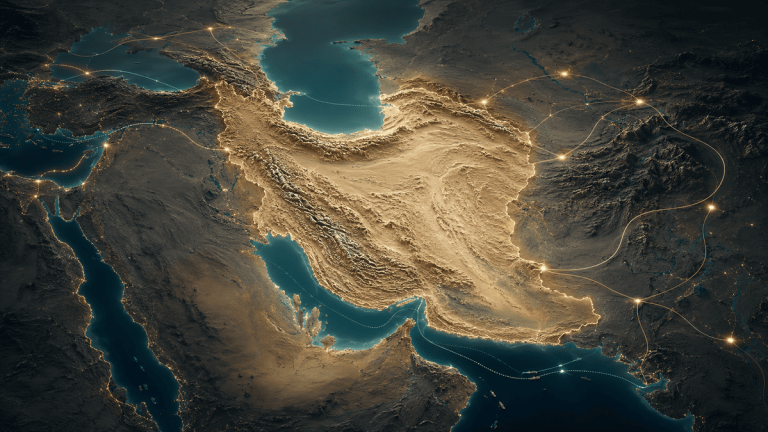
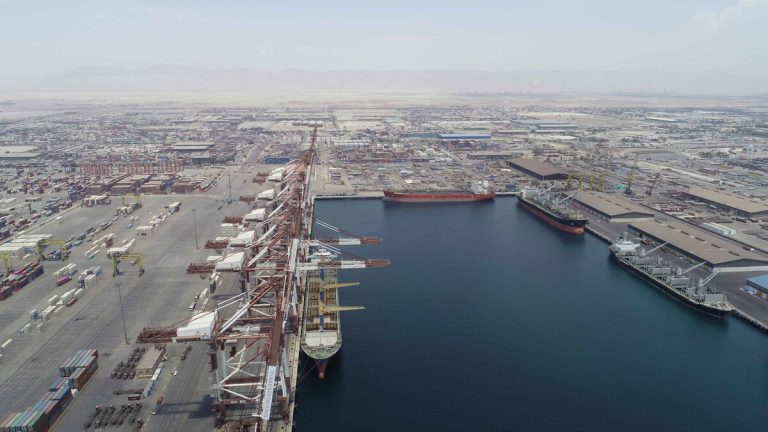
The Strait of Hormuz connects the Persian Gulf to the Gulf of Oman and the Arabian Sea. In 2024 and 2025, roughly 20 million barrels per day of crude oil, condensates and petroleum products passed through it. That was about one quarter of global seaborne oil trade. Significant volumes of LNG, LPG, petrochemicals and fertilizers travelled through the same narrow system of shipping lanes.
Most of this energy was moving toward Asia. China, India, Japan, South Korea and other Asian economies carry the largest direct exposure. The political crisis may originate in the Middle East, but the industrial consequences appear in Asian refineries, power systems, factories and trade balances.
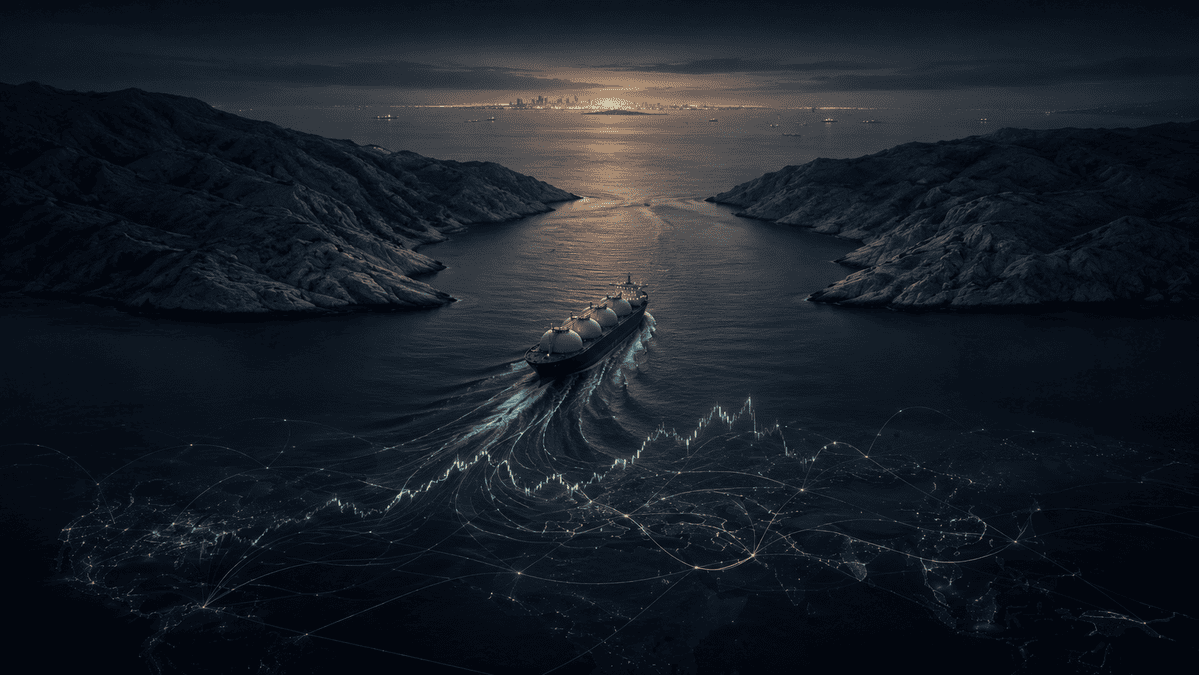
The physical Strait is around 21 miles wide at its narrowest point. Commercial traffic, however, is organized into much narrower inbound and outbound lanes. The vulnerability is not simply that two shores stand close to one another. It is that a large share of strategically important trade has to pass through an organized corridor with limited alternatives.
Saudi Arabia and the United Arab Emirates possess pipelines that can redirect some crude exports toward the Red Sea or the Gulf of Oman. These routes matter, but they cannot replace the full volume normally moving through Hormuz. They also do little for Qatar’s LNG exports, which cannot simply be transferred into an oil pipeline and sent to another coast.
Hormuz is therefore not absolutely irreplaceable in every category. It is more difficult than that. It can be bypassed at the margin, but not at the scale, speed and cost required to preserve normal market conditions.
That is enough to give the Strait power.
In a Chokepoint, Economic Power Works Backwards
In open water, a larger navy generally enjoys more space, greater range and superior surveillance. Inside a constrained maritime corridor, those advantages do not disappear, but they become less decisive.
The same inversion appears economically.
A powerful state may have the resources to protect a number of vessels, punish an attacker or destroy visible military assets. What it cannot easily do is guarantee every commercial voyage against every low-cost threat. The stronger party must secure the system. The weaker party needs only to introduce doubt.
A single incident does not have to stop twenty million barrels a day directly. It only has to make the next captain, insurer or owner uncertain.
This is why the decisive actor in Hormuz is often imagined incorrectly. It is not always the admiral on the bridge or the commander on the coast. It may be the underwriter in London, the compliance officer in Singapore or the operations director in Athens.
Their decisions can produce the same commercial outcome as a physical obstruction.
If insurance becomes unavailable, ships stop. If premiums become extreme, some cargoes no longer make economic sense. If schedules cannot be trusted, refiners increase inventories and buyers search for substitutes. If the disruption lasts, Gulf producers run out of storage and reduce output even while international prices are rising.
A Strait can therefore remain technically open and economically impaired.
The weapon is not closure alone. It is variance: the widening range of what might happen next.
Hormuz Was Important Before Oil
Oil did not create the strategic value of Hormuz. It changed the commodity moving through it.
In the early sixteenth century, Portuguese maritime expansion reached the Gulf as part of a wider attempt to control the trading network between Europe and Asia. Forts, fleets and coastal bases allowed Portugal to supervise routes, collect revenue and position itself between producers and markets.
Hormuz was valuable because commerce was already passing through it.
The Portuguese could occupy the island and fortify the route, but their presence was never independent of the wider balance of maritime power. A century later, Shah Abbas did not remove them through Iranian land power alone. Persian forces worked with the English East India Company, which had its own commercial interest in weakening Portuguese control. In 1622, Qeshm and Hormuz were retaken.
The event is usually remembered as a military recovery of territory. Economically, it reveals something broader.
Control of a chokepoint depends on the network surrounding it. The fortress matters, but so do ships, finance, alliances, trade companies and the direction in which global commerce is moving. Portugal lost Hormuz while England was beginning to replace it in the maritime order.
The Strait was not truly possessed by the side with the strongest walls. It was shaped by the side best aligned with the emerging commercial system.
This remains true today. Coastal geography gives Iran unusual leverage. But geography alone cannot determine how global banks, insurers, producers and consumers respond to that leverage.
Dardanelles: Winning the Passage Was Not the Same as Owning the Future
The Dardanelles campaign of 1915 offers a different lesson.
Britain entered the campaign with the most powerful navy in the world. The Ottoman Empire was widely regarded as weak and declining. On paper, the imbalance should have produced an uncomplicated result.
Instead, mines, coastal artillery, terrain and poor execution turned the narrow waterway into a trap. British maritime superiority, formidable in open seas, could not easily be converted into secure passage through a defended Strait. The campaign failed, and the Ottomans retained control.
Yet that victory did not rescue the Ottoman Empire. It bought time. The Empire still collapsed after the war.
The durable settlement came later, not through another decisive naval victory but through the Montreux Convention of 1936. Türkiye retained authority over the Straits, while merchant passage and the movement of warships were placed inside a framework that other powers could understand and, however imperfectly, tolerate.
Türkiye did not obtain unlimited discretion. It obtained recognized authority under rules.
That distinction is central to Hormuz.
A country may be capable of denying passage during conflict. This does not mean it can turn denial into a stable source of peacetime power. Durable control requires a regime that preserves enough access, predictability and restraint for other dependent states to accept the arrangement.
A Strait is not a hill that remains won after the battle ends. Its value has to be reproduced every day by allowing traffic to move.
Suez: When Military Success Could Not Survive the Balance Sheet
The Suez Crisis of 1956 showed the reverse problem.
Britain and France had the military capacity to attack Egypt and, with Israel, advance toward the Canal. Their difficulty was not simply battlefield performance. It was converting military action into a political and economic outcome that the wider system would permit.
Britain was no longer the financially independent imperial power it had once been. It depended on American support, access to dollars, confidence in sterling and cooperation from allies. The United States opposed the operation. Financial pressure intensified. Britain and France withdrew.
The lesson was not that the Canal had somehow become militarily untouchable. It was that control over a chokepoint could not be separated from the financial order surrounding it.
Britain could send forces toward Suez. It could not ignore Washington, the currency market, oil supply and the political response of the post-war world.
For Egypt, nationalization became a political victory and an enduring part of Nasser’s legacy. But Egypt’s long-term benefit did not come from repeatedly shutting the Canal or treating every vessel as a new bargaining opportunity. It came from operating a route on which global commerce could continue to depend.
Suez became most valuable when the passage was administered as infrastructure rather than wielded as a permanent threat.
The same logic applies to Hormuz. A chokepoint generates revenue, relevance and influence because others plan around its availability. The moment they can no longer do so, control begins to lose economic value even if it appears to gain political value.
The Tanker War: A Warning About the Secondary Effects of Leverage
The Tanker War of the 1980s brought this logic directly into the Persian Gulf.
As the Iran–Iraq War dragged on, both sides sought to weaken the other through oil exports, ports and commercial shipping. Iraq attacked Iranian oil facilities and vessels. Iran widened the risk facing Gulf shipping and the Arab states supporting Iraq.
Iran did not need to defeat every tanker or establish conventional naval supremacy. Mines, small craft and the possibility of attack were enough to make passage more costly and uncertain.
Kuwait sought protection from both superpowers. The United States reflagged Kuwaiti tankers and began escorting them under Operation Earnest Will. What started as a response to commercial insecurity became the largest American naval convoy operation since the Second World War.
This produced a result that Iran had not wanted: a deeper and more durable American military presence in the Gulf.
That is one of the most important economic and strategic lessons of the episode. Chokepoint leverage rarely produces only the intended pressure. It also changes the investment of everyone else.
States build bases. Navies establish permanent commands. Producers finance pipelines. Importers expand reserves. Insurers redesign their models. Customers diversify suppliers.
A threat aimed at increasing the value of a geographic advantage may cause other actors to spend heavily on reducing their dependence on it.
The first use of leverage can demonstrate power. Repeated use can finance the architecture that contains it.
The Real Closure Happens in the Market
Public discussion often treats Hormuz as a binary question: open or closed.
For the economy, several intermediate conditions matter more.
Traffic may continue, but only under escort. Some flags may be considered more exposed than others. Large shipowners may suspend operations while smaller operators accept the risk at higher prices. Oil cargoes may move while LNG carriers remain more cautious. A ceasefire may reopen the route formally, yet insurers may continue charging extraordinary premiums.
The Strait is fully open only when four conditions exist together:
Ships can pass.
Their cargoes can be insured.
The transactions can be financed.
The arrival date can be treated as commercially credible.
Remove one of these conditions and effective capacity begins to fall.
This also explains why selective control would be difficult to manage as a stable economic system. A vessel may be registered in one country, owned through a company in another, managed from a third jurisdiction, insured in London, chartered by a multinational trader and carrying oil that will be resold before arrival.
There is no clean line between “friendly” and “hostile” commerce inside an integrated commodity market.
Blocking a cargo notionally bound for one country can raise the benchmark price paid by another. Allowing selected vessels through does not eliminate the risk premium for everyone else. Discrimination introduces uncertainty into the entire system because traders cannot be certain how ownership, destination or political affiliation will be interpreted on the next voyage.
A selective toll gate sounds more precise than a closure. In practice, it could be nearly as corrosive to confidence.
What the 2026 Disruption Revealed
The 2026 crisis turned these mechanisms from theory into observable market behaviour.
At the height of the disruption, ship transits through Hormuz fell by roughly 95 percent. Freight rates, marine fuel costs and war-risk insurance premiums rose sharply. Energy prices reacted first, but the shock quickly spread into fertilizer, trade finance, currencies and borrowing costs.
This sequence matters.
The immediate image was an energy crisis. The deeper effect was a financing crisis for economies with limited room to absorb another external shock.
Oil-importing states had to spend more foreign currency for the same volume of energy. Their currencies weakened. Inflation expectations rose. Governments faced pressure to increase subsidies precisely when higher borrowing costs were reducing fiscal space.
The poorest states were not necessarily the ones most dependent on Gulf oil in absolute terms. They were the ones least able to pay a sudden premium for fuel, fertilizer, food and external finance at the same time.
The Strait imposes its costs unevenly.
Large powers may draw strategic reserves, subsidize consumers or outbid rivals for alternative cargoes. Smaller economies absorb the adjustment through weaker currencies, lower consumption and more expensive debt.
This is why Hormuz cannot be reduced to a contest between Iran and the United States, or between Iran and Gulf monarchies. Once commercial passage becomes uncertain, countries far from the conflict enter the equation through their balance sheets.
A chokepoint turns regional confrontation into distributed global loss.
Oil Is Only the First Transmission Channel
Oil receives most of the attention because its price moves visibly and immediately. Hormuz carries a wider industrial system.
Qatar’s LNG exports pass through the Strait with no meaningful pipeline alternative. A prolonged disruption would force gas-importing countries to compete for cargoes from the United States, Australia and Africa. Electricity prices would rise. Some utilities would burn more coal or oil. Energy-intensive industries would lose competitiveness.
The Gulf is also a major centre for ammonia, urea and other fertilizers. Disruption affects this market twice: natural gas becomes more expensive, and the resulting fertilizer becomes harder to ship.
The final effect may not appear until the next planting or harvest season. Farmers use less fertilizer. Crop yields weaken. Food prices rise after the naval crisis has left the front page.
Petrochemicals, LPG, aluminum and industrial inputs create further channels. Packaging, textiles, plastics, manufacturing and construction all absorb part of the increase.
The economic footprint of Hormuz therefore expands over time. The first week belongs to oil traders. The following months belong to utilities, factories, farmers, finance ministries and households.
The Gulf Producers Are Not Simple Winners
Higher oil prices are often treated as an automatic benefit for Gulf exporters.
That assumption fails when the export route itself is impaired.
A producer benefits from a higher price only if it can deliver the commodity. If tankers cannot load or depart, inventories begin filling. Once storage approaches its limit, production has to be reduced. Export revenue falls even while international prices remain elevated.
The same contradiction applies to Iran.
Iran’s position gives it a powerful capacity to affect passage. Yet Iran’s own oil, petrochemical trade, imports, coastal industries and fiscal position are exposed to prolonged insecurity in the same waterway.
The Strait creates mutual vulnerability, not unilateral power.
Iran can impose costs on adversaries, Gulf neighbours and distant importers. It cannot indefinitely separate those costs from its own economy.
This does not make the leverage unreal. It makes it difficult to monetize.
The challenge is not proving that Iran can make Hormuz expensive. Geography has already established that. The challenge is converting influence over the Strait into a lasting economic advantage without degrading the route, attracting permanent countermeasures or damaging Iran’s own access to the world.
The Most Dangerous Misreading of Hormuz
The tempting conclusion is that because Hormuz cannot be replaced quickly, its leverage is permanent.
It is not.
No alternative can reproduce the Strait’s current capacity at comparable cost. Saudi and Emirati pipelines can bypass only part of the oil flow. LNG is far harder to redirect. New terminals, pipelines and supply relationships require years and enormous capital.
But infrastructure decisions are not made against normal conditions alone. They are made against expected risk.
A pipeline that appears redundant when Hormuz is reliable may become commercially justified after several crises. A more expensive LNG contract may look prudent when the cheaper supplier depends on a vulnerable route. Strategic inventories that once seemed wasteful begin to look like insurance.
Dependence does not disappear in response to one incident. It erodes through a sequence of capital decisions:
a pipeline approved;
a terminal expanded;
a refinery modified to accept different crude;
a long-term contract signed with another supplier;
a strategic reserve enlarged;
an industrial process electrified;
a shipping route permanently repriced.
None of these replaces Hormuz on its own. Together, they reduce the amount of economic value exposed to it.
This creates a paradox for any state seeking to use the Strait as leverage.
Moderate, credible influence increases the value of geography.
Repeated coercion lowers it.
The harder the world is pressed through Hormuz, the more attractive it becomes to spend money escaping Hormuz.
What Durable Control Would Actually Mean
The strongest long-term position available to Iran is not absolute closure, selective passage or a permanent threat of disruption.
It is recognized indispensability.
That would require a maritime arrangement in which Iran’s role could not be ignored, but commercial passage remained predictable enough for the rest of the world to accept continued dependence on the route.
The historical precedents are imperfect, but they point in the same direction.
The Dardanelles acquired a durable regime through rules that balanced Turkish authority with freedom of merchant passage.
Suez became economically valuable under an operating framework that made the Canal available to global commerce.
Hormuz already has an internationally recognized traffic separation scheme proposed by Iran and Oman and adopted through the International Maritime Organization. That history matters. It shows that Iranian authority and international navigation do not have to be mutually exclusive.
A future Hormuz regime would require cooperation with Oman, clear navigation rules, non-discriminatory commercial passage, mechanisms for deconfliction and enough transparency to keep insurance and finance available.
Such an arrangement would not eliminate Iranian power. It would institutionalize it.
The difference is substantial.
A state that can interrupt a route is feared during a crisis.
A state whose cooperation is necessary to keep the route functioning has influence every day.
The second form of power is quieter, but more durable.
The Strait as an Iranian Economic Asset
Iran has often treated Hormuz primarily as a defensive or retaliatory instrument: an answer to military attack, export restrictions or existential pressure.
That logic is understandable. But it captures only one side of the geography.
Hormuz could also support a broader Iranian maritime economy: ports, bunkering, ship repair, logistics, petrochemical trade, insurance services, coastal industry, transit and links between the Persian Gulf, the Gulf of Oman, Central Asia and the Indian Ocean.
For that potential to emerge, investors must see Iranian geography as a source of access rather than interruption.
This is the choice hidden beneath every debate about closing the Strait.
Iran can derive leverage from making the world afraid of Hormuz.
It can derive greater long-term value from making the world need Iran in order to trust Hormuz.
Those strategies are not fully compatible. The first rewards moments of crisis. The second requires years of credibility.
The Price of Mismanagement
History does not show that a weaker coastal power can never resist a stronger maritime power. Dardanelles, Suez and the Tanker War demonstrate the opposite.
History shows something less flattering to every side.
Tactical success at a chokepoint is easier than building a durable order around it.
The Ottoman Empire held the Dardanelles and still disappeared.
Britain and France advanced at Suez and still suffered strategic defeat.
Egypt retained the Canal, but its enduring economic value came from predictable operation rather than repeated closure.
Iran demonstrated during the Tanker War that low-cost maritime threats could alter the behaviour of larger powers. The result also helped entrench the American military presence it sought to prevent.
Hormuz follows the same logic.
Closing or disrupting it can produce immediate pressure. Reopening it by force can be slow, dangerous and commercially incomplete. But neither act by itself determines the long-term balance.
What matters is the order that follows.
If no tolerable arrangement emerges, the Strait remains unstable. Exporters lose reliability. Importers pay a premium. external military presence expands. Bypass projects receive funding. Iran carries the costs of militarization and economic isolation alongside everyone else.
The ability to create pain is not the same as the ability to collect value from it.
The Economic Rule of Hormuz
The Strait of Hormuz is often called the world’s most important energy chokepoint. That description is accurate, but it misses the principle that makes the Strait consequential.
Hormuz is a place where a small change in confidence can produce a large change in cost.
Its power lies in that multiplier.
A limited threat can affect insurance across an entire fleet. A delayed tanker can alter refinery purchases. A gas disruption can change electricity generation on another continent. Higher fertilizer prices can appear months later in food markets. A short crisis can justify infrastructure that changes trade patterns for decades.
Yet the multiplier works in both directions.
The more reliable the Strait becomes, the more trade and investment organize around it.
The less reliable it becomes, the more capital is allocated to reducing its importance.
This is why no actor can fully own Hormuz in the conventional sense. Iran controls critical geography. Oman shares the coastal administration of passage. Gulf states supply much of the cargo. Asian economies provide much of the demand. Western and regional navies influence security. Insurers and banks determine whether physical passage becomes commercial passage.
Control is distributed because dependence is distributed.
The durable winner is therefore unlikely to be the actor that proves it can close the Strait, or the actor that proves it can force a convoy through.
It will be the actor—or arrangement—that makes passage predictable enough that the world continues to build its economy around Hormuz rather than away from it.
That is the real prize.
Not possession of the water, but authority over the confidence that keeps commerce moving through it.