Can Oil Pipelines Replace the Strait of Hormuz?
Why Saudi Arabia’s Red Sea corridor, the UAE’s Fujairah pipelines and emerging export routes can reduce dependence on the Strait of Hormuz, but cannot eliminate its strategic importance.
Executive Summary
The Strait of Hormuz may become less indispensable to individual oil exporters without becoming irrelevant to global energy markets.
The disruptions of 2026 have accelerated a strategic shift across the Gulf. Saudi Arabia has increased the use of its East–West pipeline to the Red Sea, the United Arab Emirates has relied on its Habshan–Fujairah corridor, and regional governments are evaluating additional pipelines, ports and overland logistics infrastructure.
The economic case for diversification is clear. The International Energy Agency estimates that approximately 20 million barrels per day of crude oil and petroleum products passed through Hormuz in 2025, equivalent to roughly one-quarter of global seaborne oil trade. Before the 2026 crisis, only an estimated 3.5–5.5 million barrels per day of spare pipeline capacity could potentially redirect Gulf crude exports away from the strait.
Yet the experience of 2026 also reveals a critical distinction between theoretical infrastructure capacity and reliable export capacity.
Alternative corridors can move oil around a maritime chokepoint. They cannot necessarily replace its throughput, flexibility, destination access or economic efficiency. Nor can crude pipelines substitute for liquefied natural gas, refined products and containerized trade without separate infrastructure.
The strategic question is therefore not whether Hormuz can be bypassed. It already can, partially. The question is how much trade can be rerouted, at what cost, and with what new concentration of risk.
1. The Scale of the Hormuz Dependency
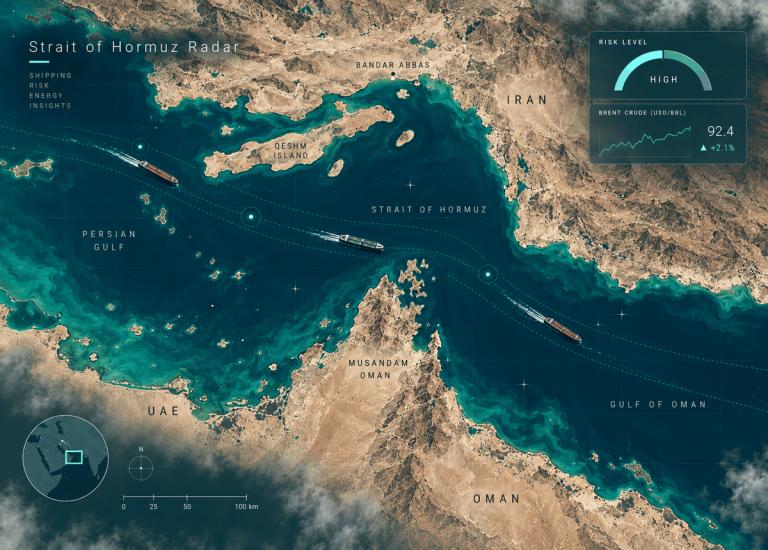
Hormuz is not simply a narrow maritime passage. It is the physical connection between the Persian Gulf’s integrated energy-export infrastructure and international shipping markets.
Its importance derives from the concentration of production, storage, processing, loading terminals and maritime trade routes on the Gulf side of the strait.
According to the IEA, around 80% of oil flows through Hormuz were destined for Asia before the 2026 disruption. China, India, Japan and South Korea were among the principal markets exposed to interruptions.
The distinction matters because replacing an established shipping corridor requires more than building a pipeline with a matching nameplate capacity.
It also requires sufficient storage, pumping capacity, loading berths, tanker availability and access to destination markets.
2. Saudi Arabia: The Red Sea Alternative
Saudi Arabia possesses the region’s most consequential existing alternative to Hormuz: the East–West Crude Oil Pipeline, commonly known as Petroline.
The system connects eastern Saudi oil infrastructure to Yanbu on the Red Sea. Its original design capacity was approximately 5 million barrels per day, while Saudi Aramco reported an increase to 7 million barrels per day in March 2025.
Before the 2026 crisis, the IEA estimated that roughly 2 million barrels per day of the system’s capacity was already being used.
The 2026 operational test
Saudi Arabia’s response to the disruption demonstrated that the East–West system could deliver substantially more than its normal pre-crisis flows.
By early June, crude exports from Yanbu had increased from approximately 2 million to more than 5 million barrels per day, according to the IEA.
This was important evidence of actual operational capability, rather than merely theoretical capacity.
However, it did not establish that 7 million barrels per day could be exported continuously under all circumstances.
The Red Sea corridor faces several constraints:
- Export terminal throughput and tanker-loading capacity must keep pace with pipeline flows.
- Red Sea shipping routes introduce exposure to a different maritime security environment.
- Deliveries to Asian customers may face different voyage distances and freight economics.
- Pipeline and terminal disruptions can concentrate export risk in fewer facilities.
These vulnerabilities became more visible later in 2026.
The IEA reported that combined exports through Yanbu and Fujairah peaked at 7.8 million barrels per day in June, before declining to 5.5 million in August following attacks affecting Red Sea shipping. The agency also reported an early-September shutdown of Saudi Arabia’s East–West pipeline following attacks.
The lesson is not that the Saudi corridor failed. It is that bypass infrastructure transfers some of the risk from Hormuz to another set of strategic assets.
3. The UAE: Fujairah and the Expansion of Eastern Export Infrastructure
The UAE’s principal crude bypass route is the Abu Dhabi Crude Oil Pipeline, also known as the Habshan–Fujairah pipeline.
It connects Abu Dhabi’s onshore production infrastructure with Fujairah, located on the Gulf of Oman outside the Strait of Hormuz.
The IEA reported an operating capacity of approximately 1.8 million barrels per day, compared with an original nameplate capacity of 1.5 million barrels per day. Before the disruption, approximately 1.1 million barrels per day was being exported through this route.
Fujairah offers an important geographical advantage: tankers loading there can access the Gulf of Oman without crossing Hormuz.
The emirate also benefits from storage and bunkering infrastructure. The IEA identified the 42-million-barrel Mandous underground storage complex as an additional source of export flexibility during the 2026 disruption.
The UAE is also pursuing further capacity. The EIA has identified a planned additional pipeline connecting Jebel Dhanna with Fujairah, with a proposed capacity of approximately 1.5 million barrels per day and a 2027 development target.
However, planned capacity must not be counted as available throughput before commissioning and operational verification.
There are also important limits to the Fujairah model.
A crude pipeline cannot independently move all the cargo currently handled by ports inside the Persian Gulf. Containerized imports, industrial equipment, food products, refined petroleum products and LNG require different handling systems.
Consequently, Fujairah’s expansion reduces one category of maritime dependence more quickly than others.
4. How Much Oil Can Actually Be Rerouted?
Hormuz vs. Alternative Routes
The figures above describe different dimensions of the export system and should not be added together.
The 20-million-barrel figure represents historical Hormuz transit. The 3.5–5.5-million-barrel range represents estimated spare bypass capacity before the crisis. The 7.8-million-barrel figure represents observed combined exports through Yanbu and Fujairah at their June peak, including flows already using those corridors.
That difference is fundamental to any investment analysis.
A pipeline with a rated capacity of 7 million barrels per day does not necessarily provide 7 million barrels per day of additional export capacity. Some capacity may already be committed, and the downstream export system may become the limiting factor.
Similarly, an observed peak does not establish sustainable annual throughput.
The 2026 experience shows that significant diversion is possible, but it also demonstrates that rerouting does not automatically restore pre-crisis regional exports.
5. Why Pipelines Cannot Replace Every Type of Gulf Trade
The strongest limitation to a pipeline-led bypass strategy is that Hormuz carries several fundamentally different categories of trade.
Crude oil
Crude oil is the most suitable cargo for pipeline diversion. Its relatively standardized handling requirements and established onshore production networks make large-scale rerouting technically feasible.
Even so, export capacity depends on crude specifications, storage compatibility, loading facilities and the ability to redirect supply contracts.
Liquefied natural gas
LNG presents a substantially more difficult problem.
The IEA estimates that approximately 93% of Qatar’s LNG exports and 96% of the UAE’s LNG exports normally transit Hormuz. Together, those flows represented around 19% of global LNG trade.
Crude pipelines cannot transport LNG.
An alternative LNG export corridor would require dedicated gas transport, liquefaction or regasification arrangements, specialized terminals and long-term infrastructure investment.
This makes LNG dependence considerably harder to resolve through conventional oil-pipeline expansion.
Refined products and petrochemicals
Refined fuels and petrochemical products require compatible pipelines, storage and loading infrastructure. Crude export corridors cannot automatically accommodate them.
For producers and traders, the relevant question is not whether a country has a pipeline to an external coast, but whether the specific product can physically use that corridor.
Containers and general cargo
Ports such as Jebel Ali serve complex commercial ecosystems involving manufacturing, warehousing, distribution and regional re-export.
Developing alternative ports on the Gulf of Oman can reduce shipping exposure, but cargo must still reach inland consumers and industrial facilities through road or rail networks.
The total logistics cost can therefore rise even when the maritime chokepoint is avoided.
6. Iran’s Jask Corridor: Strategic Potential, Limited Proven Capacity
Iran has also pursued a bypass strategy through the Goreh–Jask crude pipeline and Jask export terminal on the Gulf of Oman.
The project was designed to give Iran a crude export outlet outside the Strait of Hormuz.
Its strategic logic is straightforward: a functioning terminal at Jask could diversify Iran’s export geography and reduce reliance on loading infrastructure inside the Persian Gulf.
However, infrastructure completion and sustained commercial operation are not the same thing.
The IEA’s February 2026 assessment stated that the Goreh–Jask system had a reported design capacity of 1 million barrels per day but was effectively non-operational as a regular export corridor at that time.
The EIA has separately estimated a much lower effective capacity, around 300,000 barrels per day, reflecting the gap between design and operational capability.
These assessments refer to different measures and dates. Neither should be presented as a verified October 2026 sustainable export rate.
For investors, Jask illustrates a broader principle: a strategically located pipeline or terminal only creates commercial value when the entire transport chain can operate reliably.
Its future significance depends on technical readiness, export-terminal performance, shipping access, financing, sanctions exposure and the availability of commercially viable cargoes.
7. The Economics of Bypassing Hormuz
Bypass investments should not be evaluated exclusively on transport capacity.
The more useful question is whether the additional infrastructure reduces the expected total cost of disruption.
That calculation includes both ordinary operating costs and the financial consequences of interruptions.
A commercially rational bypass may cost more per barrel during normal conditions while still creating substantial value during a prolonged crisis.
The relevant variables include:
| Variable | Investment implication |
|---|---|
| Pipeline capital expenditure | Large upfront investment with long payback periods |
| Terminal and storage capacity | Determines how much pipeline throughput can be exported |
| Freight and voyage distance | Changes delivery economics by destination |
| Insurance and security | Can offset the benefit of avoiding Hormuz |
| Utilization | Low normal-period throughput increases unit costs |
| Operational redundancy | Reduces exposure to a single point of failure |
| Product compatibility | Limits which cargoes can use the corridor |
An important consequence is that the best bypass route is not necessarily the shortest.
For example, moving Saudi crude westward to the Red Sea may be strategically attractive when Hormuz is disrupted. But the commercial advantage depends on whether the customer is located in Europe, India, China or another destination.
For Asian buyers, the additional routing and security conditions may materially alter the calculation.
Therefore, a realistic corridor assessment must combine physical throughput, delivered cost and reliability rather than treating pipeline capacity as the sole measure of competitiveness.
8. The New Risk: Replacing One Chokepoint With Several Smaller Ones
The 2026 crisis demonstrates a less obvious consequence of diversification.
When trade shifts away from a major chokepoint, the alternative infrastructure can itself become strategically important.
Export terminals, pumping stations, storage facilities and narrow maritime approaches become concentrated points of vulnerability.
The September IEA assessment provides an example: bypass exports helped offset the Hormuz disruption, but subsequent attacks reduced flows through the alternative corridors.
This creates a trade-off between geographical diversification and infrastructure concentration.
A system with several independently operating routes is generally more resilient than one dependent on a single passage. But its resilience depends on the independence of those routes.
If multiple corridors remain exposed to correlated political, military, financial or maritime risks, their combined nominal capacity can overstate the protection they provide.
For investors and policymakers, diversification should therefore be measured by reliably available capacity under stress, not simply by the number of pipelines constructed.
9. Three Scenarios for the Next Five Years
The following scenarios are analytical possibilities, not forecasts with assigned probabilities.
Scenario A: Hormuz remains the primary corridor
Shipping conditions normalize sufficiently for the strait to retain its cost and network advantages. New pipelines function mainly as insurance against future disruptions.
Implication: Strategic importance remains high, even as exporters gain flexibility.
Scenario B: A diversified Gulf export network
Saudi Arabia and the UAE expand reliable external-coast capacity, while new terminals and overland routes absorb selected cargoes.
Implication: Hormuz becomes less dominant for crude oil, but remains essential for LNG and much of the region’s general trade.
Scenario C: Persistent multi-corridor disruption
Security threats extend to pipelines, terminals and alternative maritime routes. Governments invest heavily in redundancy, but effective export capacity remains volatile.
Implication: Additional infrastructure reduces some vulnerabilities without eliminating the region’s geopolitical risk premium.
The second scenario would represent a meaningful structural change in regional energy logistics. Even then, the degree of reduced dependence would differ substantially between countries and products.
Saudi Arabia and the UAE possess stronger physical options than Qatar, Kuwait and Bahrain. Iran’s ability to diversify depends on operationalizing its external-coast infrastructure. Iraq’s alternatives involve separate infrastructure, political and transit constraints.
There is no single Gulf-wide bypass solution.
10. What Investors Should Monitor
For energy companies, logistics investors and international suppliers, five indicators are more useful than announcements of additional pipeline capacity.
First, actual monthly export volumes through Yanbu and Fujairah indicate whether infrastructure can sustain higher utilization.
Second, terminal-loading performance and storage availability reveal whether the bottleneck has shifted from the pipeline to the port.
Third, project commissioning and independent operating evidence distinguish proposed capacity from usable capacity.
Fourth, delivered freight and insurance costs determine whether a route is commercially competitive under normal and disrupted conditions.
Finally, the development of non-crude infrastructure, especially LNG and container terminals, indicates whether diversification is expanding beyond oil exports.
A route should only be treated as a credible alternative when the full chain from production to international delivery has been demonstrated.
Conclusion: Hormuz Can Become Less Dominant Without Becoming Irrelevant
The most consequential lesson of 2026 is that Gulf exporters have more flexibility than the region’s traditional maritime geography might suggest.
Saudi Arabia and the UAE demonstrated that substantial crude volumes can be redirected to alternative coasts. New infrastructure projects may increase that flexibility over the coming years.
But these developments do not support the conclusion that the Strait of Hormuz is approaching strategic irrelevance.
Oil pipelines cannot replace LNG export systems, container terminals or the commercial networks built around Persian Gulf ports. Nor do alternative corridors eliminate security risks; in some cases, they redistribute them.
The likely structural change is a transition from near-total reliance on one maritime passage toward a more diversified, but still interconnected, regional logistics system.
For investors, the central opportunity lies not simply in building routes around Hormuz, but in financing the storage, terminals, transport connections and operational redundancy required to make those routes reliable.
Hormuz’s strategic importance may decline at the margin. Its role in global energy security will remain substantial unless alternative infrastructure can match not only its capacity, but also its flexibility and economic efficiency.
Sources and methodology
This analysis distinguishes design capacity, spare capacity, observed throughput and sustainable commercial performance. Historical baseline figures refer primarily to 2025, while operational evidence is drawn from 2026. Forward-looking infrastructure projects are not counted as commissioned capacity.