China to Iran by Rail: Can a 6,000-Kilometre Freight Route Ever Compete With Sea Shipping?
A 55-container block train moving from China to Iran through Central Asia gives a useful test of a much larger question: can rail become a serious alternative to maritime trade between China and Iran?
The answer depends on what “alternative” means.
Rail cannot match the volume economics of container shipping. But for cargo where two weeks matter, where inventories are expensive, or where maritime access becomes unreliable, the calculation changes considerably.
The current China–Iran train provides a good case for measuring that difference.
The shipment
In September 2026, Uzbekistan Railways’ container operator announced the first China–Iran block train routed through Uzbekistan.
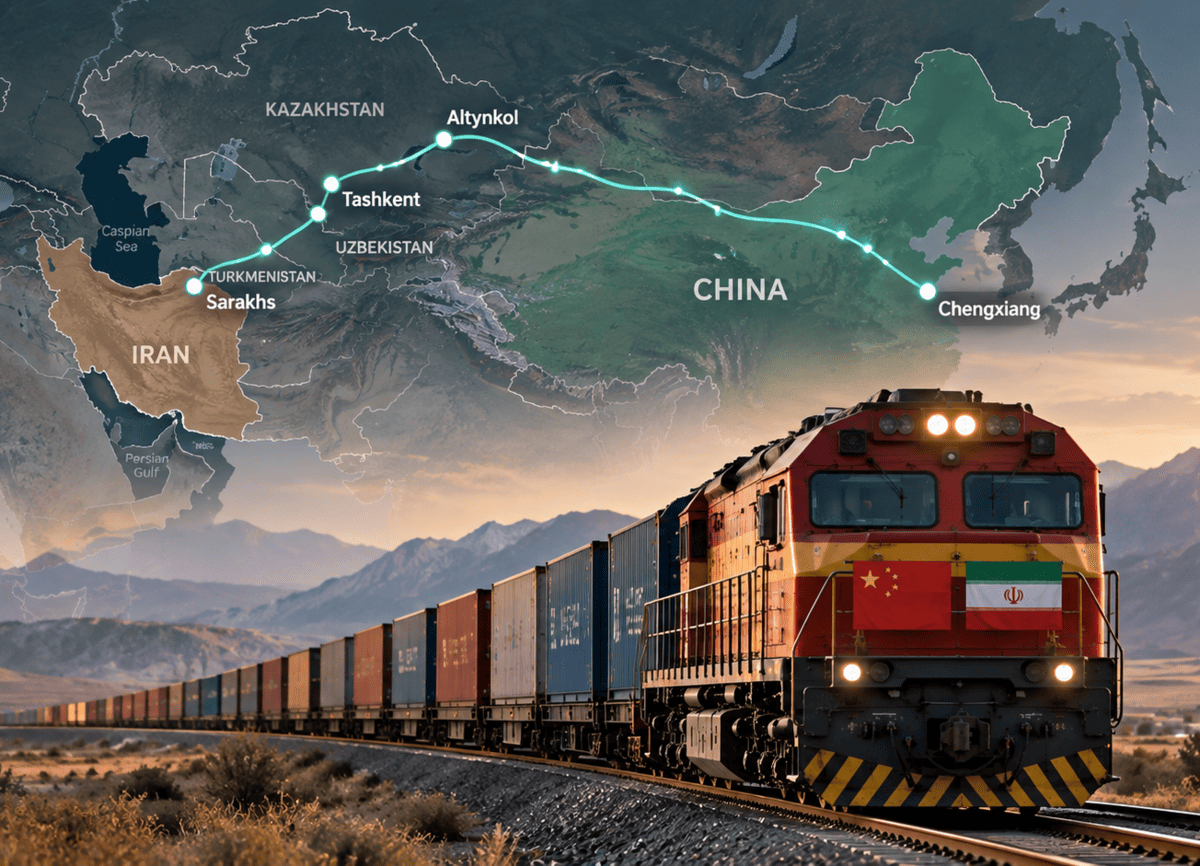
The train carries 55 containers with automotive components, consumer goods and consolidated cargo. It departed China, entered Kazakhstan through the Khorgos–Altynkol crossing, and left Altynkol on September 7. From there, the route continues through Kazakhstan, Uzbekistan and Turkmenistan before entering Iran at Sarakhs.
The full route exceeds 6,000 kilometres, with planned delivery within 14–16 days.
As of September 22, public reporting confirms the train’s progress and planned arrival window, but Hormuz has not found a reliable public confirmation of its final arrival in Iran. For that reason, the 14–16 day figure should currently be treated as the planned transit time rather than a completed journey time.
What 55 containers actually means
A 55-container train sounds substantial until it is compared with maritime capacity.
The operator has disclosed the number of containers but not their equipment mix. A 20-foot container equals one TEU; a 40-foot container equals two.
That means the train represents somewhere between approximately 55 and 110 TEU, depending on the mix of container sizes.
Now compare that with a container ship carrying 8,000 TEU.
Moving the same nominal volume would require roughly:
| Capacity comparison | Approximate requirement |
|---|---|
| 55 TEU per train | 146 trains |
| 110 TEU per train | 73 trains |
| 8,000 TEU container vessel | 1 vessel |
For a 15,000 TEU ship, the equivalent rises to roughly 136–273 trains.
This is the first structural constraint on the idea that rail can “replace” shipping.
Rail can move containers quickly. It cannot reproduce maritime scale train-for-ship.
Rail competes on time, not volume
The economic proposition is therefore different.
A ship spreads its operating cost across thousands of containers. Rail uses far smaller transport units, crosses several national networks and requires more coordination at borders.
In return, rail can reduce transit time substantially for some China–Iran supply chains.
The current block train targets a 14–16 day journey. Commercial estimates for China–Iran rail services commonly place the corridor in roughly the same two-to-three-week range, while ocean transit varies considerably by Chinese origin port, routing, transshipment and conditions around Iranian ports.
That time difference is valuable only if the cargo itself makes time valuable.
A container of low-value bulk material is unlikely to justify a large rail premium simply because it arrives earlier. Automotive components, machinery parts, electronics or inputs capable of stopping a production line are different.
The cargo carried by this first train is therefore revealing. Automotive components are precisely the type of shipment for which freight cost may be less important than inventory availability.
When does paying more for rail make economic sense?
The useful comparison is not simply:
rail freight price versus sea freight price.
It is: rail premium versus the economic value of the time and reliability saved.
Consider a simplified example.
Suppose rail costs $5,000 more per container than the equivalent sea movement and saves 15 days.
For cargo worth $100,000, assuming an annual inventory carrying cost of 20%, releasing that inventory 15 days earlier saves only about $820 in carrying cost.
That alone does not justify a $5,000 freight premium.
For cargo worth $500,000, however, the same calculation produces roughly $4,100 in inventory savings.
And neither example includes the potentially much larger cost of a stock-out, delayed production, missed sale or factory interruption.
This is why cargo value alone is not enough. A relatively inexpensive component capable of stopping a manufacturing line may justify fast transport more easily than a more valuable product sitting comfortably in inventory.
Rail becomes attractive when the cost of waiting approaches or exceeds the additional freight cost.
The route also contains two physical breaks in the railway system
The journey is not a continuous train ride from China to Iran.
China operates standard-gauge railway at 1,435 mm, while Kazakhstan and most former Soviet railway systems use 1,520 mm gauge. Containers therefore have to cross between railway systems at the China–Kazakhstan border.
At Khorgos–Altynkol, infrastructure exists specifically for transferring containers between the two gauges. Kazakhstan has continued expanding capacity there; KTZ Express said in July 2026 that transshipment capacity at the Khorgos Gateway had increased from 540,000 to 800,000 TEU per year.
The same basic problem appears again at Iran.
Turkmenistan uses 1,520 mm track while Iran uses 1,435 mm. Sarakhs is therefore another break-of-gauge point where containers or rolling stock must transition between systems.
Containerisation makes these transitions much easier because the cargo itself does not have to be unpacked. But every transfer still introduces terminal handling, scheduling dependency and another place where congestion can affect the timetable.
A 14-day rail route is therefore not just a question of locomotive speed. It depends on how efficiently multiple railways and border terminals behave as one logistics chain.
The biggest challenge is not proving that one train can make the journey
That has effectively been demonstrated.
The harder question is whether the route can operate frequently, predictably and in both directions.
Regular block-train economics require several things at the same time: enough cargo to fill trains, available wagons and containers, predictable border processing, coordinated train paths across multiple countries and sufficient return cargo.
The last point matters.
A corridor that produces strong east-to-west demand but weak return loads can end up moving empty equipment over thousands of kilometres. That changes the economics quickly.
Nor can the capacity of one terminal be treated as the capacity of the full corridor. Khorgos may be capable of handling hundreds of thousands of TEU annually, but an end-to-end China–Iran service is constrained by the least efficient combination of border capacity, customs processing, rolling stock and train paths further west.
This is the difference between demonstrating a route and industrialising it.
Sea freight still has the fundamental cost advantage
Under ordinary conditions, maritime transport remains difficult to beat for large-volume international trade.
Recent public freight quotations for China–Iran routes vary sharply depending on dates, container size and service scope, which makes a single headline comparison misleading. Recent reporting has also shown major distortions in Iranian maritime and overland freight costs during the current regional disruption.
The structural point is more durable than any weekly freight quote.
A ship can move thousands of containers with one voyage. A block train moves dozens.
Rail therefore does not need to become cheaper than sea freight across the entire market to succeed. It needs to be competitive for a specific segment of cargo.
That segment includes goods that are:
- time-sensitive but not valuable enough for air freight;
- important to industrial continuity;
- expensive to keep in large safety inventories;
- exposed to maritime disruption;
- moving between inland production and consumption centres where rail reduces additional port and trucking legs.
For these shipments, rail occupies a position between sea and air rather than replacing either one.
Maritime disruption changes the value of the corridor
There is another reason the current experiment matters.
A railway through Kazakhstan, Uzbekistan and Turkmenistan reaches Iran without entering the Strait of Hormuz.
That does not make the corridor immune to political or operational risk. It simply gives importers another physical route.
Iran’s ports handled about 3.1 million TEU in the Iranian year ending March 2025, illustrating the scale of the maritime system against which land corridors must be judged.
No plausible expansion of the current block-train service would replace that system.
But replacement is the wrong benchmark.
If rail can reliably divert even a small share of high-priority container traffic when maritime routes are slow, expensive or unavailable, its strategic value can be much greater than its percentage share of national freight volume suggests.
The real test begins after the first train
The 6,000-kilometre China–Iran service proves that the physical route exists.
It does not yet prove that the corridor is commercially mature.
The next evidence to watch is more important than the ceremonial first movement: actual arrival time, border dwell at each interchange, frequency of subsequent trains, realised freight rates, load factors and whether meaningful return traffic develops from Iran toward Central Asia and China.
Those figures will determine whether the route becomes a recurring commercial service or remains primarily a strategic demonstration.
For most China–Iran trade, sea shipping will retain the advantage in scale and base transport economics.
For a narrower category of cargo, however, the calculation is different.
Rail does not need to replace the container ship. It needs to make the cost of waiting for one more expensive than taking the train.