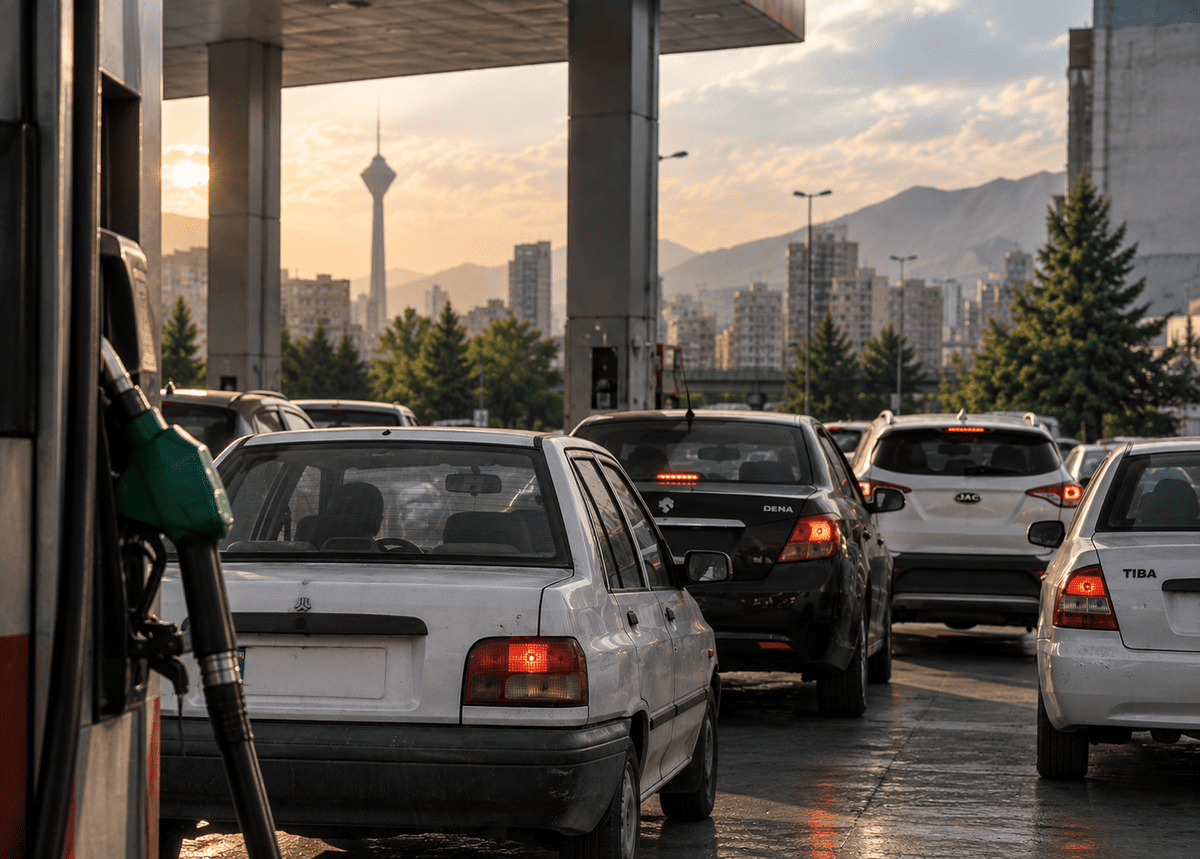
Gasoline Prices in Iran in 2026: Economic Impact and What Comes Next
Iran has changed the price of gasoline again, but the significance of the decision extends well beyond what motorists will pay at the pump.
From September 8, 2026, motorists who consume more than 110 litres of gasoline in a month will pay 10,000 tomans per litre for consumption above that threshold, double the previous third-tier price of 5,000 tomans. The first 60 litres remain priced at 1,500 tomans per litre and the next 50 litres at 3,000 tomans, meaning the government has avoided a broad increase in subsidised gasoline prices and instead concentrated the adjustment on heavier users. Reuters reported that the measure applies only beyond the existing 110-litre subsidised allocation.
At first glance, this may appear to be a relatively narrow pricing adjustment. In economic terms, however, gasoline sits at the intersection of several of Iran’s most persistent distortions: energy subsidies, excessive consumption, refining constraints, an ageing vehicle fleet, a protected automotive market, limited public transport, foreign-exchange pressure, inflation expectations and declining household purchasing power.
The latest increase matters not because 10,000 tomans is an economically high gasoline price, it remains extraordinarily cheap by international standards, but because it exposes how difficult Iran’s existing gasoline model has become to sustain.
Iran still has some of the cheapest gasoline in the world
Even after the latest increase, the third-tier gasoline price is equivalent to only around four US cents per litre at the prevailing free-market exchange rate. The first two tiers are cheaper still. Iran’s position as a major oil producer helps explain why policymakers have historically viewed inexpensive domestic energy as an economic and social benefit, but producing crude oil does not make gasoline costless. Crude must be refined, transported, stored and distributed, and every litre consumed domestically also carries an opportunity cost when that energy could otherwise be sold or used elsewhere.
The scale of the subsidy is unusually large. The IMF’s latest global study of fossil-fuel pricing estimates gasoline supply costs at roughly 80–90 US cents per litre across most countries and identifies only four cases in its comparison, Indonesia, Iran, Russia and Saudi Arabia, where retail gasoline prices are below the estimated supply cost. The IMF also finds that fuel subsidies encourage excess consumption, distort the allocation of resources and provide a disproportionate benefit to higher-income households, which generally consume more energy.
For Iran, that gap between the price paid by motorists and the economic value of gasoline has become increasingly important because the country no longer has the comfortable fuel surplus that might make such a policy easier to sustain.
An oil producer with a gasoline supply problem
Iran holds some of the world’s largest hydrocarbon reserves, yet large crude reserves do not automatically translate into unlimited gasoline production. Domestic demand has risen to levels that increasingly test the country’s refining and distribution system.
Recent consumption has reached roughly 145 million litres per day, according to reporting around the September price increase, well above domestic production capacity and high enough to require imports and other measures to cover the shortfall. The same reporting points to ageing vehicles and inadequate public transportation as important contributors to the rise in consumption.
Earlier 2026 figures attributed to Iran’s National Iranian Oil Products Distribution Company placed refinery gasoline production at around 109 million litres per day, supplemented by additional volumes obtained through blending. Although exact production and consumption figures vary across seasons, travel periods and refinery conditions, the broader direction is clear: gasoline demand has moved uncomfortably close to, and at times materially beyond, the system’s ability to supply it domestically.
This changes the economics of cheap fuel. When domestic production comfortably exceeds domestic consumption, selling gasoline below its economic value primarily creates an opportunity cost. Once demand begins to exceed domestic supply, however, the distortion becomes more immediate. The country may need to dedicate foreign currency, barter capacity or other scarce resources to obtaining a product that is then sold to consumers at a fraction of its economic cost.
A policy originally designed to make transportation inexpensive can therefore begin to create a separate problem in the external accounts.
The gasoline deficit adds another source of foreign-exchange pressure
Iran’s foreign-exchange constraints make the gasoline imbalance more consequential than it would be for an economy with unrestricted access to international markets and finance. Every imported litre ultimately competes for resources that could be used for machinery, medicines, food, industrial inputs or other goods that cannot easily be produced domestically.
That pressure becomes more serious when access to oil revenues, international payments and trade finance is constrained. The September price decision itself was announced against the backdrop of war-related economic disruption and intensified US economic pressure, with the government explicitly framing the change as a response to current conditions.
Fuel policy therefore becomes part of foreign-exchange management. Reducing excessive gasoline use is no longer simply an environmental or fiscal question; it can also reduce the amount of scarce external purchasing power devoted to filling a domestic supply gap.
This creates one of the central paradoxes of Iran’s energy economy. The country is a major exporter of hydrocarbons, yet maintaining extremely cheap domestic gasoline can still increase its need for foreign currency.
Will the new price increase inflation?
The direct inflationary effect of this particular measure should be smaller than that of a universal gasoline-price increase because the first 110 litres of monthly consumption remain unchanged. Reporting around the decision suggests that approximately 15 percent of motorists are directly exposed to the higher third-tier rate, meaning most households can theoretically avoid any increase in their gasoline bill if they remain within the existing quotas.
The indirect effect is more complicated. Passenger transport, taxis, ride-hailing services, couriers, field-service companies and urban delivery businesses can face higher costs when their vehicle usage pushes them beyond subsidised quotas. Some of those costs may eventually appear in service prices.
At the same time, gasoline should not be confused with the fuel structure of the entire logistics economy. Heavy freight in Iran is more dependent on diesel, so an increase in gasoline prices does not mechanically increase the cost of every truck carrying food, industrial materials or agricultural products across the country. The immediate cost transmission is therefore likely to be stronger in passenger mobility, light commercial transport and last-mile distribution than in long-haul freight.
The expectations channel may nevertheless prove more important than the direct cost calculation. In an economy already experiencing high inflation and substantial currency depreciation, administered-price changes can influence the way households and businesses think about future costs. Companies may interpret a gasoline increase as one more indication that other controlled prices, wages, exchange rates or utility costs could eventually adjust as well.
This is why the inflationary effect of gasoline in Iran cannot be measured only by multiplying the additional cost of fuel by the number of litres consumed. Fuel pricing also carries political and psychological information about the direction of economic policy.
Iran’s gasoline problem is also an automotive-policy problem
High gasoline consumption is frequently explained through a simple argument: fuel is extremely cheap, so consumers have little incentive to conserve it. That is true, but incomplete. Consumers do not choose fuel consumption independently of the vehicles and transportation systems available to them.
Iran has spent decades protecting its domestic automotive industry through a mixture of import restrictions, tariffs, foreign-exchange controls and regulatory intervention. Sanctions have added another layer of isolation by restricting access to international suppliers, finance, technology and partnerships.
The result is a vehicle market in which replacing an old or inefficient car with a modern alternative can be unusually expensive and difficult. When large numbers of older vehicles remain in circulation for longer, the gasoline consequences accumulate across the entire economy. The same journey undertaken in a less efficient vehicle requires more fuel regardless of whether the driver personally wants to conserve gasoline.
This helps explain why the ageing vehicle fleet is now being discussed as part of Iran’s fuel imbalance rather than simply as an automotive-sector problem. Public transportation is the other side of the same equation. Where reliable alternatives to private cars are limited, raising the cost of driving does not automatically give households a practical way to reduce their dependence on it.
Iran’s own regulator describes the car market as monopolistic
The concentration of Iran’s automotive market is not merely a criticism made by outside observers. Iran’s Competition Council continues to classify the market for domestically produced and assembled passenger vehicles as monopolistic. Its 2026 framework points specifically to high market concentration, accumulated demand, years of import restrictions and limited consumer choice as factors contributing to that condition.
That matters because the normal mechanism through which inefficient products disappear from a competitive market is weakened. In an open market, manufacturers that consistently offer worse efficiency, quality, technology or value lose customers to stronger competitors. In a protected and concentrated market, that pressure is reduced.
Imports have resumed after earlier restrictions, but they remain heavily regulated rather than fully open. Commercial import tariffs in 2026 are structured according to powertrain and engine size: electric vehicles face a 4 percent rate, plug-in hybrids 15 percent, while conventional gasoline vehicles range from 20 percent for smaller engines to 165 percent at the upper end of the engine-size schedule.
Tariffs are only one component of the distortion. Import volumes, foreign-exchange allocation, regulatory eligibility and scarcity also affect the final price available to consumers.
The consequence is that vehicles considered ordinary mass-market products elsewhere can become expensive assets in Iran. Current Iranian market data, for example, put a 2025 Kia K5 at around 11.4 billion tomans in the open market, while Kia’s US pricing for the 2026 K5 ranges from $27,490 for the base version to $34,990 for the EX before destination charges and taxes. The comparison is not perfectly like-for-like, model year, trim, tax treatment, freight and specifications differ, but it illustrates how far Iranian consumer prices can move away from international benchmarks once tariffs, scarcity, currency restrictions and market structure are layered together.
The effect of high vehicle prices is not confined to household purchasing power. When replacement becomes prohibitively expensive, owners retain existing vehicles for longer. Fleet renewal slows, older and less fuel-efficient cars remain in service, and national gasoline consumption stays higher than it otherwise would.
Iran is therefore operating two policies that partly work against one another: it heavily subsidises gasoline while maintaining an automotive structure that makes upgrading to newer and more efficient vehicles unusually costly.
The issue is broader than the idea of a “car mafia”
Public debate in Iran often uses the phrase “car mafia” to describe the network of interests surrounding the automotive industry. The phrase captures widespread frustration but is too imprecise to serve as an economic explanation.
A more useful description is a protected market containing powerful incumbents, extensive supplier networks, large employment interests and significant state involvement in regulation, finance, ownership and pricing. Such a structure can resist rapid reform even without assuming the existence of a single coordinated group controlling every decision.
Opening the market more aggressively would create real trade-offs. Larger imports could increase demand for foreign currency. Lower protection could threaten some domestic producers and suppliers. Faster restructuring could affect employment, while the financial weakness of manufacturers can make rapid technological investment difficult.
Sanctions compound each of these constraints, but they do not fully explain the structure of the domestic market. Import policy, competition policy and industrial strategy remain choices made inside Iran.
The distinction matters because it changes the policy question. If inefficient fuel consumption were simply the result of careless consumers, higher gasoline prices might eventually solve much of the problem. If part of the consumption comes from an old vehicle fleet, weak competition and insufficient alternatives to private transport, fuel-price reform alone addresses only part of the system.
Cheap gasoline and expensive cars reinforce each other
The interaction between automotive and energy policy has produced a difficult feedback loop. Cheap gasoline reduces the private financial reward for fuel efficiency, while expensive vehicles and weak competitive pressure slow the replacement of old cars. Those vehicles consume more fuel, higher fuel demand increases the subsidy burden and the probability of imports, and the government then attempts to control consumption by increasing gasoline prices.
In other words, part of Iran’s gasoline problem is being treated at the petrol station even though part of it originates in the vehicle market and transportation system.
A more durable strategy would therefore need several policies to move in the same direction: gradual fuel-price reform, accelerated scrappage of inefficient vehicles, greater competition in the automotive market, easier access to efficient conventional and hybrid vehicles, expansion of CNG and electric mobility where the economics are justified, and better urban public transportation.
Without those alternatives, households can reasonably argue that they are being asked to consume less gasoline while the cost of acquiring the technologies that would allow them to do so remains unusually high.
Vehicle efficiency, however, is only one dimension of the distortion. The subsidy itself raises another question: who actually captures the economic benefit of cheap gasoline?
The gasoline subsidy is poorly targeted
Cheap gasoline is often defended as a form of social protection because transportation is a basic household expense. The problem is that a fuel subsidy does not distribute support according to income or need. It distributes support according to fuel consumption.
A household without a private vehicle receives little direct benefit. A household with multiple vehicles, longer journeys or higher fuel consumption receives more.
This pattern is visible internationally. The IMF estimates that the poorest 20 percent of households receive only about eight cents of every dollar spent on explicit fuel subsidies. Higher-income groups capture much of the remainder because they tend to own more vehicles, travel more and consume more energy.
The economic argument for reform is therefore not simply that gasoline should become more expensive. It is that part of the resources devoted to keeping gasoline universally cheap could, in principle, provide stronger social protection if redirected toward targeted cash transfers, public transport, healthcare, infrastructure or other forms of assistance.
Iran has already experimented with shifting between broad subsidies and direct transfers, but the credibility of that exchange is politically important. Households experience the loss of a visible low price immediately, while the value of future compensation is less certain, particularly in a high-inflation environment.
That gap between economic logic and public trust is one reason gasoline reform remains politically sensitive.
Cheap gasoline also creates a smuggling incentive
The enormous gap between Iranian gasoline prices and the economic value of fuel in neighbouring markets creates a straightforward arbitrage opportunity. Where a commodity can be purchased legally at a fraction of its regional value, diversion and smuggling become economically attractive.
The precise scale of fuel smuggling is difficult to establish and official estimates have varied substantially, so it would be misleading to attribute the entire gasoline imbalance to illegal trade. The incentive itself, however, is difficult to dispute.
As long as domestic prices remain dramatically below surrounding market prices, enforcement can reduce diversion but cannot eliminate the economic reward for attempting it.
The increase of the third-tier price from 5,000 to 10,000 tomans narrows that gap only marginally.
Why not simply raise gasoline to market price?
If the distortion is so large, the obvious question is why Iran does not simply move gasoline prices much closer to their economic cost.
The answer is that the adjustment would be economically and politically severe. Moving rapidly from heavily subsidised gasoline to anything approaching an international benchmark would transfer a substantial cost onto households and transport-dependent businesses at a time when purchasing power is already under pressure.
Consumption could respond relatively quickly to a major price increase, but the rest of the economy cannot adapt at the same speed. Public transport systems cannot be expanded overnight, households cannot immediately replace inefficient cars, cities cannot rapidly change their transport patterns, and workers whose livelihoods depend on driving cannot instantly reorganise their businesses.
Gradual reform is therefore easier to absorb than a sudden shock, provided households believe the process is predictable and that alternatives or compensation will follow.
The current three-tier pricing system is effectively an attempt to make the marginal litre more expensive without immediately imposing a large price increase on ordinary consumption. It preserves very cheap gasoline for the first 110 litres while placing more of the economic cost on heavier users.
Whether 10,000 tomans is high enough to materially change behaviour remains uncertain. Relative to the economic value of gasoline, the third-tier price is still exceptionally low.
What the new gasoline price means for businesses
For companies operating in Iran, the effects will vary substantially by sector.
The clearest direct exposure lies with businesses that rely heavily on passenger vehicles and light commercial transport: ride-hailing platforms, taxis, couriers, field-service companies, urban delivery fleets and other operations where vehicles can regularly exceed subsidised quotas.
The impact on heavy industry and long-distance freight is less direct because diesel, electricity, natural gas, exchange rates and sanctions-related logistics costs generally matter more to those businesses than passenger gasoline.
The more interesting effects may emerge over a longer horizon. If gasoline prices continue to rise, fuel efficiency becomes economically more valuable. That could improve the relative economics of newer vehicles, hybrids, EVs, CNG systems, fleet-management software, route optimisation, charging infrastructure, vehicle scrappage and replacement programmes, and public-transport investment.
Yet these opportunities depend heavily on automotive policy. Higher gasoline prices alone cannot create a large efficient-vehicle market if imports remain constrained, domestic competition remains weak or consumers lack the purchasing power to replace their vehicles.
For investors, the policy interaction matters more than any individual fuel-price announcement. The important signal is that energy pricing is no longer completely static at the same time that the cost of maintaining the old model is rising.
Long-term business plans in Iran should therefore not assume that current gasoline, electricity, natural-gas or other administered energy prices will remain unchanged throughout the life of an investment.
The real issue is not whether gasoline costs 10,000 tomans
Iran’s gasoline debate is often reduced to a single politically sensitive number. The deeper problem is that the country is attempting to achieve several objectives that increasingly conflict with one another: keeping transportation affordable, protecting household purchasing power, maintaining domestic automotive production, limiting imports and foreign-exchange use, preventing politically destabilising price shocks and reducing gasoline consumption at the same time.
There is no cost-free way to satisfy all of them.
Keeping gasoline extremely cheap protects consumers in the short term but encourages consumption, weakens incentives for efficiency and becomes increasingly expensive when domestic supply cannot keep pace. Raising prices improves the economics of conservation but transfers part of the adjustment onto households. Protecting domestic vehicle production preserves industrial capacity and employment, yet excessive protection can reduce competition and slow fleet renewal. Expanding imports can increase consumer choice and efficiency but requires foreign currency.
The September 2026 increase therefore does not resolve Iran’s gasoline problem. It reveals the constraints that have accumulated around it.
The 10,000-toman third-tier price is another incremental attempt to reduce the cost of extreme subsidisation without exposing the majority of motorists to an immediate increase. Whether it succeeds will depend less on the nominal price itself than on what follows: gasoline consumption, refinery output, fuel imports, vehicle replacement, automotive competition, public transportation, inflation expectations and the credibility of household compensation.
For investors and companies analysing Iran, gasoline should therefore be watched as more than an energy commodity or consumer price.
It has become a useful indicator of the country’s fiscal constraints, foreign-exchange pressure, household stress, industrial-policy trade-offs and capacity for broader economic reform.