The War Has Reached Iran’s Supply Lines – July 2026
Attacks around Bandar Abbas are turning a maritime confrontation into a national logistics problem. The damage will be measured in delayed cargo, higher working-capital needs and a lasting premium on trade with Iran.
By the end of this week, the clearest measure of disruption in southern Iran was no longer the number of missiles fired across the Gulf. It was the condition of the roads and railways leaving Bandar Abbas.
American strikes hit transport infrastructure across Hormozgan, including bridges, tunnels and railway connections serving Iran’s main port region. Chabahar’s maritime traffic-control centre was also damaged. At sea, the United States resumed enforcement of a blockade covering Iranian ports, oil terminals and coastal areas from 14 July. Shipping through the Strait of Hormuz then fell to its lowest level in weeks: only three commodity vessels crossed on Thursday, compared with roughly 125 vessel transits on a normal pre-war day.
The geography of the campaign has widened. Control of the strait remains central, yet the pressure now extends deep into the network that connects the coast to the Iranian economy.
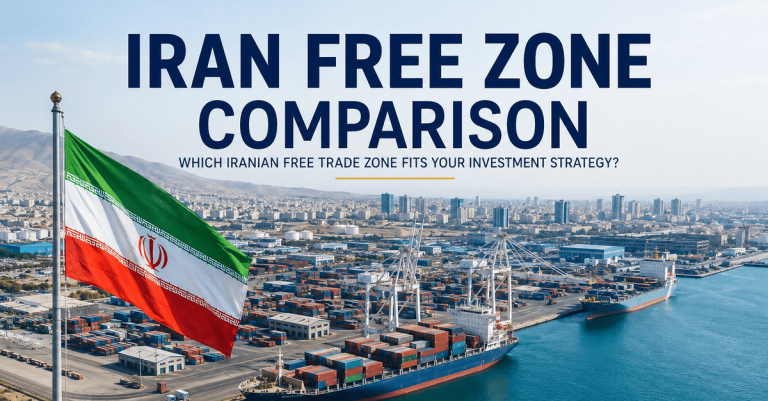
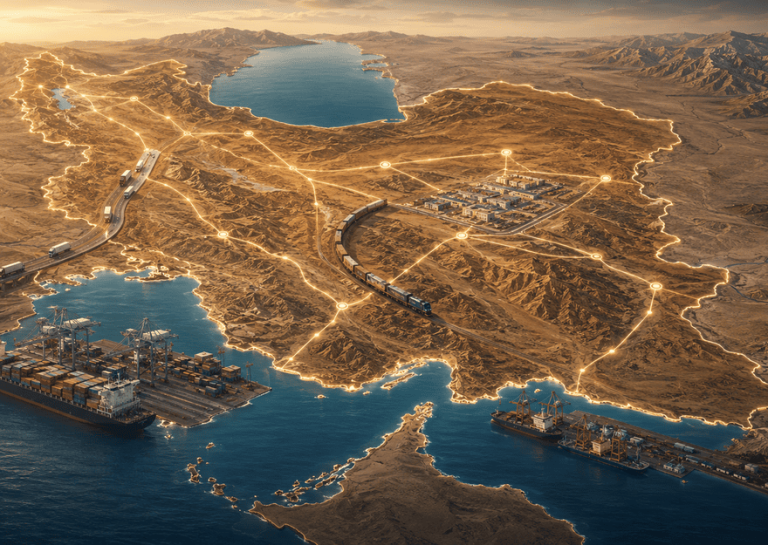
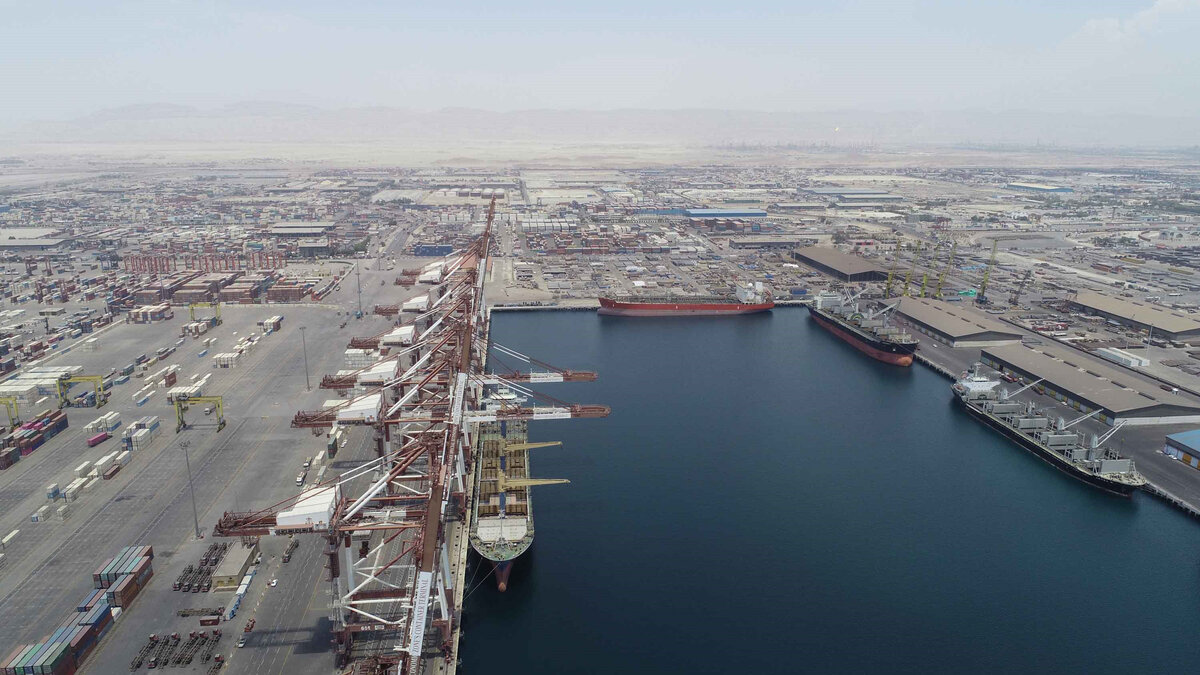
That network begins at Shahid Rajaee Port, west of Bandar Abbas. It continues through customs yards, container depots, railway junctions and a limited set of roads leading north towards Sirjan, Kerman, Yazd and Iran’s central industrial belt. When those links lose capacity at the same time, the national gateway starts to seize up even while parts of the port remain standing.
A port can stay open and still lose its commercial function
No credible public reporting available at the time of publication confirms widespread destruction of Shahid Rajaee’s main commercial berths or container cranes. The heaviest confirmed damage around Bandar Abbas has fallen on coastal surveillance, military facilities and inland transport connections.
The distinction is important, though less reassuring than it first appears.
Berths represent one stage of a cargo journey. A functioning import chain also requires a willing shipowner, insurance cover, safe access to the port, cargo clearance, available trucks or railway wagons and an unobstructed route to the final customer. Exports travel through the same chain in reverse.
Several of those stages are now operating under restrictions.
The blockade raises the risk of interception or diversion for vessels entering or leaving Iranian ports. Separate attacks on merchant shipping have pushed the maritime threat level in the strait to “severe”, the Joint Maritime Information Center’s category for an environment in which hostile action is highly likely.
For a shipping company, physical passage through the strait is only part of the decision. The voyage still requires approval from insurers, charterers, lenders, crew managers and compliance departments. A route can remain navigable while becoming commercially unusable for much of the international fleet.
This explains why an official declaration that a port remains operational offers limited guidance to an importer or industrial buyer. The useful measure is completed cargo movement: arrival, discharge, clearance and delivery without an exceptional intervention at every stage.
Bandar Abbas depends on a narrow inland network
Shahid Rajaee’s national importance rests on its access to the interior. The port feeds industrial and consumer markets far beyond Hormozgan, with the principal road and rail corridors passing through a relatively small number of junctions, bridges and mountain routes.
Recent strikes have hit infrastructure along the Bandar Abbas–Sirjan axis and the western route through Bandar Khamir towards Lar. Other attacks affected roads around Minab and Rudan. Footage and local reporting showed extensive damage to bridges in southern Hormozgan, while strikes on railway infrastructure interrupted normal services around Bandar Abbas.
Emergency repairs can restore basic movement quickly. Freight capacity returns more slowly.
A bypass suitable for passenger cars does little for a continuous flow of container trucks. Heavy vehicles require sufficient bridge strength, turning space, road width and safe access through damaged areas. Fuel tankers, bulk carriers and oversized industrial equipment face tighter limits.
The difference between an open road and a usable freight corridor can amount to thousands of tonnes of daily capacity.
Truck cycles also lengthen under diversion. A vehicle that once completed a port-to-warehouse journey in one day can spend additional hours in queues, security checks or detours. Fewer trucks return to the port for the next load. Rates rise before the road reaches complete saturation.
Rail disruption compounds the same problem. Freight that loses access to trains shifts onto roads already carrying diverted traffic. The pressure moves from one network to another rather than disappearing.
Public information on current freight-train volumes remains limited. Passenger services and railway repair announcements reveal little about the movement of containers, minerals, steel, chemicals and other bulk cargo. The indicators that count are daily freight departures, wagon availability and the time required to clear port yards.
The next bottleneck will form inside the cargo system
The immediate economic danger lies in accumulation.
Imported containers can be discharged while waiting days longer for inland transport. Export cargo can reach southern warehouses without a confirmed vessel or sailing date. Both flows consume storage space and working capital.
Port congestion seldom arrives as a single dramatic event. It builds through small delays repeated across thousands of shipments.
Containers remain in the terminal beyond their free period. Importers pay demurrage and storage charges. Trucks queue longer. Empty equipment fails to return on schedule. Exporters miss delivery windows. Factories wait for components already inside the country but still hundreds of kilometres from the production line.
These costs spread well beyond the shipping industry.
An importer financing goods from purchase to final delivery carries the cargo on its balance sheet throughout the delay. Ten additional days in transit increase the cash tied up in every shipment. Companies with weak liquidity or expensive credit feel the effect first.
Strategic goods receive priority in such an environment. Food, animal feed, medicines, fuel and essential industrial inputs move ahead of less urgent cargo. Large firms with established logistics relationships secure transport more easily. Smaller businesses absorb longer delays and higher spot-market rates.
National trade can therefore continue while individual companies face severe shortages.
Headline tonnage also understates the damage. The lost value appears in idle machinery, interrupted production, cancelled orders and inventories purchased but unavailable for use.
Shipping insurance is setting the real price of access
The commercial cost of entering the Gulf has already risen sharply.
Following attacks on merchant vessels, war-risk insurers increased premiums and tightened voyage conditions. Reuters reported quotes around 3% of vessel value, with some underwriters expecting rates of at least 5% for exposed voyages. For a ship valued at $100 million, that translates into several million dollars of additional insurance cost.
The cargo owner eventually pays much of that bill.
Shipowners add war-risk surcharges. Charterers seek stronger indemnities. Banks ask for additional security. Suppliers shorten payment periods. Buyers demand wider discounts from Iranian exporters to cover uncertain delivery.
Iranian trade already carries a sanctions premium through indirect payments, compliance screening and restricted access to major carriers. The current disruption adds a security premium on top of it.
For imports, the landed cost rises through freight, insurance, delay and finance. For exports, the supplier receives less after accepting discounts and paying more to deliver the cargo. Margins are squeezed at both ends of the transaction.
A prolonged period of high insurance rates will also alter the composition of the fleet serving Iran. Large independent operators have more to lose from detention, sanctions exposure and reputational risk. Activity shifts towards state-linked carriers, sanctioned vessels, smaller regional operators and companies built around high-risk trades.
That keeps some cargo moving, but on irregular schedules and with weaker price competition.
Chabahar offers diversification, not replacement
The pressure on Bandar Abbas has revived attention around Chabahar and Jask.
Chabahar sits outside the Strait of Hormuz and provides direct access to the Gulf of Oman. Its strategic value has never been clearer. Yet the port lacks the scale, shipping frequency and inland distribution system required to take over Shahid Rajaee’s role at short notice.
The strike on Chabahar’s maritime traffic-control centre reinforces that constraint. Iranian authorities reported structural damage while stating that port services continued. Continued handling does not restore the full confidence of shipowners navigating an active war zone without normal traffic-management capacity.
Chabahar’s inland network presents another limit. Its connection to eastern Iran, Afghanistan and Central Asia gives it a distinct commercial role. It has not yet developed the dense rail, road, warehousing and carrier ecosystem surrounding Bandar Abbas.
Jask serves a different strategic purpose, particularly in energy logistics. Its surrounding settlements and industrial facilities depend heavily on desalination and local electricity infrastructure. Recent damage to utilities across southern Iran has shown how quickly a coastal logistics site can lose support services even when its core terminal equipment survives.
Smaller ports can take selected cargoes, support emergency shipments and reduce pressure at the margin. Shifting the national cargo base requires years of investment in railways, roads, utilities, storage, customs capacity and regular shipping services.
The war has strengthened the case for that investment. It has also exposed the distance between strategic plans and operational redundancy.
A prolonged conflict will reshape Iran’s trade network
Iran retains multiple routes around the blockade. Land corridors through Turkey, Iraq, Pakistan, the Caucasus and Central Asia remain available for certain goods. Smaller vessels, indirect shipping, transshipment and ship-to-ship transfers will keep portions of maritime trade alive.
None matches the volume and cost structure of direct cargo movement through Shahid Rajaee.
Land routes carry high-value goods and priority inputs more effectively than bulk commodities. Border procedures, truck availability, rail-gauge differences and political restrictions limit rapid expansion. Every additional intermediary raises costs and reduces visibility.
Trade consequently becomes more concentrated in the hands of firms with access to capital, state institutions and established cross-border networks.
This concentration changes competition inside Iran. Large importers can reserve transport, hold more inventory and tolerate delayed payments. Smaller companies purchase logistics at spot prices and keep less safety stock. Their production becomes more vulnerable even when aggregate imports look adequate.
Foreign counterparties will also change their terms. Longer delivery windows, smaller orders, larger advance payments and stronger force-majeure clauses become standard. Products sourced from Iran require wider margins to compensate for the risk of non-performance.
These adjustments survive the fighting. Once embedded in contracts and credit models, they are removed gradually.
The lasting damage will sit in the cost of reliability
A ceasefire would reduce immediate pressure on the ports. Commercial recovery would still lag behind diplomacy.
Insurers need a sustained period without attacks. Shipping companies must reposition vessels and crews. Cargo backlogs take time to clear. Temporary road and railway repairs impose lower speed and weight limits. Disputes over delayed contracts continue after the route reopens.
Iran will emerge with a larger reliability discount attached to its trade.
That discount appears in required returns, insurance terms, payment conditions and inventory policy. An overseas buyer places a smaller order. A supplier requests cash earlier. A lender values cargo more conservatively. An investor assumes longer construction and procurement schedules.
The underlying problem is concentration. A large share of the country’s external trade depends on one port cluster, one maritime chokepoint and a limited set of inland connections.
The current attacks have turned that structural weakness into a measurable commercial cost.
What investors and operators should track
Daily military updates provide a poor guide to commercial recovery.
The useful signals come from operations:
- regular vessel calls at Shahid Rajaee;
- the return of independent international carriers;
- freight-train movements between the port and inland terminals;
- unrestricted heavy-truck traffic towards Sirjan and Lar;
- container dwell times inside the terminal;
- war-risk premiums and policy exclusions;
- availability of empty containers;
- stable power, water and communications across the southern port network.
A lower number of strikes improves the outlook. Repeatable cargo movement confirms the improvement.
For companies exposed to Iran, logistics analysis now belongs inside the investment case. Due diligence should identify the full physical route, alternative ports and borders, responsibility for insurance surcharges, inventory locations, working-capital exposure and the weakest point in the delivery chain.
A supplier that relies on one vessel, one port and one northbound road carries a different risk from a competitor with inland storage, alternative borders and contracted transport capacity. Conventional market analysis often treats those differences as operational detail. In the present environment, they determine whether revenue can be collected at all.
Hormuz assessment
Southern Iran has entered a period of reduced capacity and expensive uncertainty.
Shahid Rajaee remains the country’s most valuable commercial gateway. Its physical assets alone cannot preserve that position. The port depends on safe maritime access, functioning inland corridors and reliable utilities across a region now exposed to repeated attack.
The immediate priorities are repair and cargo continuity. The larger agenda is structural: dry ports farther inland, redundant railway links, stronger heavy-vehicle corridors, distributed power, decentralised desalination, additional storage and real-time visibility across the cargo network.
These investments were previously discussed as efficiency upgrades. They now define the minimum resilience required for Iran’s external trade.
The central question for Bandar Abbas is no longer whether ships or trucks are moving on a given day. It is whether businesses can rely on the same journey next week, at a price they can finance and within a timetable their contracts can survive.