What Happens to Iranian Supply Chains When Maritime Routes Are Disrupted?
The first consequence is not always a shortage. It is the loss of certainty over when goods will arrive, how much they will cost and whether a company can keep its production plan intact.
A maritime disruption enters an economy quietly.
A shipment that was expected next Tuesday is moved to the following week. A supplier refuses to confirm a new delivery date. A manufacturer releases part of its safety stock. A distributor reduces the quantity offered to smaller customers. A buyer places two orders instead of one because it no longer trusts either shipment to arrive.
Nothing has formally stopped. Goods are still being produced, purchased and transported. Yet the supply chain has already changed.
For Iranian businesses, the most damaging effect of maritime disruption is often not the loss of a single cargo. It is the collapse of planning reliability across hundreds of transactions. Companies no longer know which inputs will arrive first, how long current inventory must last, whether customers will accept delays or how much cash will remain tied up before goods can be sold.
The resulting pressure moves through the economy in stages. It begins with uncertainty, passes through inventory and finance, and eventually reaches production, employment and consumer prices.
Supply chains fail through timing, not only volume
Trade statistics measure quantities. Businesses operate through schedules.
A factory does not simply need 500 tonnes of material during a quarter. It needs specific quantities on specific dates, often in a sequence linked to production plans, labour shifts, maintenance schedules and customer commitments.
When maritime routes become unreliable, the total volume arriving over several months can remain substantial while individual companies still experience severe disruption.
A shipment arriving three weeks late cannot always repair the damage caused by its absence. The factory may already have stopped a production line, missed a delivery deadline or purchased an expensive substitute. The customer may have changed supplier. Workers may have been moved to another shift. A seasonal sales window may have closed.
This is why aggregate import figures often provide a misleading picture of supply-chain health. The more useful questions are:
- Did the cargo arrive when it was needed?
- Did it contain the exact specification required?
- Could the buyer clear and finance it?
- Was production still scheduled to use it?
- Had the customer already cancelled or reduced the order?
A supply chain can continue moving in statistical terms while becoming commercially unreliable at the company level.
The first internal response is inventory rationing
When a business loses confidence in future deliveries, it begins to protect what it already holds.
Inventory that was previously available for normal production becomes strategic stock. Managers delay its release, reduce production batches or reserve it for higher-margin customers. Maintenance teams postpone non-urgent repairs to preserve spare parts. Distributors divide available goods among customers rather than fulfilling each order in full.
This behaviour is rational for the individual company. Across an industry, it creates a second disruption.
Goods may exist inside the country but stop circulating normally.
A wholesaler that expects a replacement shipment to be delayed becomes reluctant to sell its remaining stock at the old price. A manufacturer with limited imported inputs prioritises products with the highest margin or the strongest contractual obligation. Smaller customers receive less, later or only against immediate payment.
The market therefore begins to feel short before physical inventories are exhausted.
This is particularly important in Iran, where many businesses already operate with irregular access to foreign currency, uneven supplier terms and limited working-capital buffers. Maritime disruption does not enter a stable system. It adds uncertainty to a system that is already expensive to finance.
Not all inventory provides the same protection
Companies often measure resilience through the total value of goods held in stock. That number can be almost meaningless.
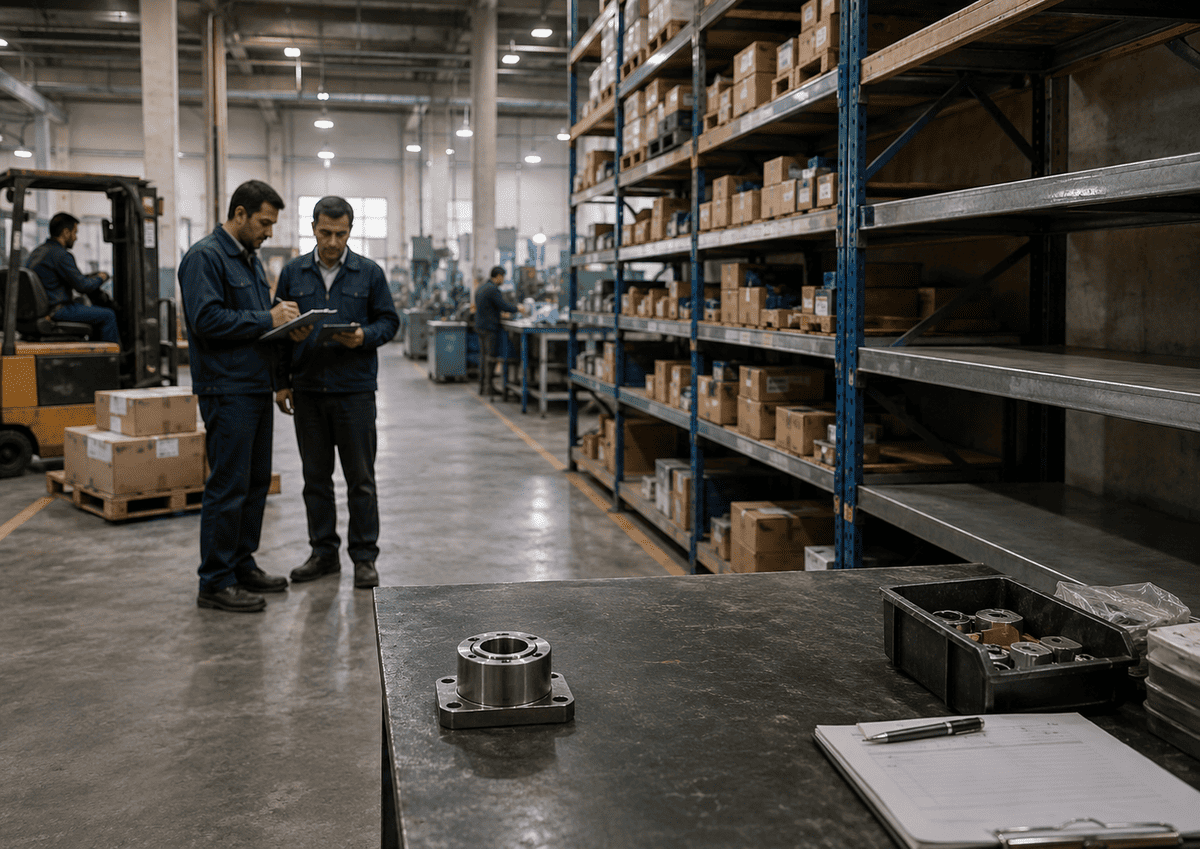
A factory may have a large warehouse full of raw material and still be unable to operate because it lacks one imported seal, sensor, additive or control unit. Another company may hold modest inventory but continue production because it understands which items are genuinely critical.
The correct unit of analysis is not inventory value. It is production continuity.
Each input should be assessed through four questions:
- How many days of production depend on it?
- How quickly can it be replaced?
- Can another specification be used safely?
- What happens downstream if it is unavailable?
Low-cost items can carry disproportionate operational importance. Packaging material can stop a food product from reaching the market. A laboratory reagent can delay an entire pharmaceutical batch. A specialised bearing can idle machinery worth millions of dollars.
Maritime disruption exposes companies that have treated inventory as an accounting category rather than an operating system.
Buyers begin ordering more than they need
Uncertainty changes purchasing behaviour.
When delivery dates become unreliable, companies place orders earlier and often in larger quantities. Some divide one order among several suppliers. Others duplicate orders and plan to cancel whichever shipment appears least likely to arrive.
This creates a distorted signal for suppliers.
A foreign supplier may see Iranian demand rise sharply and assume that consumption has increased. In reality, buyers are trying to protect themselves against delay. The supplier then allocates more production, raises prices or tightens payment terms. Once delayed cargoes eventually arrive together, the buyer can be left with excess inventory and insufficient cash.
The same pattern appears inside Iran.
Distributors place larger orders with manufacturers. Retailers request more stock from distributors. Producers order additional packaging and raw materials. Each participant adds a buffer because it does not trust the next stage.
Demand appears to increase at every level, although final consumption may be unchanged or even falling.
This produces a familiar sequence:
- Orders rise.
- Prices move higher.
- Businesses accumulate inventory unevenly.
- Cash becomes scarce.
- Delayed shipments arrive in clusters.
- Some companies are left overstocked while others still lack critical goods.
A disruption can therefore create shortage and surplus at the same time.
Supplier relationships become more selective
When transport capacity and production slots are limited, suppliers do not treat every customer equally.
They prioritise buyers who pay quickly, accept revised prices, place regular orders and create fewer documentation problems. Long-standing relationships become more valuable. Smaller or less predictable customers move to the back of the queue.
Iranian buyers are particularly exposed because many already purchase through indirect structures, regional intermediaries or suppliers willing to manage additional compliance and payment complexity. During disruption, these suppliers have stronger alternatives and greater bargaining power.
The immediate effect is not always a formal refusal to sell. More often, the commercial terms deteriorate:
- Larger deposits
- Shorter payment periods
- Higher minimum order quantities
- Less flexibility over specifications
- No guarantee of dispatch date
- Limited responsibility for delay
- Priority given to other markets
This shifts risk from the supplier to the Iranian buyer.
Companies with strong international relationships can preserve access even at a higher price. Businesses dependent on a single trader or informal channel may discover that the relationship was based on convenience rather than commitment.
Substitution keeps production moving, but creates new risks
When the preferred input is unavailable, businesses search for substitutes.
They change suppliers, origins, specifications, formulations or packaging. This can prevent an immediate shutdown, but substitution is not a costless solution.
A replacement component may have a shorter life. A different chemical can affect the production process. Alternative packaging can reduce shelf life. A new supplier may provide incomplete documentation or inconsistent quality. Machinery can require recalibration. Customers may reject the change.
The risks are especially serious in regulated or technically sensitive sectors.
Pharmaceuticals
A producer cannot freely replace an active ingredient, excipient or packaging material without considering quality, stability and regulatory approval. An emergency substitute can preserve output while creating future testing, recall or compliance risk.
Food production
Changes in ingredients, feed inputs, oils, additives or packaging can alter taste, shelf life and production yield. The cost of the substitute is only one part of the decision.
Automotive and industrial manufacturing
Components that appear interchangeable can behave differently under heat, pressure or continuous use. A lower-cost substitute can produce higher warranty and maintenance costs months later.
Construction materials
Changes in chemicals, coatings, insulation or mechanical systems can affect project performance long after installation.
In a prolonged disruption, companies gradually redesign products around what they can obtain. Some of these changes become permanent. The result is not merely a more expensive supply chain, but a different product.
Production plans narrow before factories stop
Complete shutdown is usually the final stage.
Before that point, companies simplify production.
A manufacturer with limited inputs reduces the number of models or product variants. A food producer concentrates on standard items and suspends smaller lines. A retailer gives more shelf space to products with reliable domestic supply. An industrial company uses available components for its most profitable or strategically important contracts.
This response protects cash and preserves throughput, but it reduces market choice.
The effect can be seen in several forms:
- Fewer product sizes or colours
- Longer waiting periods
- Removal of lower-margin products
- Greater use of standardised components
- Reduced customisation
- Priority for institutional or large customers
- Temporary suspension of new product launches
For investors, a stable revenue figure can hide this deterioration. A company may maintain sales by concentrating on higher-priced products while losing range, customer diversity and future competitiveness.
Operational resilience should therefore be measured through more than output volume. Product mix, order fulfilment and customer retention often provide earlier signals.
Working capital becomes the central constraint
Maritime disruption is frequently described as a logistics problem. For many Iranian businesses, it becomes a financing problem first.
A longer and less predictable delivery cycle traps cash at several points:
- Deposits paid to suppliers
- Goods waiting for dispatch
- Cargo in transit
- Inventory held as protection
- Additional stock purchased from local traders
- Customer payments delayed because orders are incomplete
The company pays earlier and receives revenue later.
At the same time, suppliers ask for stronger payment terms, transport costs become less predictable and exchange-rate exposure remains open for longer. A business that was profitable under a normal operating cycle can become cash-flow negative without any change in underlying demand.
This divide favours firms with:
- Access to shareholder funding
- Large cash reserves
- Strong banking relationships
- Faster customer collection
- Pricing power
- The ability to reduce product variety
- Inventory that can be used across several products
Smaller companies often face the opposite structure. They pay in advance, buy in smaller volumes, have less bargaining power and sell to customers who still expect credit.
The disruption therefore changes market share. It allows well-financed firms to continue buying while weaker competitors retreat.
Prices rise unevenly, not all at once
A maritime shock does not produce one national inflation rate.
Prices move differently depending on inventory levels, supplier concentration, import dependence, product urgency and the ability of buyers to delay consumption.
Some goods react immediately because traders price them according to expected replacement cost. Others remain stable until existing stock is depleted. Products with government controls or strategic reserves can show little movement at first, followed by a sharper adjustment later.
The sequence often looks disorderly:
- Spot-market prices rise before official prices.
- Wholesale prices move before retail prices.
- Imported substitutes rise before locally produced goods.
- Smaller buyers pay more than large customers.
- Prices differ sharply between regions.
- Availability deteriorates even where official prices remain unchanged.
Quality can also decline without a visible price increase. A producer reduces packaging weight, changes ingredients, shortens warranty terms or replaces a component while keeping the retail price stable.
For this reason, supply-chain inflation should be measured through price, availability and quality together.
Consumer-facing sectors absorb the shock differently
The consequences vary widely by sector.
Food and household essentials
Businesses try to preserve availability because demand is continuous and politically sensitive. They reduce variety, change sourcing and accept lower margins before allowing complete shortages.
Pharmaceuticals and medical supplies
Priority is given to critical medicines and high-volume products. Less common items become harder to source. Hospitals and pharmacies may hold inventory defensively, which reduces circulation further.
Consumer electronics
Sales can fall quickly because customers delay purchases when prices rise. Traders hold inventory as a store of value, making availability less predictable.
Automotive products
Production can continue at reduced efficiency while incomplete vehicles, missing parts and warranty risks accumulate. Repair markets also become more expensive as replacement components become scarce.
Construction
Projects slow rather than stop immediately. Contractors substitute materials, postpone installations and renegotiate schedules. The financial impact appears through delayed completion and claims.
Industrial equipment
Companies extend the life of existing machinery, increase repair activity and postpone capital expenditure. This supports maintenance businesses while weakening demand for new equipment.
The same maritime event therefore produces inflation in one sector, lost sales in another and delayed investment elsewhere.
Smaller firms lose flexibility first
Large companies are not automatically more efficient, but they usually have more options.
They can hold larger inventories, negotiate supplier priority, distribute orders across several channels and absorb temporary increases in cost. They can also use their market position to pass part of the disruption to customers or smaller suppliers.
Smaller firms rely more heavily on speed.
They purchase limited quantities, turn inventory quickly and depend on regular cash circulation. When lead times lengthen, the advantage of a lean operating model disappears. The company needs more stock and more financing at the same time.
This creates a consolidation effect.
Large distributors gain share because they can maintain availability. Smaller importers become brokers for larger firms or leave the market. Manufacturers with strong balance sheets acquire customers from competitors that cannot complete orders.
The eventual market structure can become less competitive even after maritime conditions improve.
Contracts begin to change
Repeated disruption alters commercial behaviour long before formal legal frameworks change.
Buyers and sellers begin to renegotiate:
- Delivery windows
- Price-adjustment mechanisms
- Advance-payment requirements
- Minimum order quantities
- Responsibility for substitute materials
- Cancellation rights
- Inventory commitments
- Penalties for delayed performance
Contracts written for stable transit times become difficult to enforce commercially. A supplier may technically remain within a force-majeure provision while the buyer still needs the goods. A customer may refuse a delayed order even when the seller is not legally at fault.
Companies therefore move away from fixed commitments and towards flexible arrangements.
This reduces legal exposure but transfers uncertainty into prices. The customer pays for optionality, priority or guaranteed stock. The supplier avoids long-term pricing unless its costs can be adjusted.
Over time, the economy becomes more transactional and less relationship-based. Each party protects itself against the next disruption.
Recovery does not begin when transport resumes
When normal movement returns, supply chains do not immediately return to normal.
Delayed orders arrive out of sequence. Some buyers have already found alternatives. Others no longer have enough cash to receive the goods they ordered. Warehouses contain too much of one input and too little of another. Suppliers continue applying stricter terms because they do not yet trust the improvement.
The recovery period can create its own instability.
Companies cancel duplicate orders. Traders sell excess inventory. Prices fall for some products while remaining high for others. Businesses that purchased at peak cost face losses when competitors receive cheaper replacement stock.
Production planning also remains difficult. A factory cannot automatically use every delayed component. The customer order linked to it may have expired, the product design may have changed or another required input may still be missing.
A supply chain is fully recovered only when delivery times become predictable enough for companies to reduce defensive behaviour.
That can take much longer than the physical disruption itself.
What operators should examine inside their own businesses
The most useful response begins with internal visibility.
Companies should identify:
Critical inputs
Which items can stop production or prevent a finished product from being sold?
True inventory cover
How many operating days remain under different production scenarios?
Supplier concentration
Which inputs depend on one supplier, one origin or one intermediary?
Substitute readiness
Which replacements have already been tested, approved and documented?
Cash exposure
How much additional working capital is required if delivery times extend by 30, 60 or 90 days?
Customer priority
Which contracts, products and customers should receive limited inventory first?
Cancellation risk
Which incoming orders could become unnecessary if they arrive late?
Decision authority
Who can approve substitutions, emergency purchases, production changes and revised prices?
A business that cannot answer these questions quickly is managing disruption through reaction rather than control.
What investors should look for
Maritime disruption provides a practical test of business quality.
The strongest companies are not simply those with the largest warehouses. They are the ones that understand their dependencies and can change decisions before the market forces them to.
Useful indicators include:
- Production days lost because of missing inputs
- Percentage of revenue dependent on imported components
- Inventory of critical rather than general items
- Supplier concentration
- Cash conversion cycle
- Ability to change product mix
- Frequency of emergency purchasing
- Share of orders delivered on time
- Customer cancellations
- Margin changes caused by substitution
- Dependence on short-term trade finance
Management quality becomes visible in the speed and discipline of the response.
Weak companies buy indiscriminately, hold the wrong inventory and react to every price movement. Strong operators preserve cash, protect essential production, communicate early with customers and distinguish temporary scarcity from structural dependence.
The deeper effect is a change in corporate behaviour
Maritime disruption does more than delay goods.
It changes how companies purchase, price, finance and compete. It rewards access to cash over operating efficiency. It shifts market share towards firms with stronger supplier relationships. It reduces product variety. It encourages substitution and creates hidden quality risks. It turns inventory into a strategic asset and makes working capital a condition of survival.
These effects remain after shipping schedules improve.
Once businesses have experienced repeated uncertainty, they continue holding more stock, demanding larger deposits and relying on fewer trusted partners. The cost of resilience becomes embedded in the operating model.
The central question is therefore not only whether Iranian supply chains can continue moving during maritime disruption. They usually can, in some form.
The harder question is what kind of market emerges after every company has paid to protect itself.