Iran Solar Market 2026: Investment Opportunities & Equipment
Iran’s solar market is moving into a different phase.
For years, the country’s renewable-energy story was largely about potential: abundant sunlight, a large electricity system, rising power demand and repeated government targets for new capacity.
That is beginning to change.
Solar projects are now being commissioned at a much faster pace, financing is being directed toward large-scale deployment, and the government is simultaneously trying to build a domestic supply chain for the equipment behind those projects.
That creates a more interesting investment question than simply whether Iran needs more solar power.
Where in the solar value chain is the real opportunity?
The answer may increasingly be in the equipment, services and industrial infrastructure surrounding new solar plants rather than in power generation alone.
Deployment is accelerating
Iran has historically added renewable capacity relatively slowly.
That pace has recently increased sharply.
Iranian energy officials said in September 2026 that renewable capacity additions had accelerated from roughly 100 MW per year in the past to around 100 MW per week. At the same time, approximately 1.7 GW of a planned 7 GW solar programme had already entered operation, according to statements by the head of Iran’s Renewable Energy and Energy Efficiency Organization, or SATBA.
The acceleration is important because equipment demand behaves differently once installation moves from hundreds of megawatts over several years to gigawatt-scale deployment.
Every new solar project requires more than panels.
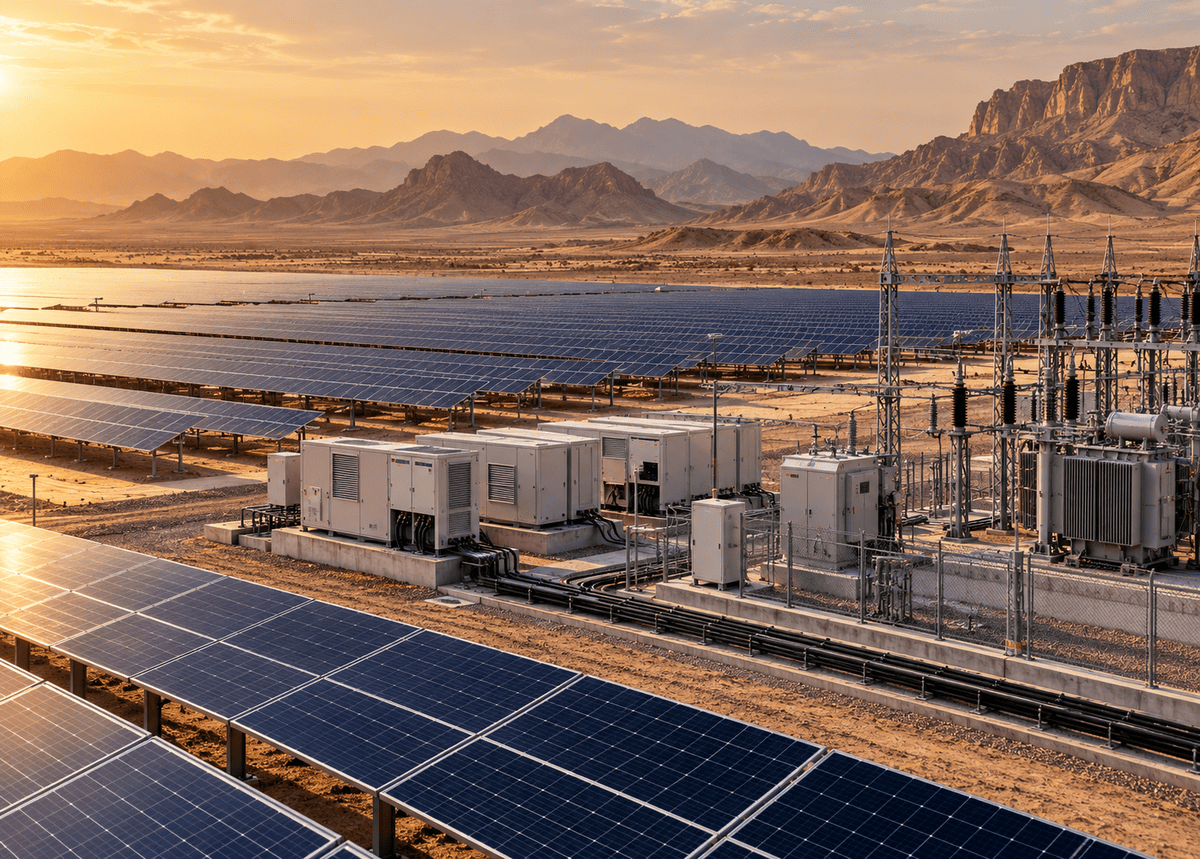
It requires inverters, mounting structures, transformers, cables, switchgear, monitoring systems, control equipment, engineering services and eventually maintenance and replacement components.
As deployment scales, the economics of producing some of these components locally begin to change.
Iran is trying to build the supply chain at the same time
The government is clearly attempting to use the expansion of solar generation to create an industrial market around it.
SATBA has said it is preparing support mechanisms — including potential guaranteed purchasing — for domestically manufactured solar panels and inverters. Officials have also acknowledged that much of Iran’s current panel production is still essentially assembly rather than deep domestic manufacturing.
The distinction matters.
Assembling imported cells into modules creates local activity, but it does not create the same industrial depth as producing wafers, cells, power electronics or critical components domestically.
Iran’s solar equipment market should therefore not be viewed as one industry.
It is several different industries with very different barriers to entry.
Panels may be the largest market, but not necessarily the best opportunity
Solar modules represent one of the largest components of project procurement.
That makes panel manufacturing the obvious place to look.
But it is also one of the hardest parts of the value chain in which to create a durable competitive advantage.
Global module manufacturing is dominated by extremely large Asian producers with enormous scale, highly integrated supply chains and continuous cost reduction.
Iranian manufacturers competing only by assembling imported cells into locally finished panels therefore face an uncomfortable equation.
When imported modules are available, they may struggle to compete on price.
When imports are constrained, local assembly becomes more attractive, but remains dependent on imported cells and other components.
The result is that domestic panel production can improve supply security without necessarily becoming globally competitive.
Government purchasing support may make the economics more attractive, but investors still need to separate policy-supported demand from structurally competitive manufacturing.
Inverters are becoming more interesting
The inverter market presents a different case.
In September, Iran opened what officials described as the country’s first industrial-scale solar inverter manufacturing facility, capable of producing units in roughly the 125 to 510 kW range.
There is also a programme for approximately 1 GW of domestically produced grid-connected and hybrid solar inverters, involving a consortium of five Iranian technology companies and a guaranteed first-purchase arrangement.
Inverters are strategically important because they sit between the solar array and the electricity grid.
They control power conversion, grid interaction, monitoring and increasingly elements of plant intelligence.
Unlike basic mounting structures, they require substantial power-electronics capability, software, certification and after-sales support.
That raises the technical barrier to entry, but also makes the market more defensible.
For investors and technology suppliers, this may be one of the more attractive segments of Iran’s emerging solar equipment ecosystem.
The opportunity is not necessarily limited to manufacturing complete inverters.
It also includes control systems, components, monitoring software, testing, maintenance and industrial electronics.
The least glamorous parts of the system may offer the strongest economics
Solar investment discussions often focus on panels and inverters because they are the most visible technologies.
But large deployment programmes generate significant demand for simpler components as well.
These include:
- steel mounting structures;
- transformers;
- medium-voltage equipment;
- cables and connectors;
- switchgear;
- monitoring systems;
- cleaning systems;
- engineering and installation;
- operations and maintenance.
Iran already has manufacturing capability in several of these industries.
That changes the economics significantly.
Producing a steel mounting system locally, for example, does not require recreating a global photovoltaic supply chain. It requires steel fabrication, engineering and logistics, industries in which Iran already has substantial capacity.
The same is true for some electrical equipment.
This means the most commercially realistic localisation opportunity may not be the most technologically sophisticated part of the solar plant.
It may be the components that can be integrated into Iran’s existing industrial base.
Storage is the next market to watch
Solar deployment solves one problem but creates another.
Solar generation is concentrated during daylight hours, while electricity demand does not follow exactly the same profile.
As solar penetration increases, the value of battery storage increases with it.
Iranian authorities have already issued permits for around 500 MW of battery-storage capacity alongside the current renewable expansion programme.
This is still small compared with the potential future requirement.
If several additional gigawatts of solar capacity enter the grid, storage, grid balancing and flexible generation will become increasingly important.
That creates an emerging second market around the solar boom.
Battery systems, battery-management systems, power conversion, thermal management and energy-management software could eventually become as strategically relevant as the solar modules themselves.
For international companies, storage may also provide a more differentiated entry opportunity than competing directly with low-cost imported panels.
Financing remains as important as technology
A large project pipeline does not automatically create a large investable market.
Projects must also be financed.
Iran has allocated substantial financial resources toward the current solar buildout. In September, SATBA said close to $1 billion from National Development Fund foreign-currency resources had been received for solar projects, within a broader financing programme.
That improves the near-term deployment outlook.
But investors still need to examine where project revenues ultimately come from.
Important questions include:
- Who buys the electricity?
- At what tariff?
- In which currency are project costs incurred?
- How are foreign-currency equipment costs financed?
- How reliably are electricity purchases settled?
- Can industrial users sign economically attractive direct agreements?
- What happens when exchange rates move substantially during construction?
These questions can be more important than solar irradiation.
A technically excellent solar plant with a weak payment structure is not necessarily a good investment.
Industrial customers could become a major demand driver
Iran’s electricity shortage also changes the economics of solar power.
For many industrial users, the comparison is no longer simply:
solar electricity versus cheap grid electricity.
It is increasingly:
solar electricity versus the cost of unreliable electricity.
Factories exposed to power restrictions lose production, labour hours and equipment utilisation.
That gives on-site or dedicated solar generation a different economic value.
SATBA has explicitly encouraged industrial facilities to install solar systems, including on industrial rooftops.
This could expand the market beyond utility-scale projects.
Factories, industrial parks, warehouses, mines and logistics facilities can create demand for distributed solar systems that may require different equipment and financing structures than large power plants.
For equipment manufacturers and EPC companies, this segment could ultimately be more fragmented but also more resilient.
Imports will not disappear
The push toward domestic manufacturing should not be interpreted as Iran becoming self-sufficient in solar technology.
Even locally manufactured products can depend heavily on imported components.
Panels may require imported cells or production equipment.
Inverters require semiconductor components and sophisticated electronics.
Battery projects require cells and battery materials.
Automation and monitoring equipment may also rely on imported technology.
The relevant question is therefore not whether Iran can manufacture solar equipment locally.
It is how much of the value chain can realistically be localised without raising project costs or reducing equipment reliability.
That distinction will determine whether domestic manufacturing becomes an economically sustainable industry or remains primarily dependent on policy protection.
Where the opportunity appears strongest
The Iranian solar market can roughly be divided into four opportunity groups.
Power generation offers the largest capital requirement but also faces the greatest exposure to financing, tariffs and regulatory structures.
Panel manufacturing benefits from large expected demand but faces intense international competition and continued dependence on imported upstream components.
Inverters and power electronics offer a smaller market but higher technical barriers and greater potential for localisation, engineering and after-sales value.
Balance-of-system equipment and services — structures, transformers, cables, EPC, maintenance and monitoring — may offer the most immediate opportunity because they can build on industries that already exist inside Iran.
Battery storage represents the emerging fifth category.
Its market is still small, but its strategic value should grow as solar penetration increases.
The real solar opportunity is becoming industrial
Iran’s solar expansion started as an electricity story.
It is gradually becoming an industrial one.
The most important indicator may no longer be simply how many megawatts of solar capacity are installed each month.
The more revealing indicators will be:
- how much equipment is produced domestically;
- which components remain import-dependent;
- whether local manufacturers become cost competitive;
- how quickly storage is deployed;
- whether industrial customers become major buyers;
- and whether project financing remains available as the market scales.
If deployment continues at the current pace, Iran will need a much larger ecosystem around every gigawatt of new solar generation.
That ecosystem — equipment, engineering, electronics, storage, software and maintenance — may ultimately represent a broader commercial opportunity than the power plants themselves.