Iran–Turkmenistan Trade and Investment: From Border Commerce to Strategic Connectivity
Iran and Turkmenistan have spent decades as neighbours with more physical connectivity than commercial scale.
Two gas pipelines cross their border. Two major rail routes connect Iran with the Turkmen network and, through it, Central Asia. Several road crossings link northeastern Iran directly with Turkmen markets. The two countries share access to the Caspian Sea, and Iran offers Turkmenistan something geography otherwise denies it: a relatively short route south to the Persian Gulf and Gulf of Oman.
Yet bilateral trade remains modest compared with this infrastructure.
That gap between what already exists physically and what has been achieved commercially is increasingly becoming the central question in Iran–Turkmenistan economic relations.
The latest round of diplomacy has brought it back into focus. Iranian President Masoud Pezeshkian travelled to Turkmenistan on October 8, 2026 for high-level events in Avaza, including the first Caspian Environmental Summit, and on October 9 became the first Iranian president to participate in a CIS heads-of-state meeting as a special guest. He also met Turkmen President Serdar Berdimuhamedov, with the Turkmen side highlighting energy, transport, communications and agriculture among the established areas of economic cooperation.
The visit followed another meeting just one day earlier between Turkmen Foreign Minister Rashid Meredov and Iran’s Minister of Roads and Urban Development Farzaneh Sadegh. The discussion was notably practical: transport infrastructure, transit capacity and regional connectivity were placed at the centre of the agenda.
These meetings are not isolated diplomatic gestures. They sit on top of a broader attempt to redefine the relationship from simple bilateral trade into something more ambitious: an energy, production and transit partnership connecting Central Asia with Iran and markets further south and west.
Trade Is Growing, but the Starting Point Is Still Small
The commercial relationship has gained momentum. Bilateral trade was estimated at roughly $600 million in 2024, and in May 2025 the two countries developed a roadmap aimed at raising trade to $3 billion by 2028. That target is significant precisely because of how far it sits above the existing base.
Iranian customs data provide a clearer picture of what is already moving across the border. During the first nine months of the Iranian year ending December 21, 2025, Iran exported approximately $495 million of non-oil goods to Turkmenistan, up 22.5% by value from a year earlier. Total reported non-oil trade between the two countries reached about $504 million during the same period. Iranian exports included agricultural and food products, industrial goods, transformers, cooling equipment and petrochemicals.
The figures also reveal an important structural issue: the non-oil relationship is heavily weighted toward Iranian exports.
That is not necessarily a weakness. Iran is a nearby manufacturing economy with a broad product base, while Turkmenistan’s export structure remains much more concentrated in energy, petrochemicals and textiles. But it does mean that achieving a $3 billion relationship cannot realistically depend on selling more Iranian consumer and industrial products into Turkmenistan alone.
The bigger opportunity lies elsewhere.
Trade can become substantially larger if the two countries begin monetising energy swaps, transit flows, joint processing, infrastructure services and third-country trade, rather than measuring the relationship only by goods crossing the bilateral border.
This distinction matters. A truck carrying Iranian food to Ashgabat creates bilateral trade. A Central Asian container moving through Turkmenistan and Iran to Bandar Abbas creates transit revenue. Turkmen gas entering northeastern Iran and an equivalent volume being delivered to Türkiye or Iraq creates an energy service. Agricultural goods processed in Iran and re-exported through a southern port create a regional value chain.
Those activities can increase the economic value of the relationship without requiring Turkmen domestic demand to expand fivefold.
Energy Is Still the Strongest Strategic Link
Gas remains the most developed piece of infrastructure connecting the two countries.
The Korpeje–Kurt Kui pipeline, opened in 1997, was designed for about 8 billion cubic metres of gas annually. A second route, the Dowletabat–Sarakhs–Khangiran pipeline, opened in 2010 with design capacity of roughly 12.5 billion cubic metres. Turkmen official sources have historically described the two routes as capable of supplying considerably larger volumes if infrastructure and contracts are expanded.
The relationship has not always been smooth. A dispute over Iranian payments for earlier Turkmen gas deliveries eventually went to international arbitration after supplies were interrupted in 2017. That episode remains relevant because energy cooperation between the two countries depends not only on pipeline capacity but also on pricing, settlement and confidence that contracts will be honoured.
Recent developments suggest both sides are again trying to move beyond that history.
In July 2024, Iran and Turkmenistan announced plans for Iranian companies to construct a new 125-kilometre gas pipeline and three compressor stations inside Turkmenistan. Turkmen authorities also announced a contract envisaging up to 10 billion cubic metres per year of Turkmen gas being supplied to Iraq through Iran under a swap arrangement. Officials separately discussed infrastructure capable of supporting much larger future Turkmen gas deliveries toward Iran. These figures describe proposed or contracted capacity, not current realised flows, but they show the scale of the ambition.
The more important proof of concept came in 2025.
Türkiye and Turkmenistan reached an agreement for Turkmen gas to be supplied through Iran using a swap structure, with deliveries beginning in March. Türkiye’s Energy Ministry initially expected around 1.3 billion cubic metres to be supplied during 2025, while the EBRD later identified the launch of swap-based deliveries through Iran as a meaningful step in Turkmenistan’s diversification of gas export routes.
This changes how Iran’s value should be understood.
For Turkmenistan, Iran does not have to be the final buyer of every cubic metre. Iran can be a network.
Turkmen gas can enter Iran close to the production areas and consumption centres of northeastern Iran, while Iranian gas is delivered from another part of the network to a third market. The commercial value is therefore not limited to Iran’s own demand. In principle, swap structures could connect Turkmen supply with Türkiye, Iraq, Azerbaijan and potentially other regional markets where commercial and political conditions permit.
For Iran, the arrangement also solves a domestic geographic problem. Major Iranian gas production is concentrated far to the south, while substantial winter demand sits in northern provinces much closer to Turkmenistan. Receiving gas in the northeast can reduce the need to transport every unit of gas across the full length of Iran’s domestic network.
That makes energy one of the rare areas where the geography of both countries produces a genuine two-sided economic advantage.
Electricity adds a second layer. At the May 2025 intergovernmental commission, the two sides discussed further Turkmen electricity supplies to Iran and implementation of the Turkmen section of the Mary–Mashhad transmission project.
Given Iran’s persistent electricity shortages, cross-border power trade could become commercially more important than its historical share of bilateral economic relations would suggest.
The Bigger Opportunity May Be Transit, Not Bilateral Trade
Turkmenistan occupies an unusual position in Iran’s regional trade map.
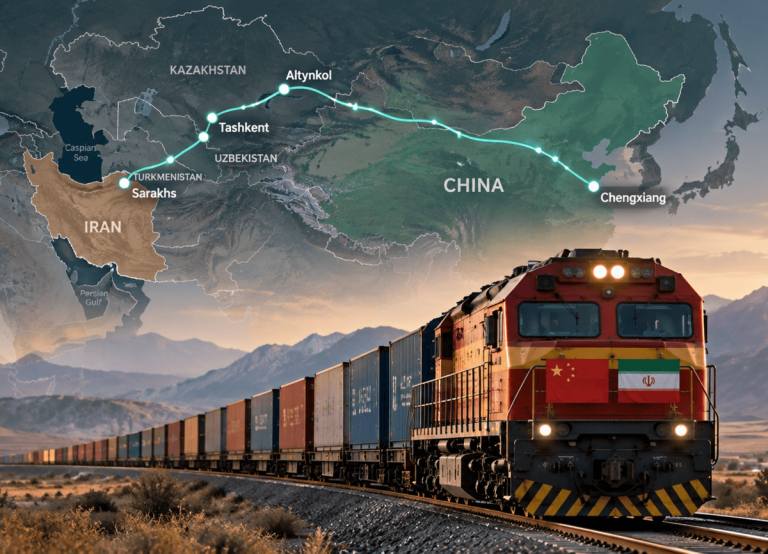
For Iranian companies, it is both a market and a gateway. Routes crossing Turkmenistan lead toward Uzbekistan, Kazakhstan, China and eventually wider Eurasian networks.
For Turkmenistan, Iran provides access in the opposite direction: toward Persian Gulf ports, the Gulf of Oman, Türkiye and other Middle Eastern markets.
This creates an opportunity that neither country’s domestic market size captures.
Iranian officials explicitly framed the relationship this way at the Turkmenistan Investment Forum in October 2026. Tehran argued that Turkmenistan could act as Iran’s bridge into the wider Eurasian economic space, while Iran could provide Central Asian economies with access to southern ports and Middle Eastern markets. Energy, logistics, agriculture and industrial investment were identified as the four principal areas for a new generation of cooperation.
There are several physical gateways through which this can happen.
Sarakhs is the most strategically important because it combines road and rail connectivity and sits on routes connecting Iran with Turkmenistan and the deeper Central Asian network. In October 2026, work on a new Iranian rail terminal at Sarakhs was reported to be 60% complete. The project includes an 18-hectare specialised container handling area designed to accelerate transfers between Iran, Central Asia and China.
Incheh Borun provides another rail connection, particularly important for northern Iran and the Kazakhstan–Turkmenistan–Iran corridor. Lotfabad–Artyk and Bajgiran–Howdan provide additional road interfaces, giving companies several routing options depending on cargo, destination and origin.
The wider Turkmen transport system is also expanding. During the first half of 2026, Turkmenistan reported more than 10.5 million tonnes of cargo passing through its border checkpoints, up 10% year on year. International transit cargo exceeded 3.5 million tonnes, a 15% increase. These are national Turkmen figures rather than Iran-specific flows, but they show that Ashgabat is actively developing transit as an economic activity rather than treating it merely as supporting infrastructure.
Iran–Turkmenistan transport cooperation also has a Caspian dimension. Earlier agreements established sister-port cooperation between Turkmenbashi International Port and Iran’s Amirabad Port, opening another potential layer of multimodal trade linking the eastern Caspian with northern Iran.
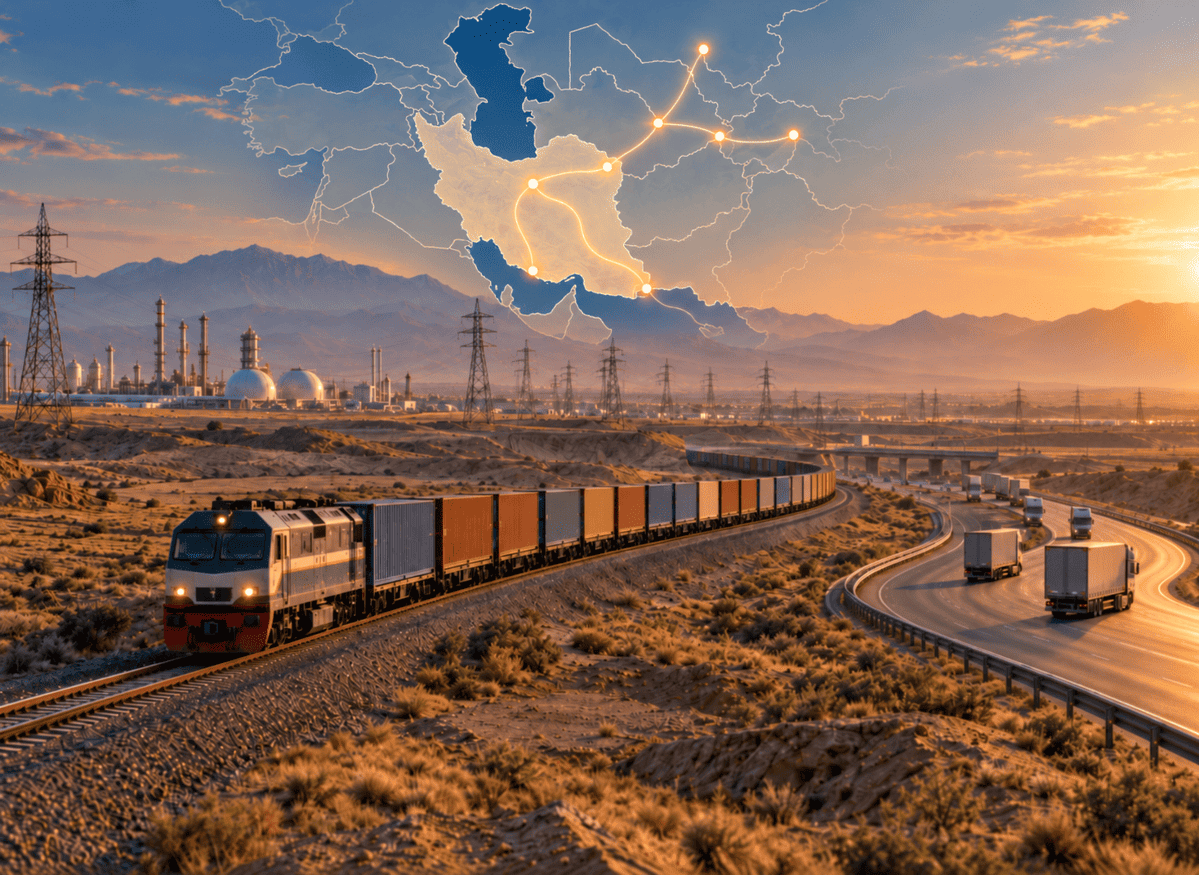
The opportunity, therefore, is not to choose between rail, road and sea. It is to create an integrated network in which cargo can enter Iran through a southern port, cross the country by rail or road, pass through Turkmenistan and reach Central Asia—or move in the opposite direction toward international shipping routes.
That is a materially bigger economic proposition than bilateral trucking alone.
Border Infrastructure Is Becoming an Investment Theme
The four main Iran–Turkmenistan gateways have historically functioned primarily as customs and transport nodes.
They could increasingly become economic zones in their own right.
At the 18th Iran–Turkmenistan Intergovernmental Commission in May 2025, Turkmenistan proposed establishing trade and economic zones along sections of the shared border. The two sides have subsequently discussed border-zone concepts around Sarakhs and Incheh Borun as part of efforts to increase trade and transit.
If implemented properly, this could create a different type of opportunity from conventional free zones.
Instead of expecting investors to establish factories solely to serve the Turkmen domestic market, border zones could support logistics centres, warehouses, cold storage, packaging, assembly, maintenance, customs services and distribution facilities serving traffic moving between Central Asia and Iran.
That model is more consistent with the real economics of the border.
The strongest locations are likely to be those where trade volume, rail access and onward connectivity overlap. Sarakhs is the clearest example, while Incheh Borun gives northern Iranian provinces an alternative entry into the Turkmen and Kazakh networks. Lotfabad may have an advantage for road-based trade serving Ashgabat and Ahal.
The investment case should therefore be evaluated corridor by corridor, rather than treating the entire 1,000-plus-kilometre border as one commercial geography.
Agriculture Could Become a Regional Value Chain
One of the more interesting ideas presented at the October 2026 investment forum was not about selling more Iranian food in Turkmenistan.
Iran proposed combining Central Asian agricultural production with Iranian processing, packaging and market access to create products that could then be sold into international markets.
That is a more sophisticated model than conventional bilateral agricultural trade.
Turkmenistan and other Central Asian economies can supply agricultural commodities and inputs. Iran has a much larger food-processing base, packaging industry and access to Persian Gulf ports. Northern Iranian provinces such as Golestan, Razavi Khorasan and Mazandaran are geographically positioned to participate in such a system.
A commercially viable chain could therefore look like this:
Central Asian agricultural production moves south through Turkmenistan, is processed or packaged in northern Iran, and then either returns to regional markets or continues toward the Persian Gulf and international buyers.
The reverse model is equally relevant. Iranian processed foods, agricultural inputs, machinery, greenhouse equipment and industrial food-production systems can move north into Turkmenistan.
This is particularly interesting because the Turkmen government itself has recently promoted the creation of joint export-oriented agro-industrial complexes as part of deeper regional economic cooperation.
The opportunity is consequently less about competing for one country’s supermarket shelves and more about deciding where each stage of a regional supply chain should take place.
That is exactly the kind of investment decision in which geography, energy cost, processing capacity and border efficiency matter simultaneously.
Industrial Suppliers May Have a More Immediate Opportunity
Turkmenistan remains a major buyer of industrial equipment, infrastructure and energy-sector materials.
For Iranian manufacturers, proximity provides a clear logistical advantage, particularly in products where freight accounts for a meaningful share of delivered cost.
Recent procurement activity illustrates the opportunity. On October 8, 2026, state oil company Turkmennebit re-announced international tenders for pipes and rolled metal products. The tender is limited to manufacturers meeting the technical requirements, rather than simple intermediaries.
That type of procurement potentially matches areas where Iran already has substantial domestic capacity: steel pipe, structural steel, electrical equipment, transformers, cables, industrial pumps, valves, cement, construction materials and selected engineering services.
Iranian companies also have an existing history of participation in Turkmen road and infrastructure projects. The two governments have continued discussing Iranian involvement in transport construction, including the Gumdag–Etrek–Iran border highway.
The more attractive model may therefore be project supply and contracting, rather than large-scale equity investment.
An Iranian manufacturer can supply equipment or materials to a defined project, potentially with payment and delivery terms structured around a specific contract. That creates less exposure than investing capital in a local operation whose revenues must later be converted and repatriated.
Where the Opportunity Is Strongest — and Where It Is Not
The strategic fit between the two economies is real, but it should not be confused with an easy investment environment.
| Area | Strategic potential | Core commercial logic | Main execution risk |
|---|---|---|---|
| Gas & energy swaps | Very high | Existing pipelines + Iran as bridge to third markets | Contract, pricing and settlement |
| Electricity | High | Turkmen supply close to power-deficit northern Iran | Transmission capacity and project execution |
| Rail & transit | Very high | Central Asia ↔ Iran ↔ southern ports | Border capacity, transfer time and tariffs |
| Border logistics | High | Warehousing, terminals, cold chain and distribution | Scale and regulatory coordination |
| Industrial supply | High | Iranian manufacturing + short distance | Tender access and payment structure |
| Agri-food processing | Medium–High | Central Asian inputs + Iranian processing/export access | Standards, customs and commercial scale |
| Conventional FDI in Turkmenistan | Selective | Local market and strategic projects | FX convertibility, state control and repatriation |
The final row is important.
Turkmenistan continues to operate a heavily state-influenced economic model. The U.S. State Department’s investment-climate assessment has identified foreign-currency conversion and profit repatriation as major constraints, while state-owned enterprises dominate much of energy, transport, chemicals and industrial production. The EBRD’s 2025–26 assessment similarly described foreign-exchange liberalisation as a key reform priority.
Import and investment contracts may also face registration and approval procedures, and state procurement remains a major route into strategically important sectors.
For foreign companies, this means Turkmenistan should not be approached like an open consumer market where a company simply establishes a subsidiary, sells locally and freely repatriates its earnings.
The more robust models are likely to involve hard-currency export contracts, project-specific procurement, energy swaps, transit services, engineering contracts or structures in which settlement risk is clearly allocated before capital is committed.
Iranian companies may have political and geographic advantages compared with more distant competitors, but proximity does not eliminate these financial risks.
A $3 Billion Relationship Requires a Different Definition of Trade
The target of raising bilateral trade toward $3 billion is ambitious.
If the relationship remains primarily a flow of Iranian manufactured and agricultural products into the Turkmen domestic market, reaching that level will be difficult.
If the definition broadens, the calculation changes.
Turkmen gas moving through Iran to third countries has value. Electricity trade has value. Containers moving from China or Central Asia through Turkmenistan and Iran generate logistics revenue. Iranian companies supplying Turkmen infrastructure generate exports of goods and services. Agricultural processing creates value on both sides of the border. Warehousing and terminals capture revenue from goods that may ultimately be sold in neither Iran nor Turkmenistan.
Seen this way, the central opportunity is not simply Iran–Turkmenistan trade.
It is the creation of an Iran–Turkmenistan economic corridor.
Turkmenistan sits between Iran and some of the fastest-developing trade routes across Central Asia. Iran sits between Turkmenistan and the open seas to the south. Both countries possess energy infrastructure that can turn geography into cross-border gas and electricity trade. And both are now explicitly discussing investment in the physical systems required to connect those roles.
The October 2026 meetings in Avaza are significant because they place this logic at the political level at the same moment that projects on the ground—from Sarakhs rail infrastructure to energy swaps and border-zone proposals—are becoming more tangible.
The real test will not be the number of memoranda signed.
It will be whether border waiting times fall, container volumes rise, gas swaps expand, power links are completed, industrial contracts reach manufacturers, and private companies can build profitable businesses around the corridor.
If that happens, Iran and Turkmenistan could move from being neighbouring trading partners to becoming complementary nodes in a wider Central Asian–Middle Eastern economic network.
That is where the larger opportunity lies.