Iran’s Housing Market Is Rising Without Buyers: Understanding the Stagflation Trade
Iran’s housing market is sending two signals that normally should not coexist.
Home prices remain under upward pressure, while actual buying activity has weakened sharply. Construction is becoming more expensive, rents are still rising, and property remains one of the assets Iranians use to protect savings from inflation. Yet fewer households can afford to buy, developers face slower sales, and sellers are increasingly dealing with a market in which the quoted price of a property and the price at which it can actually be sold are two different things.
This is not a conventional housing boom. It is closer to housing stagflation: rising nominal prices combined with weak transaction volumes, deteriorating affordability and limited real market liquidity.
Understanding that distinction matters for investors, developers and companies exposed to Iran’s construction and real-estate sectors.
Prices can rise even when demand is weak
In a normal property cycle, higher prices usually come with stronger demand, rising transaction volumes and increased construction activity.
Iran’s current market works differently.
According to the Ministry of Roads and Urban Development, monthly housing transactions in Tehran have fallen to roughly 2,000 deals, compared with around 10,000 in more normal conditions — an approximately 80% contraction in activity.
Yet the collapse in transactions has not translated into a comparable fall in asking prices.
There are several reasons.
The first is inflation. Property owners rarely evaluate their homes only in terms of current buyer demand. They also compare them with the cost of replacing the asset, construction costs, land prices, foreign exchange rates and alternative stores of value such as gold.
When the rial loses purchasing power rapidly, accepting a substantially lower nominal price can feel like locking in a permanent loss.
As a result, sellers often respond to weaker demand not by immediately cutting prices, but by withdrawing the property, delaying the sale or holding their asking price.
That creates a market in which transaction volume adjusts faster than prices.
Replacement cost is putting a floor under prices
The second force is the cost of new construction.
The Statistical Center of Iran’s construction-input index for residential buildings in Tehran showed input prices rising 20.7% in a single quarter in spring 2026, after an even larger increase in the previous quarter. Year-on-year construction-input inflation exceeded 100%.
That matters even in a weak housing market.
If land, steel, cement, labor, mechanical systems and finishing materials become significantly more expensive, developers cannot easily replace an existing unit at yesterday’s price.
This produces a form of cost-push housing inflation.
Existing properties do not need strong end-user demand to become more expensive in nominal terms if the cost of producing the next unit is rising faster.
The result is uncomfortable for both sides of the market: buyers cannot afford existing prices, while developers and owners often cannot justify materially lower ones.
The real constraint is purchasing power
The strongest brake on Iran’s housing market is no longer the willingness to own property. It is the ability to pay for it.
For most households, incomes have not remotely kept pace with asset prices.
Iran also lacks the kind of deep mortgage market that allows households in many other countries to spread the cost of a property across decades. Housing purchases still depend heavily on accumulated savings, family wealth, the sale of another asset and relatively limited bank financing.
That structure becomes particularly restrictive during periods of rapid inflation.
A household may still want to buy a home, but each new round of currency depreciation increases the required down payment faster than wages can replenish savings.
The market therefore loses first-time buyers and middle-income upgrading buyers long before it loses demand in the abstract.
Demand still exists.
Purchasing power does not.
This distinction helps explain why high advertised prices can coexist with extraordinarily low transaction volumes.
Housing is also competing with household survival
The deterioration in affordability is no longer limited to home ownership.
Rental costs have also increased substantially. Official data placed year-on-year rent inflation at about 31% in June 2026, considerably below overall inflation but still a major increase for households whose real incomes were already under pressure.
The fact that rent inflation has risen more slowly than general inflation should not automatically be interpreted as improving affordability.
Housing contracts adjust with a lag. Iran’s rental system also commonly combines monthly rent with large upfront deposits, which can shift part of the burden outside simple monthly-rent comparisons.
Meanwhile, market asking data in Tehran point to substantial absolute rental costs relative to ordinary salaries.
As more household income is absorbed by food, transport, utilities and rent, the pool of savings available for a future home purchase shrinks further.
That reinforces the transaction freeze.
A frozen market changes what “price” means
This is where investors need to be careful.
In a highly liquid market, the latest transaction provides useful information about the value of similar assets.
In an illiquid market, price discovery becomes weaker.
A seller may advertise an apartment at a certain price for months without finding a buyer. Another seller with an urgent need for liquidity may eventually accept a meaningful discount. Both units can then appear to belong to the same nominal price environment even though their realizable values are different.
The gap between asking price and executable price becomes an important market indicator.
So does time on market.
For an investor, a property that has appreciated 40% on paper but requires a 15% discount and six months to sell has generated a very different return from a liquid asset showing the same nominal gain.
This is why headline property-price inflation alone is increasingly insufficient for understanding Iran’s housing market.
Liquidity needs to be treated as part of valuation.
Nominal returns can conceal weak real performance
Iranian property has historically been viewed as an inflation hedge, and that logic has not disappeared.
But the relevant question for investors is not simply whether prices are rising in rials.
The better comparison is against:
- consumer inflation;
- construction-cost inflation;
- the exchange rate;
- gold and other liquid stores of value;
- rental income;
- and the opportunity cost of holding an illiquid asset.
A home whose rial price rises while the currency depreciates at a similar or faster rate may generate little or no return in hard-currency terms.
Likewise, a property producing a relatively low rental yield can become expensive to hold if the owner needs liquidity.
The investment case therefore varies significantly by buyer.
A household seeking long-term shelter, an investor protecting domestic purchasing power, a developer building for sale and a foreign investor measuring returns in dollars are participating in fundamentally different markets even when they are looking at the same apartment.
Developers face a particularly difficult equation
For developers, the current environment is more challenging than simple inflation data suggest.
Rising construction costs increase the capital required to complete a project.
Weak household purchasing power reduces the number of buyers capable of absorbing completed units.
High macroeconomic uncertainty increases the risk that a project launched under one cost structure will be completed under another.
And slow transactions increase the amount of time developers must keep capital tied up before realizing revenue.
That can produce a damaging combination:
higher development cost + slower absorption + more expensive working capital.
In such an environment, developers may reduce new starts, delay projects or increasingly focus on segments where buyers are less dependent on wage income.
Over time, lower construction activity can itself reinforce supply constraints, preventing weak demand from producing the price correction that would normally clear the market.
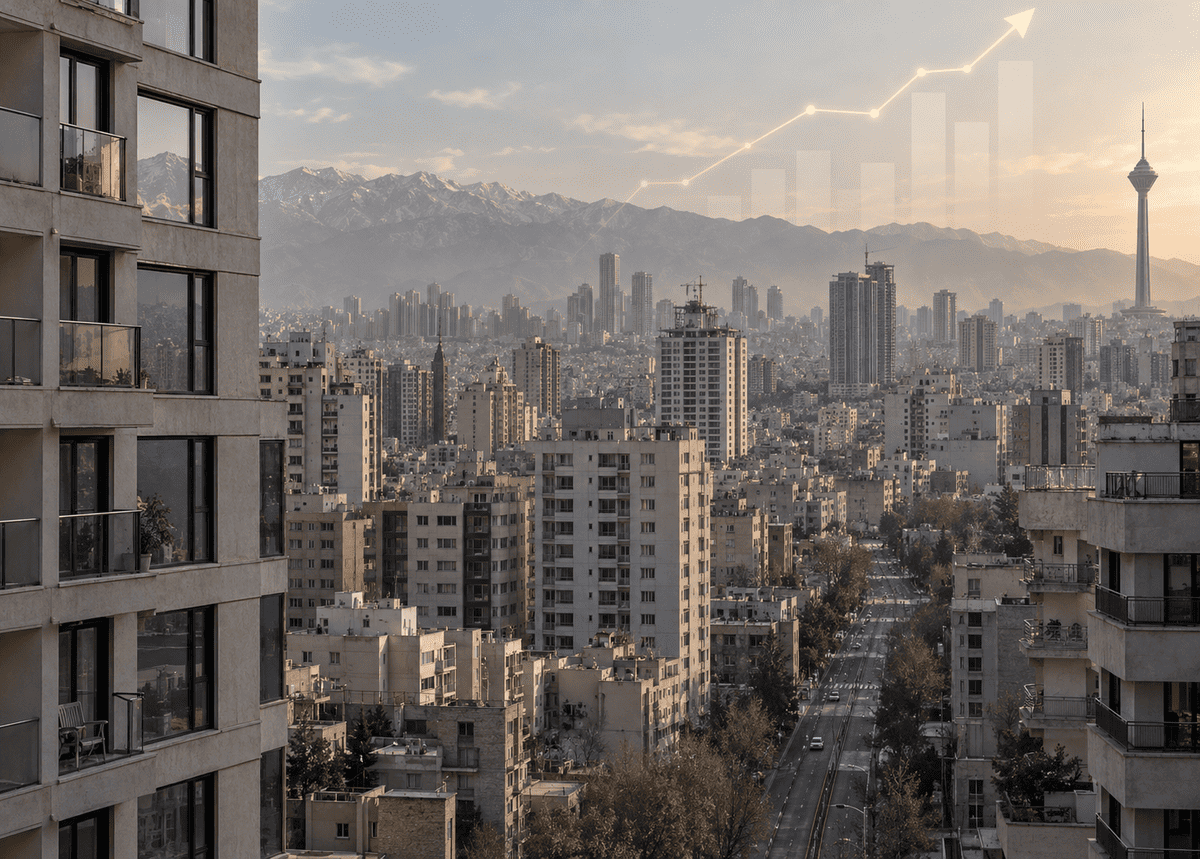
Tehran is not one housing market
The national picture also hides substantial segmentation.
High-income northern Tehran, middle-income western districts, southern neighborhoods and satellite cities do not respond to affordability pressure in the same way.
Recent reporting indicates that price appreciation has been considerably stronger in some affluent northern and western districts than in parts of southern Tehran.
At the same time, households priced out of central or higher-cost districts increasingly look toward cheaper peripheral areas.
That creates a second-order effect: affordability pressure can move demand outward rather than eliminate it entirely.
For investors and developers, city-wide averages therefore become less useful.
The relevant variables are increasingly local:
household income, access to employment, transport infrastructure, construction pipeline, rental demand and the depth of actual transactions within each district.
What could unlock the market?
A genuine recovery in housing activity would require more than another rise in prices.
Several conditions would need to improve.
First, macroeconomic visibility would need to increase. Households are reluctant to commit large amounts of capital when exchange rates, inflation and geopolitical conditions can change rapidly.
Second, the gap between household income and housing prices would need to narrow — either through slower asset inflation, rising real incomes or substantially more effective financing.
Third, transaction volumes would need to recover. Higher prices without higher turnover would continue to indicate a frozen rather than healthy market.
Fourth, construction economics would need to stabilize. If replacement costs continue rising rapidly, even prolonged demand weakness may struggle to pull nominal prices materially lower.
Finally, rental-market pressure matters. A household spending an increasing share of income simply remaining housed has less capacity to become a future buyer.
The market is expensive, but that is not the whole story
Iran’s housing problem is often reduced to one sentence: homes are becoming more expensive.
That description is correct but incomplete.
The more important change is that the connection between price, demand and liquidity is weakening.
Prices can rise because the currency is losing value.
They can rise because construction costs are increasing.
They can remain high because owners refuse to sell.
None of those forces necessarily means that buyers are becoming stronger.
The result is a market where wealth may continue to be stored in property while fewer people can enter it, transactions become thinner and the distinction between nominal appreciation and realizable investment return becomes increasingly important.
For investors, the key question is therefore no longer simply:
Will Iranian housing prices rise?
It is:
Will the asset rise faster than inflation and the currency, generate sufficient rental income, and remain liquid enough to realize that return when needed?
That is the real housing trade in Iran’s stagflationary economy.