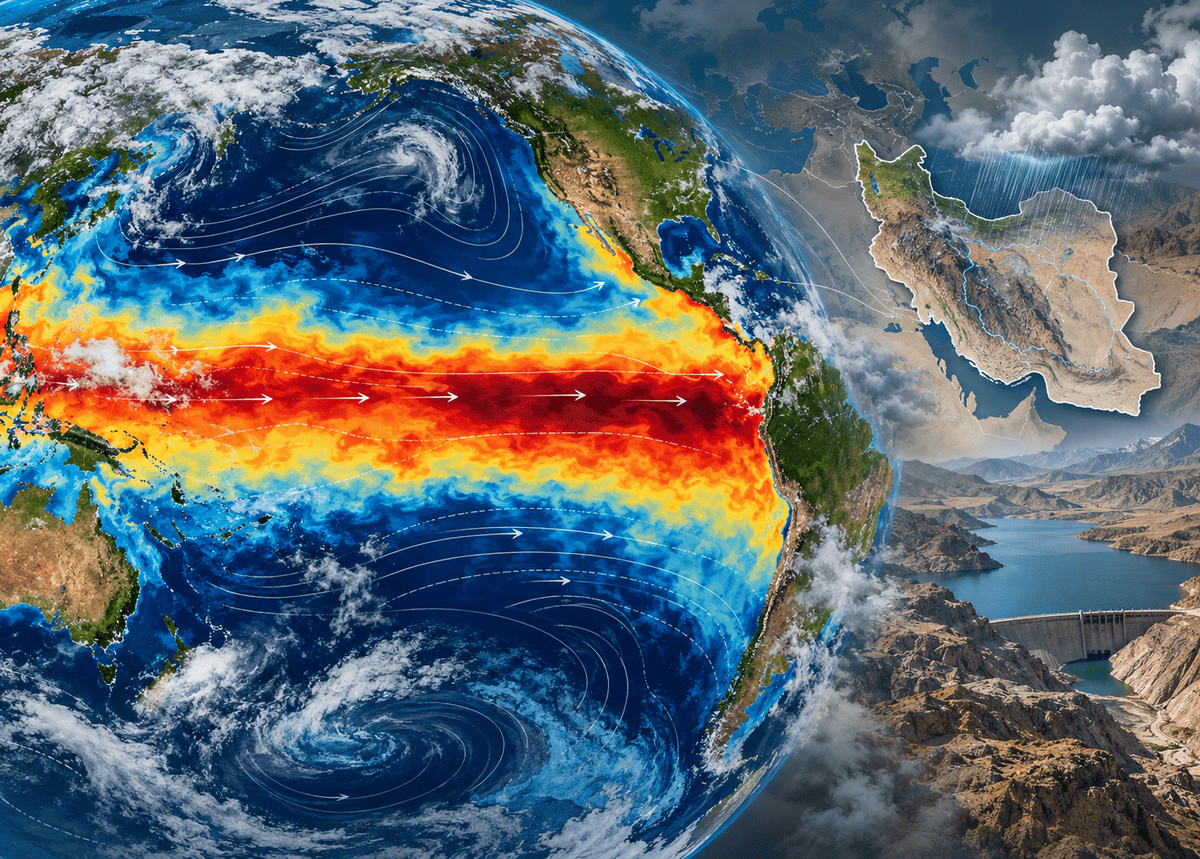
El Niño 2026–27: What a Historic Climate Event Could Mean for Iran
One of the strongest El Niño events on record is developing in the Pacific. Historical evidence suggests it could bring wetter conditions to parts of Iran, but the consequences for agriculture, water supplies and industry will depend on much more than rainfall.
Iran may be heading into an unusually important rainy season. Thousands of kilometres away, the tropical Pacific Ocean is experiencing an exceptionally strong El Niño, a climate phenomenon capable of influencing weather patterns across much of the world.
On October 8, 2026, the World Meteorological Organization (WMO) warned that the event could become one of the strongest since modern records began. Its forecast puts the average sea-surface temperature anomaly in the Niño 3.4 region at approximately 3.7°C above normal during October–December, with the event expected to persist into early 2027.
For Iran, the development is particularly interesting. Although El Niño is often associated with destructive droughts in parts of Asia, historical research has found a generally positive relationship between El Niño and precipitation across many Iranian watersheds.
That raises a consequential question for a country facing prolonged water stress: could an exceptionally strong El Niño bring meaningful relief to Iran?
The scientific evidence offers reasons for cautious optimism, but also important limits to what can be predicted.
Why a Warmer Pacific Can Affect Rainfall in Iran
El Niño is the warm phase of the El Niño–Southern Oscillation (ENSO), a recurring climate pattern involving ocean temperatures and atmospheric circulation across the tropical Pacific.
Under normal conditions, trade winds push warm surface water towards the western Pacific. During El Niño, these winds weaken or change, allowing unusually warm water to spread eastward. The resulting changes in tropical rainfall and atmospheric circulation can influence weather systems far beyond the Pacific itself.
These effects are known as teleconnections: changes in one region of the climate system that influence conditions in distant parts of the world.
Iran lies within the broader region affected by atmospheric circulation systems extending across the Mediterranean, West Asia and the Indian Ocean. Its rainfall is particularly sensitive to the behaviour of these systems during the cooler months.
El Niño can alter the circulation patterns that influence moisture transport and storm activity, potentially changing the likelihood of wetter or drier conditions.
The relationship is not direct, however. Iran does not become wetter simply because Pacific waters become warmer. Other atmospheric and oceanic conditions determine whether the El Niño influence strengthens, weakens or fails to appear.
What Previous El Niño Events Tell Us About Iran
The historical evidence is substantial enough to take the relationship seriously.
A study published in the Journal of Hydrology: Regional Studies in April 2026 examined annual precipitation anomalies across Iranian watersheds between 1960 and 2019. Researchers found that El Niño phases were generally associated with positive rainfall anomalies in most sub-basins, with the frequency and magnitude of wetter conditions increasing during stronger events.
The same study found that La Niña, El Niño’s cooler counterpart, was more commonly associated with below-average precipitation.
Another study, published in the International Journal of Climatology in 2018, examined observations from 45 meteorological stations across Iran between 1980 and 2016. It found that events concentrated in the eastern Pacific were associated with wetter annual conditions in Iran on average.
Yet the researchers also identified significant geographical differences.
Along Iran’s Makran coast, for example, eastern-Pacific and central-Pacific El Niño events were associated with opposite precipitation responses. The effect also varied between seasons.
A separate 2019 study of wet-season rainfall found that interactions involving the Indian Ocean Dipole and the Madden–Julian Oscillation could be more important for certain daily rainfall patterns than ENSO alone.
These findings are not necessarily contradictory. They examine different rainfall measures, periods and climate mechanisms. Together, they show why a historical tendency towards wetter conditions should not be interpreted as a reliable forecast for every Iranian province.
The current event makes this distinction especially relevant. The WMO also expects a positive Indian Ocean Dipole during late 2026, introducing another influence on regional atmospheric circulation.
Iran’s actual rainfall will reflect the interaction of these climate systems rather than the strength of El Niño in isolation.
Where Additional Rainfall Could Matter Most
The economic significance of a wetter season would differ considerably across Iran.
In western and northwestern Iran, where rain-fed agriculture is important, favourable precipitation during planting and crop-development periods could improve soil moisture and support cereal production.
That would matter for wheat and barley growers, agricultural suppliers and food-processing businesses. But the timing of rainfall may be as important as its total volume. Rain arriving too late, or in a small number of intense storms, may deliver considerably less agricultural benefit than regular precipitation during the growing season.
In the southwest, the implications extend beyond farming.
River systems in Khuzestan support irrigation, hydropower and industrial activity. Higher precipitation in the relevant upstream catchments could improve reservoir inflows, potentially easing pressure on competing water users.
Infrastructure such as the Karkheh and Karun dams would be important to monitor. However, increased rainfall within a province does not necessarily imply higher inflows into every reservoir, particularly where catchments extend across several provinces.
Central Iran presents a different picture.
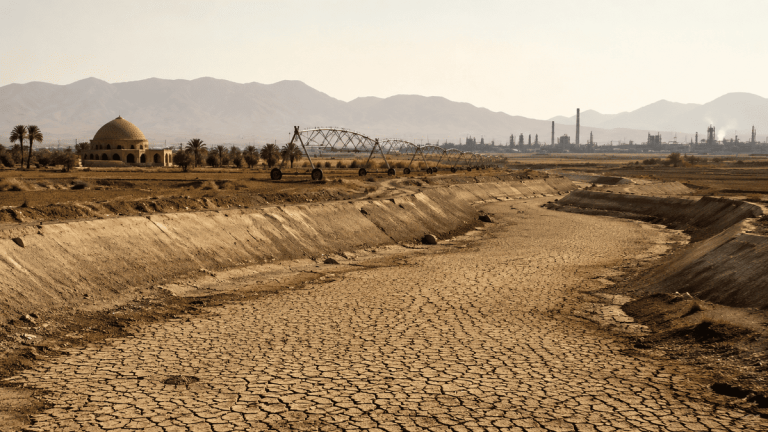
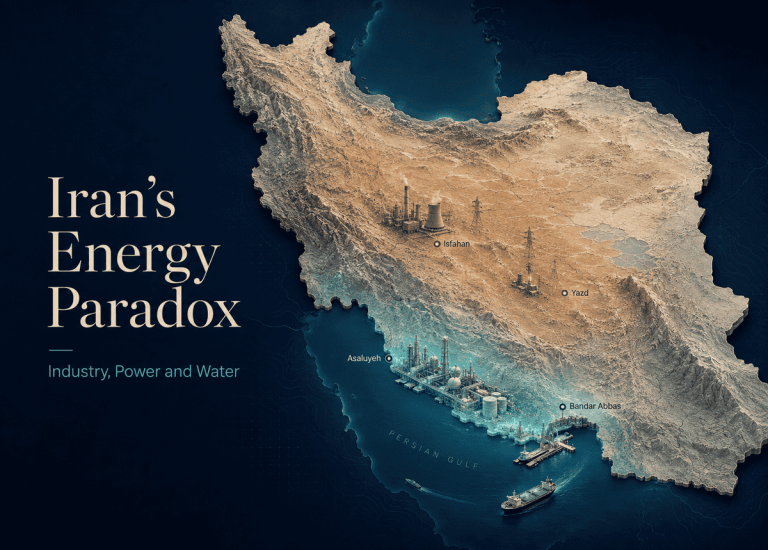
Industrial and agricultural regions in Isfahan, Yazd and Kerman depend heavily on water systems already under considerable pressure. A wetter season could provide some temporary relief, but the benefits would depend on where precipitation falls, how much becomes usable runoff or groundwater recharge, and how water is allocated.
In agricultural centres such as Rafsanjan, even substantial seasonal rainfall would not automatically restore groundwater reserves depleted over many years.
These regional differences make provincial and watershed-level observations far more useful than a single national rainfall figure.
Could El Niño Ease Iran’s Water Crisis?
Additional rainfall would be welcome, but Iran’s water problems cannot be explained by weather alone.
A 2023 study in Nature Communications, examining groundwater conditions between 2002 and 2017, identified a significant nationwide decline in groundwater recharge. The researchers attributed much of the problem to unsustainable management of water and environmental resources, with climate variability adding further pressure.
More recent satellite-based research has documented widespread land subsidence linked to groundwater extraction. A 2025 study in the Journal of Geophysical Research: Solid Earth identified extensive areas where the compaction associated with declining groundwater levels is largely irreversible.
This has an important implication: rainfall can replenish water, but it cannot necessarily restore the underground storage capacity lost through aquifer compaction.
Even a significantly wetter winter would therefore have different effects on reservoirs, rivers and groundwater.
Reservoir levels can respond relatively quickly to sustained inflows. Groundwater recovery often takes much longer and depends on local geology, soil conditions, infiltration and continued extraction.
Some rainfall evaporates, some runs off into rivers, and only a portion reaches aquifers. Where land has compacted or surfaces have become less permeable, recharge may be further constrained.
An exceptionally wet season could consequently improve short-term water availability while leaving much of the country’s structural water deficit intact.
The Economic Effects Go Beyond Agriculture
Water availability influences a broad range of Iranian industries, particularly where production is concentrated in water-stressed regions.
Food processors depend on predictable agricultural supplies. Mining and mineral-processing operations require water for several production stages. Steel and chemical plants need reliable industrial water systems, while power generation can be affected by reservoir conditions and competing demand.
For these businesses, the commercial importance of a wetter season is not necessarily the amount of rain itself. It is whether the additional water reduces interruptions, improves production reliability or lowers operating costs.
A manufacturer facing water restrictions may benefit from stronger reservoir inflows. A farmer may require less groundwater pumping if soil moisture improves. A hydropower facility may have greater generation potential if usable inflows increase.
None of those outcomes is automatic.
There is also a less favourable possibility. Intense rainfall can damage agricultural land, overwhelm drainage infrastructure, interrupt transport and increase flood-related losses.
A season can produce above-average rainfall and still impose substantial economic costs.
The distinction matters for companies and investors. A favourable seasonal forecast may justify reviewing near-term operating assumptions, but it is not sufficient evidence for a long-term investment in a water-intensive activity.
Such investments still require an assessment of water rights, supply reliability, groundwater conditions, infrastructure and the cost of alternative water sources.
What Will Determine the Outcome in Winter 2026–27?
The next several months will provide increasingly useful evidence about whether the Pacific climate signal is translating into meaningful changes in Iran.
The first indicator will be seasonal precipitation relative to historical averages, especially across the country’s major watersheds. Regional forecasts from Iran’s meteorological authorities will be more relevant for operational decisions than global ENSO forecasts alone.
Reservoir inflows and storage levels will provide a second measure. Strong rainfall without a corresponding improvement in usable water storage may have limited economic significance.
Agricultural conditions will take longer to assess. Planting progress, soil moisture, irrigation demand and eventual yields will help determine whether seasonal weather translates into improved production.
Groundwater data will be particularly important for distinguishing temporary relief from recovery. An increase in rainfall should not be presented as evidence of aquifer restoration without supporting measurements.
Finally, the distribution of rainfall deserves as much attention as the national total. A wet season concentrated in a few regions, or delivered through destructive storms, could produce a very different outcome from widespread, moderate precipitation.
The WMO’s October outlook already identifies a heightened likelihood of above-normal rainfall in parts of Central Asia and the northern Arabian Peninsula. But these regional signals cannot substitute for a dedicated seasonal forecast for Iran.
A Promising Climate Signal, Not a Guaranteed Recovery
The strength of the 2026–27 El Niño makes it an unusually important development for Iran’s climate and economic outlook.
Historical studies provide a credible basis for expecting an increased likelihood of wetter conditions in parts of the country. The prospect is especially relevant to rain-fed agriculture, reservoir management and industries facing seasonal water constraints.
There is still considerable uncertainty over which regions will benefit, how rainfall will be distributed and whether improvements will be large enough to affect agricultural output or industrial operations.
More fundamentally, one favourable season cannot reverse the consequences of long-term groundwater depletion and excessive pressure on water resources.
The coming winter could offer Iran meaningful relief. Its lasting value will depend not only on how much rain falls, but on how much of that water can be retained and used without repeating the practices that created the existing shortages.
For businesses and investors, that is the distinction worth watching.