The Sulfur Squeeze: How the Hormuz Crisis Is Reshaping Iran’s Industrial Supply Chain
Disruptions in the Persian Gulf have turned sulfur, a by-product of oil and gas processing, into an expensive industrial input. The consequences extend from copper mines to fertilizer plants, creating a complicated mix of risks and opportunities for Iran.
The global sulfur market rarely attracts the attention given to oil, copper or natural gas. Yet in 2026, this relatively obscure commodity has become a source of pressure on industries that depend on it.
Sulfur prices in several international markets have approached $1,000 per tonne, compared with roughly $100–200 before the latest supply disruptions. The immediate cause is the interruption of trade through the Strait of Hormuz, a route that normally handles close to half of the world’s seaborne sulfur shipments.
The effects are spreading well beyond the energy sector. Copper and nickel producers need sulfuric acid to process certain ores. Fertilizer manufacturers use the same acid to turn phosphate rock into agricultural nutrients. When sulfur becomes scarce or prohibitively expensive, these industries compete for a common raw material.
For Iran, the situation is unusual. The country produces sulfur through its substantial oil and gas industry, but it also needs sulfur and sulfuric acid for its own mining, chemical and agricultural supply chains.
Higher international prices could increase the value of Iranian sulfur output. They could just as easily raise costs for domestic manufacturers or leave producers holding inventory they cannot economically export.
Understanding the difference requires looking at how sulfur is produced, where it is consumed and why the market has become so difficult to balance.
Why Sulfur Supply Is Different From Most Commodity Markets
Unlike copper, iron ore or many other industrial minerals, most commercial sulfur is not extracted from dedicated mines.
It is recovered during the processing of natural gas and petroleum. Sulfur-containing compounds must be removed from these fuels for environmental, technical and product-quality reasons. Specialized recovery units then convert much of the removed sulfur into a saleable product.
This creates an unusual relationship between supply and demand.
A mining company can sometimes respond to higher mineral prices by increasing production, provided it has spare capacity. A sulfur producer generally has much less flexibility. The amount recovered depends largely on the volume and composition of gas and oil being processed and the capacity of the recovery facilities.
A sudden increase in sulfur prices does not necessarily produce a corresponding increase in supply.
This matters particularly in the Persian Gulf, where large oil refineries and gas-processing complexes generate significant volumes of recovered sulfur.
Before the war disrupted maritime trade in February 2026, the region was a critical supplier to fertilizer and industrial markets across Asia and Africa.
According to the US Geological Survey, global sulfur production reached approximately 84 million tonnes in 2025. China, the United States, Russia, Saudi Arabia and the United Arab Emirates were among the major producers.
The Gulf’s influence on international trade is considerably greater than its share of total world production. Much of the sulfur generated elsewhere is consumed domestically or traded through different routes. Gulf producers, by contrast, have traditionally supplied substantial quantities to overseas buyers.
When access to those exports becomes unreliable, the disruption is felt disproportionately in import-dependent markets.
That is precisely what happened in 2026.
The Hormuz Disruption Has Created a Two-Sided Market
Restrictions on shipping through the Strait of Hormuz initially deprived international buyers of a major source of sulfur.
The result was a sharp increase in prices as fertilizer producers, metal processors and chemical manufacturers searched for alternative supplies.
However, the market’s behaviour has become more complicated as the disruption has continued.
By early October, prices remained exceptionally high compared with historical levels, but they were no longer rising uniformly.
Commodity intelligence provider ICIS reported on October 6 that weakening downstream demand had begun to shift negotiating power back towards buyers. Some fertilizer producers had reduced operating rates because they could no longer absorb high sulfur costs, while alternative supplies from countries such as Canada and Kazakhstan were reaching previously Gulf-dependent markets.
QatarEnergy reduced its October sulfur selling price by $45 per tonne to $835 per tonne on an FOB basis.
Prices delivered to some import markets remained closer to $1,000 per tonne, reflecting differences in location, freight, contractual terms and availability.
These developments reveal two pressures operating simultaneously.
Buyers still face an unusually expensive and geographically constrained supply chain. But suppliers cannot assume that a physical shortage will allow them to increase prices indefinitely.
At a certain point, high prices destroy demand.
A fertilizer producer can reduce output, postpone purchases or accept smaller margins. A mining operation may slow production, change its processing mix or seek alternative acid supplies. Neither response restores the missing sulfur, but both reduce immediate purchasing pressure.
The market can therefore experience declining prices while still suffering from serious supply constraints.
For Iranian producers evaluating export opportunities, this distinction is essential. A high international quotation is not evidence that a profitable sale is available at the point of production.
Why Copper Mines and Fertilizer Plants Are Competing for the Same Material
Most sulfur enters industrial supply chains through sulfuric acid, one of the world’s most widely used industrial chemicals.
Sulfur can be burned to produce sulfur dioxide, which is subsequently converted into sulfuric acid. The resulting product has applications throughout chemical manufacturing, mineral processing and fertilizer production.
Two uses are particularly important in the present shortage.
The first is metal extraction.
Sulfuric acid is used to dissolve copper from suitable oxide and secondary sulfide ores in hydrometallurgical processing. The dissolved copper can then be recovered using solvent extraction and electrowinning.
Nickel producers employing high-pressure acid leaching also consume substantial quantities of acid. These operations are especially important in Indonesia, where new processing capacity has been developed to supply the battery-materials industry.
The intensity of sulfur consumption varies considerably by ore characteristics and processing technology, but some nickel projects are particularly exposed to higher costs.
S&P Global reported in July that certain high-pressure acid leach operations require approximately ten tonnes of sulfur per tonne of nickel produced. On that basis, a $100 increase in sulfur prices could add roughly $1,000 to production costs per tonne of nickel.
Not all copper production faces the same exposure. Conventional smelting of copper sulfide concentrates can generate sulfur dioxide, which can itself be captured and converted into sulfuric acid.
An integrated copper producer with its own acid plant may therefore have a very different cost structure from a mine that must purchase sulfur or sulfuric acid externally.
The second major use is phosphate fertilizer production.
Phosphate rock cannot simply be applied in its natural form to produce most commercial phosphate fertilizers. It must be processed to make the phosphorus more accessible to plants.
Sulfuric acid is commonly used to manufacture phosphoric acid from phosphate rock. That phosphoric acid then becomes an input for fertilizers such as monoammonium phosphate (MAP) and diammonium phosphate (DAP).
When sulfur prices rise, phosphate fertilizer producers face higher raw-material costs, even if phosphate rock itself remains available.
This should not be confused with urea production, which is primarily dependent on natural gas and ammonia rather than sulfuric acid. Although both are agricultural fertilizers, their exposure to the sulfur shortage differs substantially.
The economic problem is that metal producers and fertilizer manufacturers do not respond to higher input costs in the same way.
A copper operation benefiting from elevated metal prices may be able to justify paying more for acid to maintain production. A fertilizer manufacturer selling into price-sensitive agricultural markets may have much less room to pass on additional costs.
As a result, sulfur can remain available to higher-margin industrial users while becoming unaffordable for some fertilizer producers.
That creates a potential connection between the economics of metal extraction and the cost of agricultural production.
The effect on food prices is not immediate or automatic. It depends on fertilizer inventories, application seasons, farmers’ purchasing decisions, crop yields and other input costs.
Nevertheless, a prolonged shortage creates another source of uncertainty for global agriculture.
Iran’s Position: A Producer With Its Own Industrial Requirements
Iran is not merely exposed to the sulfur market as an importer or transit country.
According to the US Geological Survey’s 2026 Mineral Commodity Summaries, Iran produced an estimated 2.1 million tonnes of sulfur in all forms in 2025, compared with approximately 2 million tonnes in 2024.
That represents roughly 2.5% of estimated global production.
The figures establish Iran as a meaningful sulfur producer, although production volume should not be confused with export availability.
Much of the country’s sulfur recovery is associated with oil refining and natural gas processing. Facilities linked to Iran’s gas and petrochemical industries produce sulfur that can enter domestic chemical production or, where commercial conditions permit, export markets.
The broader industrial geography is important.
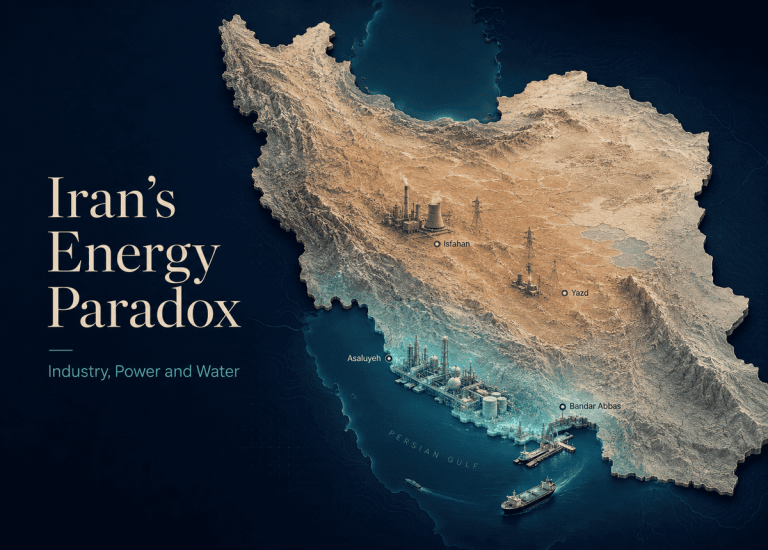
In the southwest, petrochemical and gas-related operations around Khuzestan provide connections between recovered sulfur and chemical manufacturing. Razi Petrochemical Company, in Mahshahr, is one example of a producer using sulfur as a feedstock for sulfuric acid.
In Kerman, the relationship runs through the copper industry.
The Sarcheshmeh complex and other facilities associated with National Iranian Copper Industries Company (NICICO) connect mining, smelting and sulfuric acid production. Capturing sulfur dioxide from smelting gases allows sulfur-bearing material to be converted into a commercially useful chemical while reducing industrial emissions.
Iran also has sulfuric acid production linked to chemical operations in other provinces, including West Azerbaijan, while zinc and other metal-processing activities create additional industrial demand.
The country therefore has two related but distinct sulfur supply chains.
One starts with recovered elemental sulfur from oil and gas processing. The other involves sulfur dioxide generated during metal smelting and converted into sulfuric acid.
Both contribute to domestic industrial supply, but they have different production economics and cannot necessarily substitute for each other without additional processing or infrastructure.
This distinction is especially relevant when assessing Iran’s potential to benefit from international shortages.
A facility that produces elemental sulfur does not automatically have the equipment, logistics or customer relationships needed to supply sulfuric acid. Likewise, sulfuric acid generated at a copper smelter may already be committed to domestic customers or integrated industrial operations.
The commercial opportunity depends on where the material is produced, in what form, and at what cost it can reach a buyer.
Higher Prices Do Not Automatically Mean Higher Iranian Export Revenue
At first glance, a global sulfur shortage would appear favourable to a country with established production capacity.
If buyers are willing to pay several times historical prices, even modest export volumes could generate additional revenue.
But Iran’s ability to capture that increase is constrained by several factors.
The first is production itself. Since much of Iran’s sulfur is recovered from oil and gas operations, disruptions to refining, gas processing or related infrastructure can directly reduce available sulfur output.
The second is logistics.
Sulfur produced in southern Iran must still reach customers through functioning storage, handling and transport systems. Maritime restrictions, vessel availability, insurance costs and port operations can materially change the economics of a transaction.
The third is commercial access.
Sanctions, banking restrictions, counterparty requirements and payment arrangements may prevent Iranian suppliers from accessing the same customers and prices available to other exporters.
Even when a buyer is willing to purchase sulfur, the seller’s actual revenue depends on the discount required, the delivery terms and the costs of completing the transaction.
This can produce a substantial difference between the international benchmark and the effective price received by an Iranian producer.
For example, a quoted market price of $900 per tonne does not mean a producer can realize $900 at its facility. Freight, financing, insurance, handling, contractual discounts and other costs must be considered before estimating the achievable netback.
There is also a domestic opportunity cost.
Sulfur allocated to export cannot simultaneously be used to manufacture sulfuric acid for domestic industries. Where local acid production supports higher-value activities, exporting the raw material may not be the most attractive use of available supply.
The appropriate comparison is therefore not simply the price of sulfur abroad against its domestic selling price.
It is the net value of exporting sulfur versus converting or consuming it domestically, after accounting for processing costs, market access and the risks involved.
The More Interesting Opportunity May Be in Sulfuric Acid
Iran’s most durable advantage may lie less in selling additional sulfur and more in improving how sulfur-bearing industrial by-products are converted and distributed.
Sulfuric acid production illustrates why.
Recovered sulfur can be converted into acid through established industrial processes. Copper smelters can also capture sulfur dioxide from their exhaust gases and use it as feedstock.
The second route is particularly relevant to Iran’s mining industry because it can combine environmental compliance with industrial production.
Improved sulfur dioxide capture can reduce emissions while creating usable acid. Where an appropriate market exists nearby, that acid can be supplied to mining, fertilizer or other chemical operations.
However, sulfuric acid is considerably more demanding to transport than solid sulfur.
It is highly corrosive and requires suitable tanks, handling equipment, trained operators and specialized transport systems. Long-distance delivery can become expensive, particularly where return logistics are inefficient.
Consequently, a sulfuric acid plant’s location relative to its customers can be as important as its nominal capacity.
For Iran, this points to several practical areas of investigation.
In established copper regions, integrated acid production may improve the economics of smelting and nearby mineral processing.
In chemical-producing regions, reliable sulfur sourcing and efficient acid conversion could strengthen domestic supply.
Where producers and consumers are geographically separated, specialized storage and chemical logistics may have commercial value.
These are not automatic investment opportunities. Each depends on verified production capacity, customer demand, operating costs, environmental requirements and actual market access.
But they represent a more substantial industrial question than whether Iran can export additional tonnes of sulfur during a temporary price spike.
The value of the chain depends on how effectively recovered sulfur can be connected to downstream demand.
What Businesses Should Watch Next
The sulfur market is now being influenced by both geopolitical restrictions and the ability of industrial consumers to tolerate higher prices.
For businesses evaluating Iran’s position, several indicators deserve particular attention.
Export availability and shipping conditions. Changes in traffic through the Strait of Hormuz matter, but actual sulfur cargo movements are more informative than headline crude oil flows. The two markets share infrastructure risks without having identical logistics or recovery patterns.
Regional price differences. FOB prices in the Gulf, delivered prices in Asian and African markets, and the cost of alternative supplies reveal where shortages remain commercially significant.
Fertilizer production rates. If phosphate producers continue reducing operations, sulfur demand may weaken even without a meaningful recovery in Gulf exports.
Copper and nickel processing activity. Higher metals prices can support acid-intensive operations, but rising processing costs may eventually force adjustments in production.
Iranian downstream capacity. The operational availability of sulfur recovery units, sulfuric acid plants, industrial storage and transport capacity will determine how much value Iran can retain domestically.
Trade feasibility. For an individual transaction, the critical questions remain whether the material is available, whether the buyer can legally and practically purchase it, and whether delivery is commercially viable.
These indicators will help distinguish a temporary shortage-driven trading opportunity from a longer-term change in the economics of sulfur and sulfuric acid production.
A Supply Shock That Exposes a Larger Industrial Question
The sulfur disruption of 2026 demonstrates how closely the energy, mining and agricultural sectors are connected.
A restriction on maritime trade can reduce access to a material recovered from oil and gas processing. That shortage can increase the cost of extracting copper and nickel while simultaneously placing pressure on phosphate fertilizer production.
Iran occupies several positions within this chain. It recovers sulfur from hydrocarbons, converts sulfur-bearing material into industrial chemicals, and consumes those products in mining and manufacturing.
That creates potential advantages, but also vulnerabilities.
High world prices have little value to a producer that cannot deliver its product. Equally, abundant sulfur production does not necessarily protect domestic industries if conversion capacity or distribution systems are inadequate.
As the market adjusts, prices may continue to retreat from their peaks even while physical supply remains constrained. For Iran, the important question is not whether sulfur remains expensive indefinitely.
It is whether the country can make better use of the sulfur it already produces—through reliable processing, stronger industrial integration and commercially viable access to customers.
That opportunity could remain relevant long after the immediate disruption in the Strait of Hormuz subsides.
Sources and Further Reading
- Financial Times — Sulphur scramble poses latest threat to global food prices, October 13, 2026.
- ICIS — Sulphur market analysis and October 2026 outlook, October 6, 2026.
- USGS — Mineral Commodity Summaries 2026, sulfur production statistics.
- Reuters — Iran war’s sulfurous fallout spreads to copper and nickel, April 17, 2026.
- S&P Global — Sulfur supply shocks reshape nickel costs, July 14, 2026.
- USGS — Iran mineral industry profile, production and industrial context.
- World Bank/IFC — Environmental, Health, and Safety Guidelines for Phosphate Fertilizer Plants, sulfuric acid and phosphate production processes.